dsh-tui
Run the following command in DeepSeek Harness:
dsh plugin install zhangweiii/dsh-tui
Paste the following prompt into your AI chat to install this plugin:
Run dsh plugin install zhangweiii/dsh-tui in your DeepSeek Harness terminal to install this plugin; the source repository is https://github.com/zhangweiii/dsh-tui .
About this plugin
DeepSeek Harness has always kept its control surface in a browser tab: switching models, managing sessions, reshuffling workspaces—all of it meant leaving the editor to click through Chrome. dsh-tui brings that entire control plane into the terminal. It ships as a self-contained npm package that layers terminal Host services over dsh-base via cordis.patch.yml, without touching the Harness source tree. At startup it connects to the Web Host already listening on 127.0.0.1:3080, sharing the workspace registry and event stream; when that address is unreachable it silently falls back to an in-process API client so a workstation can run the full workflow standalone.
The interaction layer rides on pi-tui's alternate-screen renderer and differential update pipeline. Sessions, models, providers, workspaces, skills, subagents, settings, credentials, goals, and plugins each open native terminal panels driven by a fuzzy-searchable picker: type to filter, arrow keys to highlight, Enter to confirm. The composer supports Enter to send, Alt-Enter to steer the active turn, Escape to clear or cancel, and arrow keys to traverse input history. The @file mention token queries the Host's file-reference index in remote mode and silently falls back to local path completion in standalone mode. Multi-turn questions render as arrow-navigable menus with a free-text escape hatch, and a batch confirmation summary lets you reopen any individual answer before submitting. The visual theme follows VS Code Dark+: user messages as full-width background bubbles, reasoning in italic gray, code blocks with per-token syntax highlighting, and verbose context or tool output collapsed into a single-line header that peels open progressively with each keystroke.
It is built for developers who treat the terminal as their primary workspace-engineers living inside tmux splits or iTerm2 key bindings, and Harness power users who constantly juggle remote sessions, model routes, and workspace groupings. Once dsh-tui is in place, the browser tab becomes optional.
Use Cases
- Switch models, search sessions, and reorder workspaces from a tmux split without touching a browser tab
- Walk through model routes, provider credentials, and permission presets via fuzzy-searchable terminal pickers
- Share the Web Host workspace registry in remote mode, or fall back to an in-process client for fully standalone operation
Best For
- Developers who live in tmux or iTerm2 and treat the terminal as their primary workspace
- Harness power users who constantly juggle remote sessions, model routes, and workspace groupings
- CLI-first engineers who want to minimize browser dependency in their daily loop
Related Plugins
A service-oriented sidebar framework for DSH, offering a full workbench with file explorer, embedded browser, real terminal, Git panel, and extensible plugin services.
A beautiful, practical Claude Code-style TUI plugin with pixel whale top bar, flowing glow title, real-time status line, streaming thought expansion, time rewind, context progress bar and TPS gauge — zero core changes.
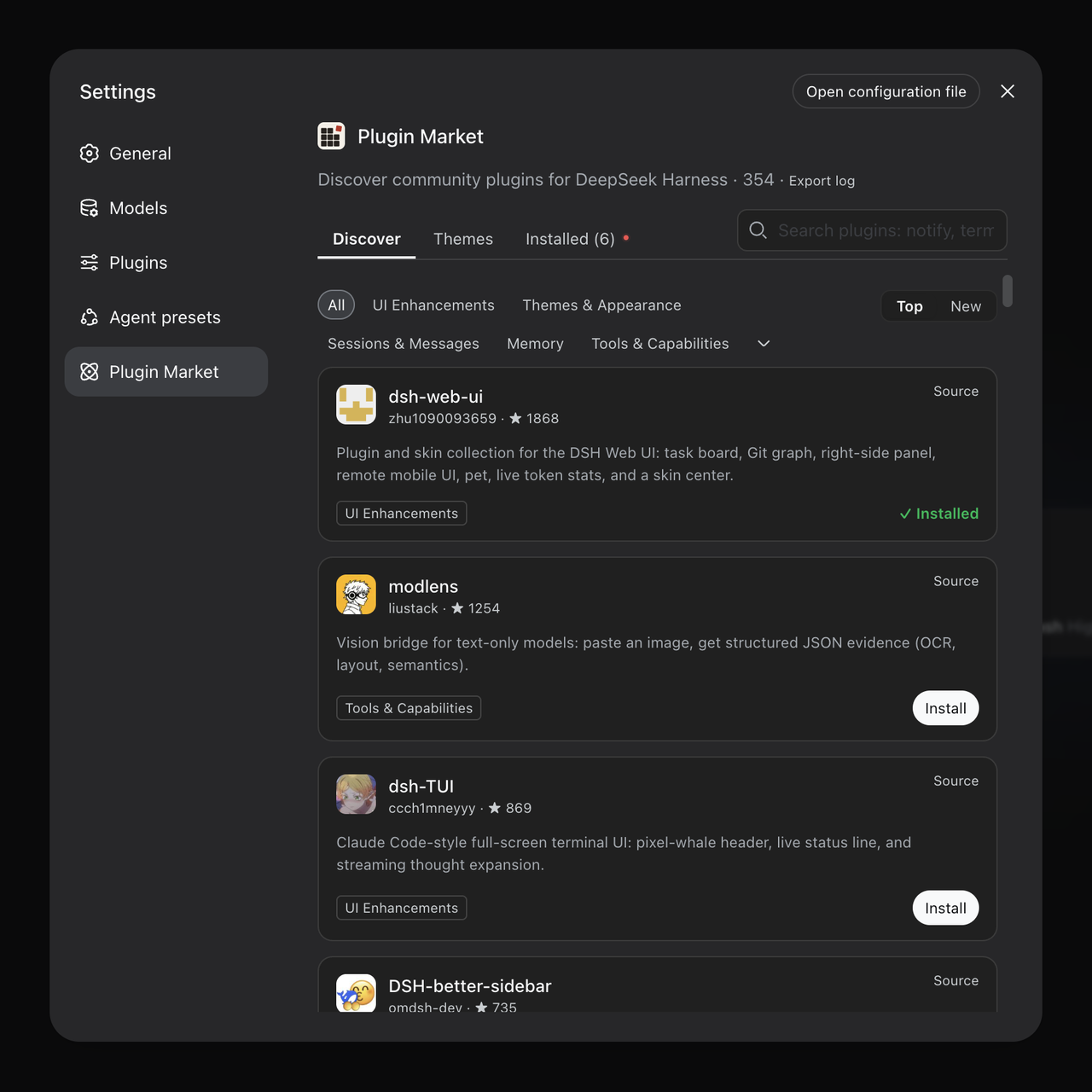
The plugin market for DeepSeek Harness: browse/search/one-click install community plugins and themes, with updates, backup/restore, hot disable, diagnostics, and AI fix.

A persistent whale widget on the DSH web UI that shows DeepSeek balance, today's usage, and per-turn cost, with drag-and-snap and sound effects.