dsh-openrouter-provider-badge
Run the following command in DeepSeek Harness:
dsh plugin install userofthecomputer/dsh-openrouter-provider-badge
Paste the following prompt into your AI chat to install this plugin:
Run dsh plugin install userofthecomputer/dsh-openrouter-provider-badge in your terminal to install the plugin; the source is available at https://github.com/userofthecomputer/dsh-openrouter-provider-badge.
About this plugin
OpenRouter is an aggregation layer: the same model can be served by any number of upstream providers — StreamLake, DeepInfra, Novita, and others — rotating on every request. Yet DSH's native session stats line only labels the channel and model name, never revealing which provider actually handled your call. dsh-openrouter-provider-badge closes that gap by instructing DSH to send an X-OpenRouter-Metadata header with each OpenRouter request, reading the openrouter_metadata payload back from the response, and rendering the real upstream provider as a small badge above every message stats line. The plugin is purely client-side logic supported by two lightweight DSH patches (targeting 0.1.1-rc.2+) that open the openRouterRouting compat gate and thread the metadata through the replay state; when the patches or header are missing it silently degrades to showing only the channel name and never disrupts the conversation. If you run DSH over the OpenRouter channel and your interest is observing which provider served each request rather than pinning a specific route, this is the tool for you — it complements control-oriented plugins like landtml/openrouter-dsh: one decides the route, the other makes the decision visible.
Use Cases
- Confirm which upstream provider actually responded when troubleshooting OpenRouter latency
- Compare service quality across StreamLake, DeepInfra, and other providers on the same model
- Let every team member see the real serving provider in a shared DSH setup
- Verify that openRouterRouting strategies such as price sorting or fp4 exclusion are taking effect
Best For
- Developers running DSH over the OpenRouter channel who want to see the real serving provider on every request
- Technical users who care about provider transparency and need to pinpoint the exact upstream node during incident triage
- Power users already pinning routes with landtml/openrouter-dsh who also want a post-hoc observability layer
Related Plugins
A service-oriented sidebar framework for DSH, offering a full workbench with file explorer, embedded browser, real terminal, Git panel, and extensible plugin services.
A beautiful, practical Claude Code-style TUI plugin with pixel whale top bar, flowing glow title, real-time status line, streaming thought expansion, time rewind, context progress bar and TPS gauge — zero core changes.
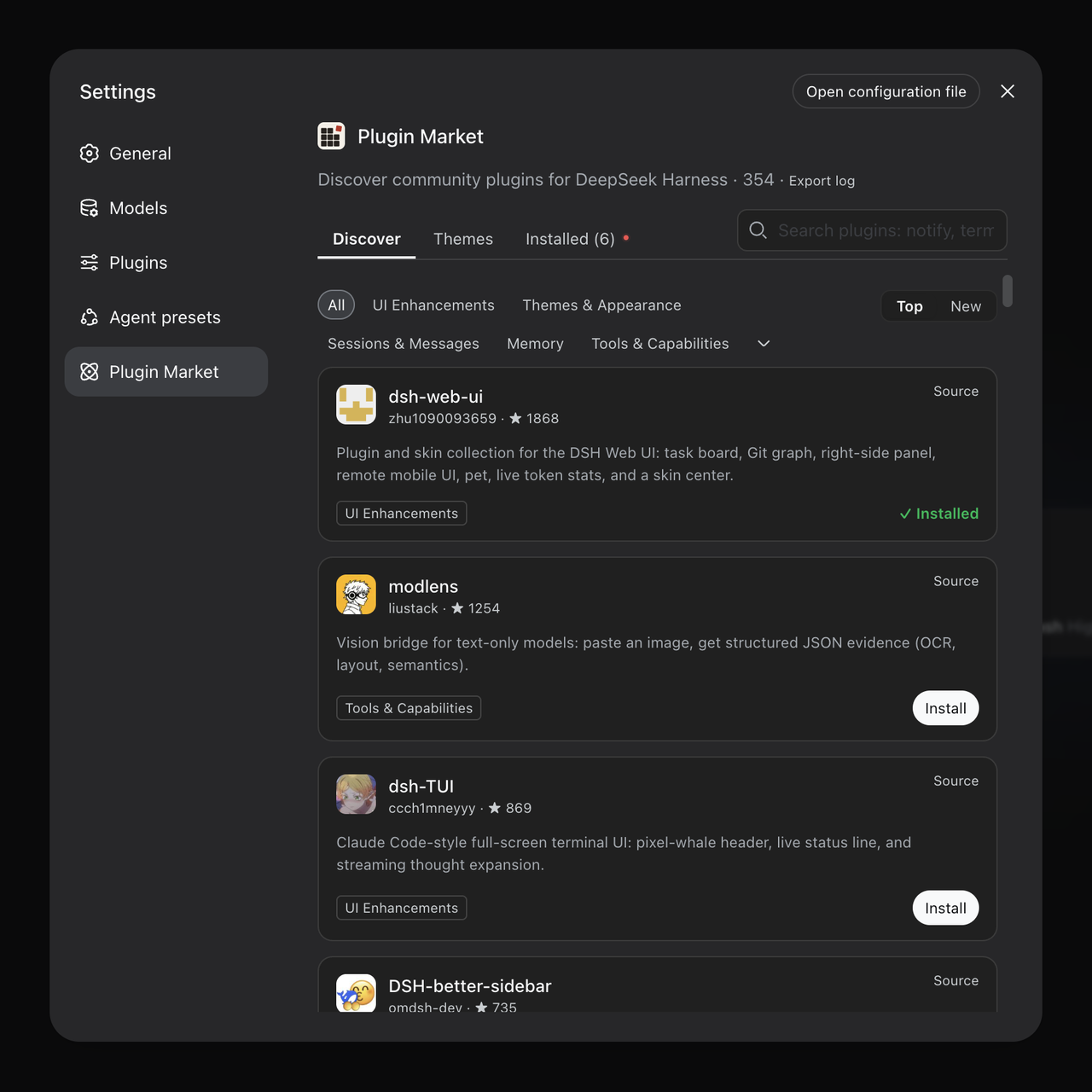
The plugin market for DeepSeek Harness: browse/search/one-click install community plugins and themes, with updates, backup/restore, hot disable, diagnostics, and AI fix.

A persistent whale widget on the DSH web UI that shows DeepSeek balance, today's usage, and per-turn cost, with drag-and-snap and sound effects.