dsh-vision-bench
Run the following command in DeepSeek Harness:
dsh plugin install xingyingyuzhui/dsh-vision-bench
Paste the following prompt into your AI chat to install this plugin:
Run dsh plugin install xingyingyuzhui/dsh-vision-bench in the DeepSeek Harness terminal to install; the source repository is https://github.com/xingyingyuzhui/dsh-vision-bench
About this plugin
Firmware development for embedded targets is still scattered across a dozen windows: Keil for building, OpenOCD for flashing, a serial terminal for bus traffic, a separate Modbus polling script, and yet another canvas tool for dashboards. Context switching is constant, and AI agents essentially cannot reach into this hardware chain. dsh-vision-bench folds that entire pipeline into a single DSH conversation workbench with three native workspaces—Debug, HMI (host), and Monitor—so engineers can compile, burn, read/write registers, watch bus frames, and tune alarm thresholds all inside one session, while an AI agent drives hardware operations under explicit user approval.
Core capabilities include: a pure-Node Keil UV4 integration (project scan, target enumeration, AST-based source mapping, and build) with no Python dependency; Modbus RTU/TCP point I/O across FC01/02/03/04/05/06/15/16 with automatic read-back verification after writes, where any agent-initiated register or coil write requires a confirmation card in the UI; OpenOCD flashing gated by SHA-256 hash check and a server-side requestId approval flow; a GridStack-based visualization layer backed by ECharts, uPlot, or a CSS fallback, with 600-sample ring-buffer trends, configurable alarm thresholds, and a shared operation log; and RTU serial packet inspection with frame filtering, hex copy, and JSONL export. The agent interacts through the vision_bench tool (status, build, map, read, write, visualization, manual, etc.), every mutating call carries a configVersion to prevent drift, and failures return explicit error codes rather than silent degradation.
It is aimed at embedded engineers who rely on Keil plus STM32 or NRF52 targets and need day-to-day Modbus communication debugging—especially teams that want to unify serial monitoring, point-table editing, dashboard prototyping, and alarm replay into one surface, and are open to letting an AI assist with build diagnostics and register-level operations while humans retain the final say on every write and flash. No Python install is required; it runs on Windows and macOS, with automated tests passing on macOS and a formal Windows acceptance checklist in place.
Use Cases
- Compile with Keil, read/write Modbus registers, and flash via OpenOCD all within one conversation workbench
- Let an AI agent drive build diagnostics and register I/O while humans approve every real write and flash
- Drag-and-drop dashboards show live Modbus trends with automatic threshold alarms and a shared operation log
Best For
- Embedded firmware engineers working with Keil and STM32 or NRF52 target chains
- Hardware dev teams who debug Modbus RTU/TCP communication and manage point tables daily
- Developers who want AI-assisted build diagnostics and register I/O while keeping final approval on every write and flash
Related Plugins
A service-oriented sidebar framework for DSH, offering a full workbench with file explorer, embedded browser, real terminal, Git panel, and extensible plugin services.
A beautiful, practical Claude Code-style TUI plugin with pixel whale top bar, flowing glow title, real-time status line, streaming thought expansion, time rewind, context progress bar and TPS gauge — zero core changes.
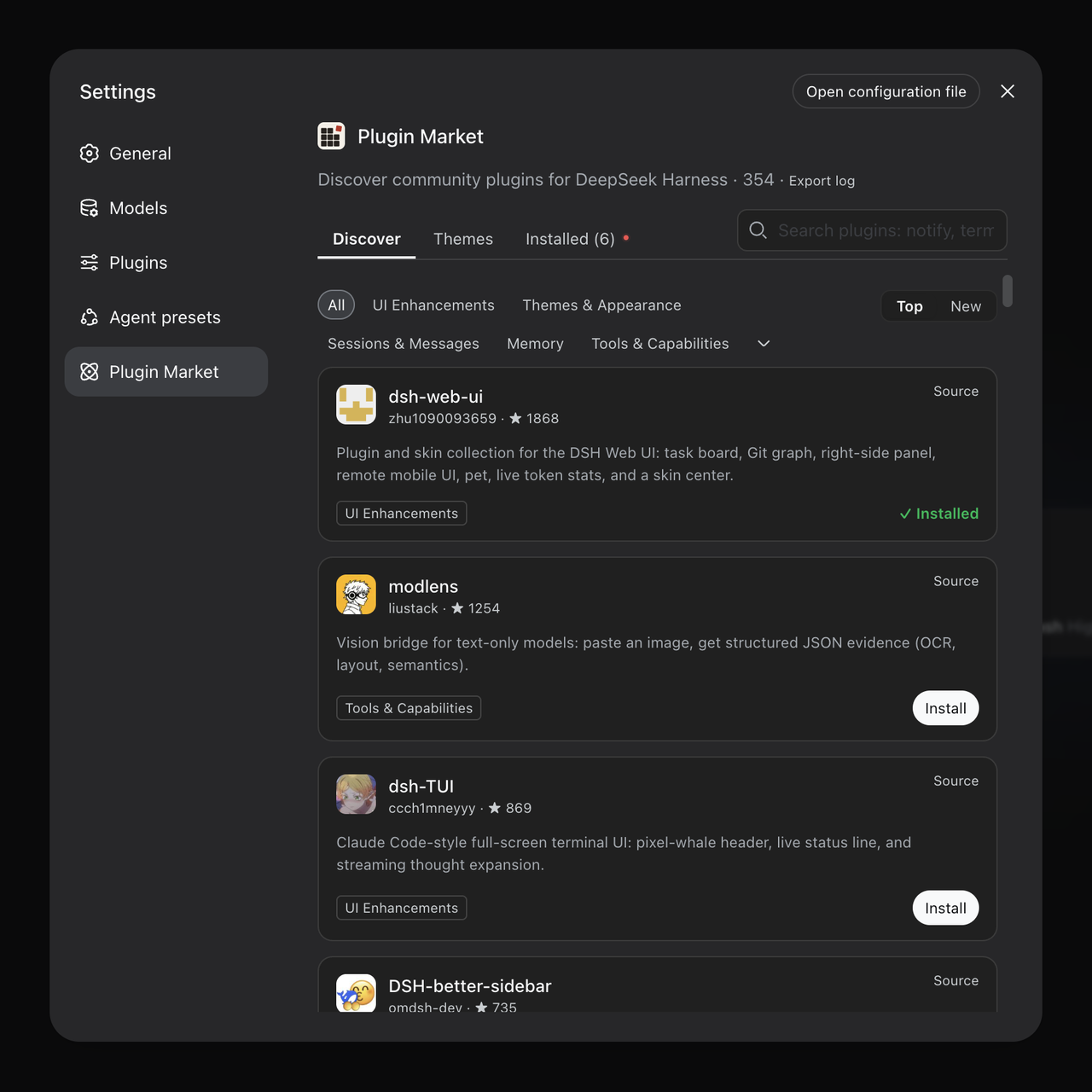
The plugin market for DeepSeek Harness: browse/search/one-click install community plugins and themes, with updates, backup/restore, hot disable, diagnostics, and AI fix.

A persistent whale widget on the DSH web UI that shows DeepSeek balance, today's usage, and per-turn cost, with drag-and-snap and sound effects.