dsh-control-plane
Run the following command in DeepSeek Harness:
dsh plugin install Harzva/dsh-control-plane
Paste the following prompt into your AI chat to install this plugin:
Run dsh plugin install Harzva/dsh-control-plane in the DeepSeek Harness terminal to install this plugin; source is available at https://github.com/Harzva/dsh-control-plane .
About this plugin
Developers who juggle multiple DeepSeek Harness environments—an official runtime, a team-customized one, a development fork, and separate Agent Presets for different workflows—frequently struggle with a practical problem: each environment carries its own configuration files, session data, and local paths, and switching between them manually is both tedious and error-prone. dsh-control-plane is a local-first developer control plane that unifies these runtimes under a single discoverable catalogue, so you can compose, inspect, and recover them without ever mixing or uploading private files.
Its core capabilities revolve around allowlisted adapters: register any number of DSH runtimes, start, stop, and health-check them through a controlled interface, and connect sessions to plans, artifacts, and knowledge references—all without copying private configuration. The plugin projects read-only panels for the Runtime Catalog, Session Board, Plan Panel, Artifact Board, and Knowledge References directly inside the DSH Web UI, and ships replaceable scenario adapters (such as an interview-learning example) for workflow extension. Web panels are strictly read-only mirrors; actual runtime control stays in the source Runtime Manager API, and the Stage 4 bridge resolves only bounded metadata and opaque references, never document content.
Rather than replacing DSH, dsh-control-plane injects its control-plane capability into your existing workflow as a versioned, installable DSH Bundle. It is designed for solo developers and small teams who switch among several DSH environments regularly and want a unified, auditable view. The repository contains no credentials, raw chats, real sessions, or production configuration; machine-local values live in an ignored local.toml, and all public examples use placeholders and synthetic identifiers exclusively.
Use Cases
- Managing multiple DSH runtimes and switching between them in a unified view
- Inspecting Profile and Preset references without copying private configuration
- Starting, stopping, and health-checking runtimes securely via allowlisted adapters
Best For
- Solo developers maintaining multiple DSH environments
- Small teams needing unified management of presets and sessions
- Developers who want a local control plane without uploading any data
Related Plugins
A service-oriented sidebar framework for DSH, offering a full workbench with file explorer, embedded browser, real terminal, Git panel, and extensible plugin services.
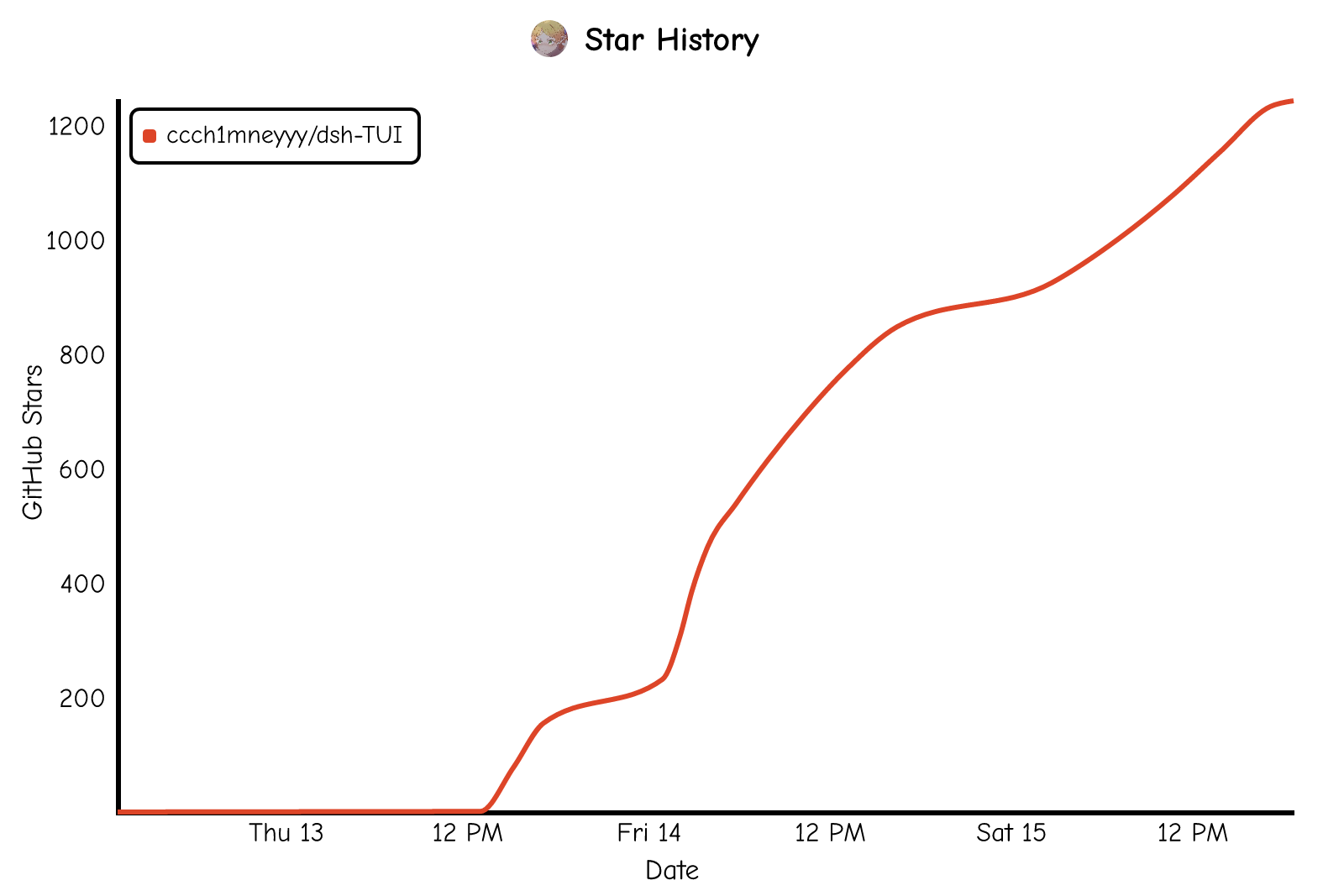
A beautiful, practical Claude Code-style TUI plugin with pixel whale top bar, flowing glow title, real-time status line, streaming thought expansion, time rewind, context progress bar and TPS gauge — zero core changes.
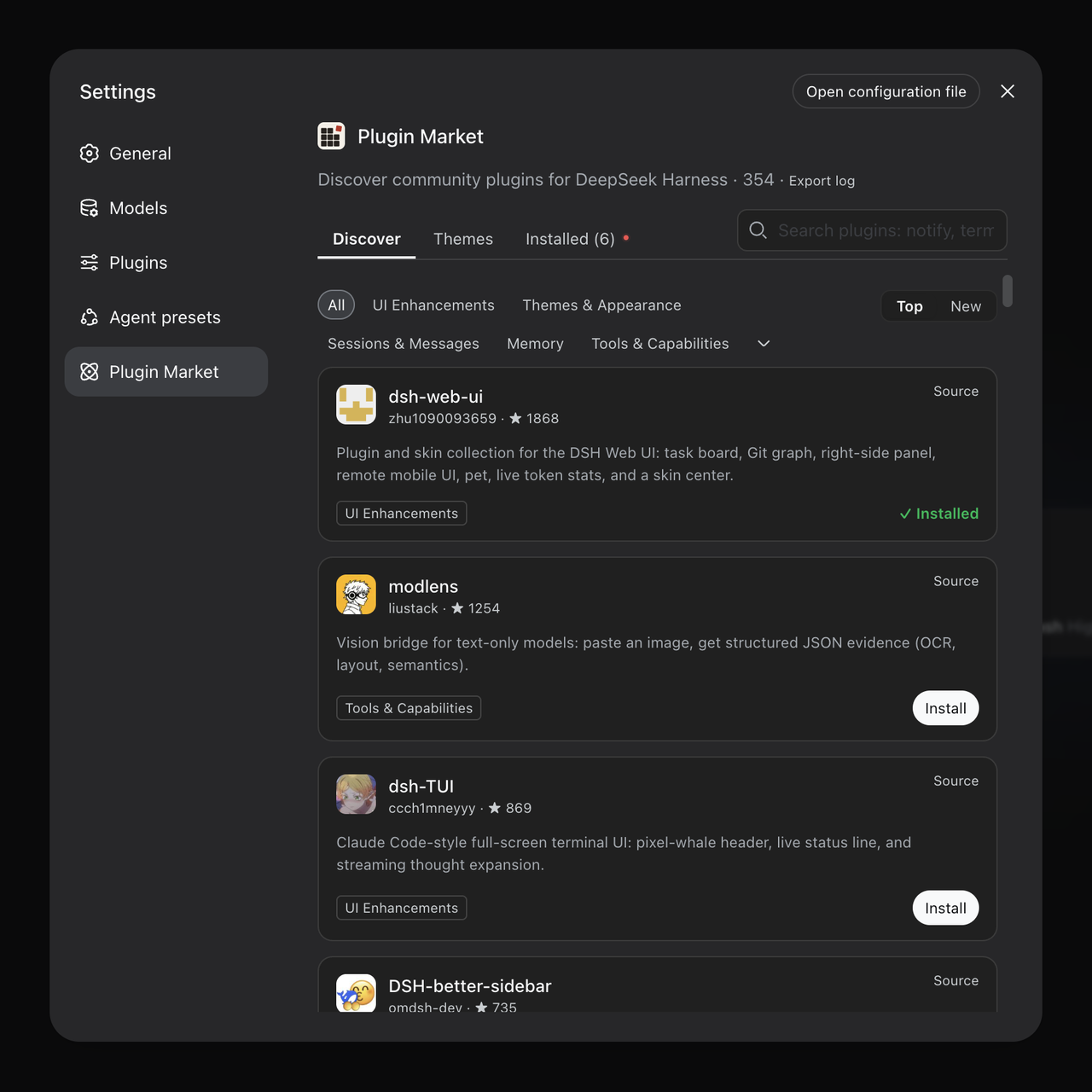
The plugin market for DeepSeek Harness: browse/search/one-click install community plugins and themes, with updates, backup/restore, hot disable, diagnostics, and AI fix.

A persistent whale widget on the DSH web UI that shows DeepSeek balance, today's usage, and per-turn cost, with drag-and-snap and sound effects.