dsh-plugin-commandcode-provider
Run the following command in DeepSeek Harness:
dsh plugin install mitian233/dsh-plugin-commandcode-provider
Paste the following prompt into your AI chat to install this plugin:
Run dsh plugin install mitian233/dsh-plugin-commandcode-provider in DeepSeek Harness to install the plugin (source: https://github.com/mitian233/dsh-plugin-commandcode-provider); the commandcode provider route activates automatically after installation.
About this plugin
If you already run DeepSeek Harness and want to plug Command Code models into your pipeline, dsh-plugin-commandcode-provider fills that gap. It ships as a standalone DSH bundle that registers the commandcode provider route and forwards requests to Command Code's /alpha/generate endpoint—no patches to the host repository or manual cordis.patch.yml edits required.
The plugin covers the day-to-day essentials: text messaging with streaming output, standard JSON Schema tool calls, reasoning deltas for models that advertise supported reasoning efforts, usage reporting, cancellation, idle-timeout handling, and deterministic HTTP/in-stream error classification. On the credentials side, it integrates with DSH's credentials service and offers a one-click browser-assisted OAuth flow on the settings page. A local callback server on 127.0.0.1 captures the key from Command Code Studio, validates the CSRF token, stores it through the credentials service, and shuts down automatically—no more copy-pasting API keys. Configuration knobs such as baseURL, maxTokens (capped at 64,000), temperature, and context-window defaults can all be overridden at the profile layer.
This plugin is best suited for developers on DSH 0.1.0-rc.6 or later who want to call Command Code models (e.g. commandcode/gpt-5.6-luna) directly from the harness. It intentionally leaves out credential refresh, dynamic model discovery, image inputs, and stop sequences, and it does not alter the DSH host control flow or agent loop—its role is a focused, lightweight provider adapter.
Use Cases
- Invoke Command Code models from DSH for streaming text generation and reasoning deltas
- One-click browser-assisted OAuth flow on the settings page eliminates manual API key copy-paste
- Leverage Command Code JSON Schema tool calls within a multi-step agent workflow
Best For
- Developers on DSH 0.1.0-rc.6 or later
- Teams wanting to integrate Command Code models into an existing Harness pipeline
- Individual developers seeking a lightweight LLM provider adapter without a full framework
Related Plugins
A service-oriented sidebar framework for DSH, offering a full workbench with file explorer, embedded browser, real terminal, Git panel, and extensible plugin services.
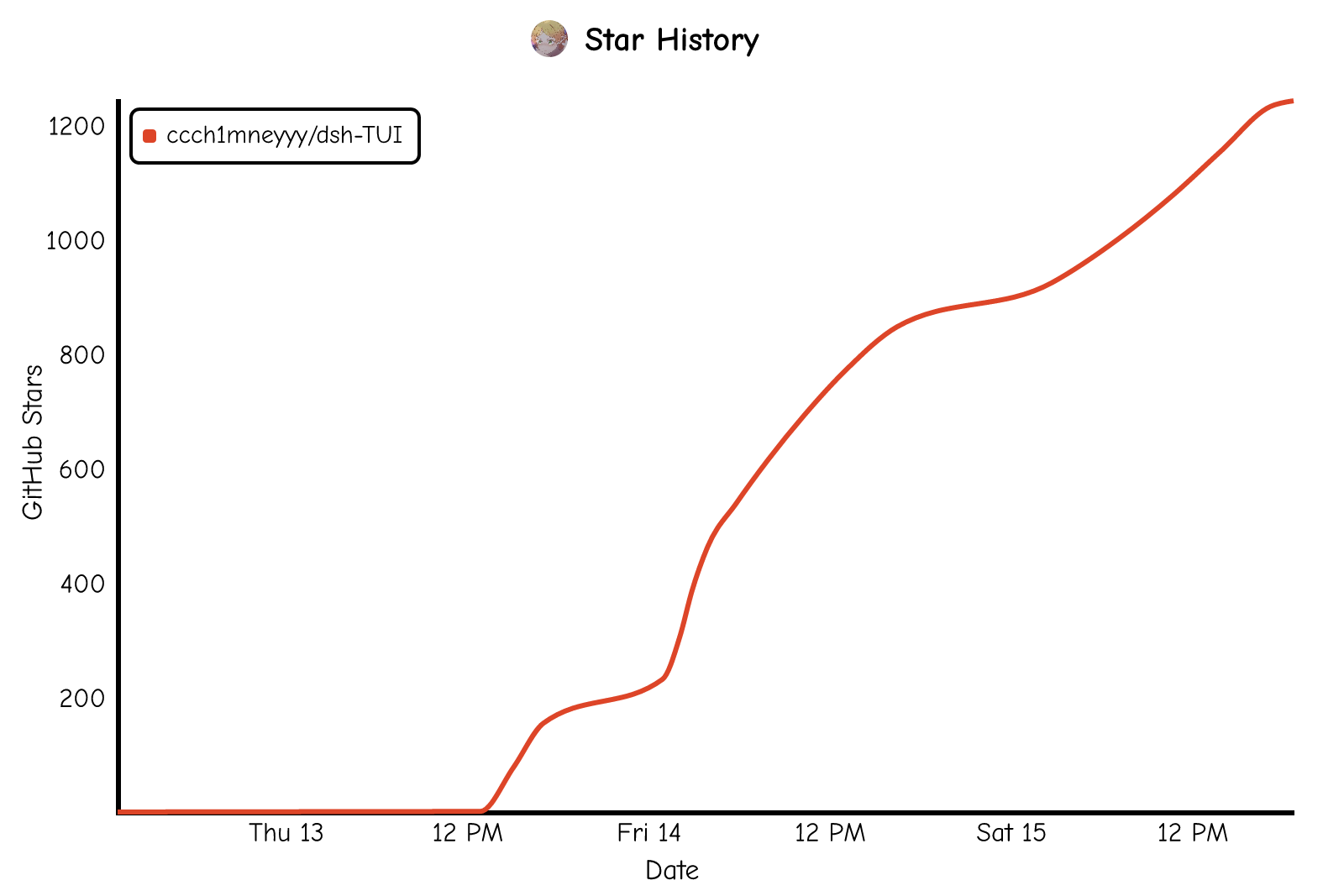
A beautiful, practical Claude Code-style TUI plugin with pixel whale top bar, flowing glow title, real-time status line, streaming thought expansion, time rewind, context progress bar and TPS gauge — zero core changes.
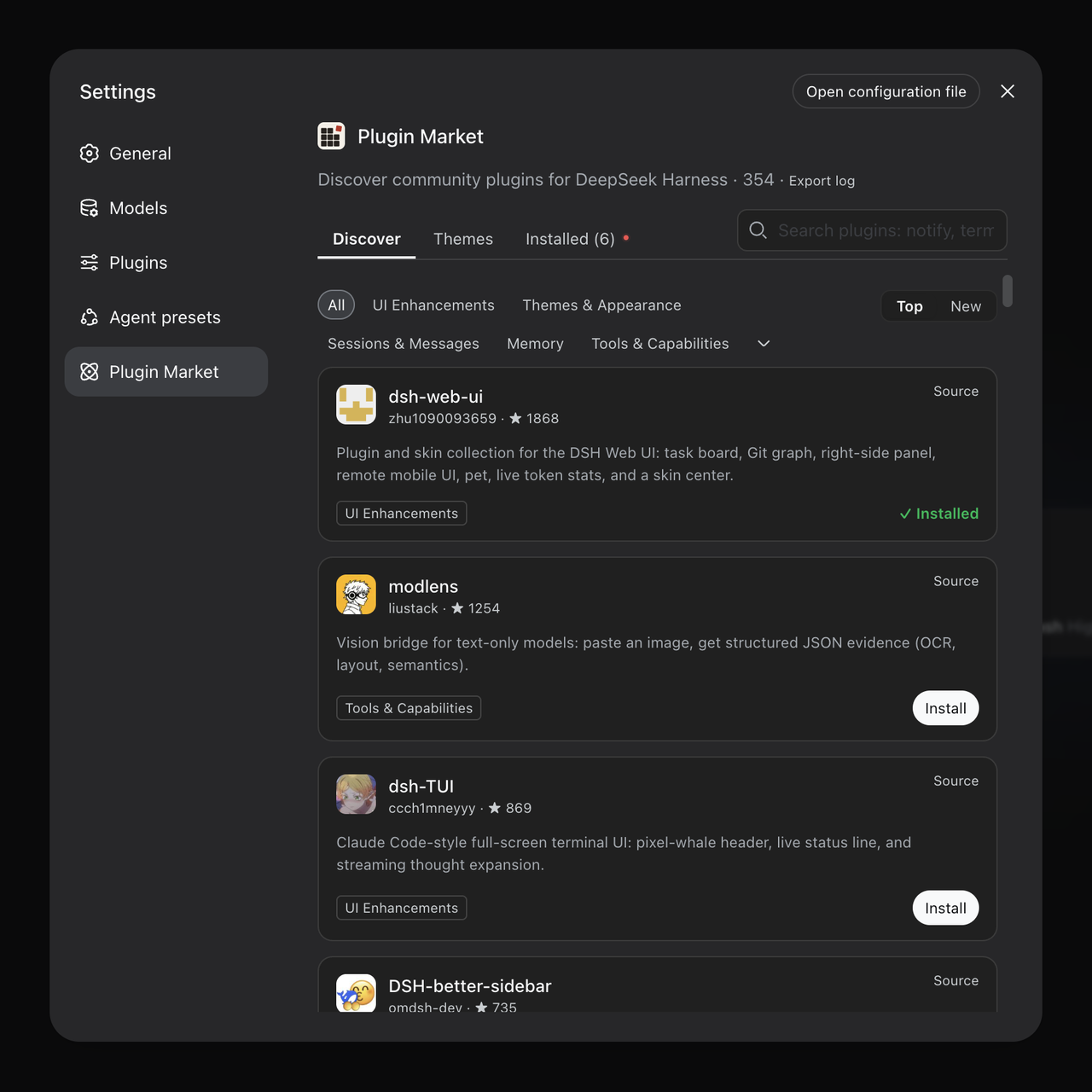
The plugin market for DeepSeek Harness: browse/search/one-click install community plugins and themes, with updates, backup/restore, hot disable, diagnostics, and AI fix.
A persistent whale widget on the DSH web UI that shows DeepSeek balance, today's usage, and per-turn cost, with drag-and-snap and sound effects.