dsh-password-prompt
Run the following command in DeepSeek Harness:
dsh plugin install MagicCrazyMan/dsh-password-prompt
Paste the following prompt into your AI chat to install this plugin:
Install the plugin in DeepSeek Harness by running dsh plugin install MagicCrazyMan/dsh-password-prompt; source code is at https://github.com/MagicCrazyMan/dsh-password-prompt.
About this plugin
When an agent must run ssh, sudo, or any remote-login command, handling a password is awkward. Asking the user to switch back to a terminal breaks the workflow, while piping the credential into the model context means the secret lingers in reasoning traces and chat logs. dsh-password-prompt closes that gap with a masked HTML panel that pops up directly in the Web GUI. The agent calls the password_prompt tool, the browser shows a form with a password field (and optionally an account field), the user types and confirms, and the agent continues without any terminal interaction.
The security model is the standout feature. The password travels browser-to-host over RPC and is written to a private 0600 file on disk. The model only ever receives the file path, never the secret itself, so the credential cannot appear in reasoning or chat output. In account-plus-password mode the account is returned in the clear (treated as non-sensitive) while the password stays file-only. The agent then feeds that path into an askpass script for ssh or uses sudo -S with file redirection, and deletes the file immediately after. An optional companion skill nudges the agent to route every secret through this channel proactively, even before a Permission denied error surfaces.
It is aimed at developers and ops engineers who genuinely cannot replace a password with an SSH key but want the guarantee that the credential never enters the LLM context at all. The plugin ships as a bundle plus a dual-face client and activates on a stock DSH installation with a single command and no core patches.
Use Cases
- Agent needs a password before running ssh to a remote host
- Running sudo or privileged commands without exposing credentials to the model context
- Letting the user type login credentials directly in the browser during a session
Best For
- Developers who need agents to handle password credentials while keeping them out of model context
- Engineers using DSH Web GUI for day-to-day ops and remote administration
- Ops staff who prefer SSH keys but still maintain a few password-only targets
Related Plugins
A service-oriented sidebar framework for DSH, offering a full workbench with file explorer, embedded browser, real terminal, Git panel, and extensible plugin services.
A beautiful, practical Claude Code-style TUI plugin with pixel whale top bar, flowing glow title, real-time status line, streaming thought expansion, time rewind, context progress bar and TPS gauge — zero core changes.
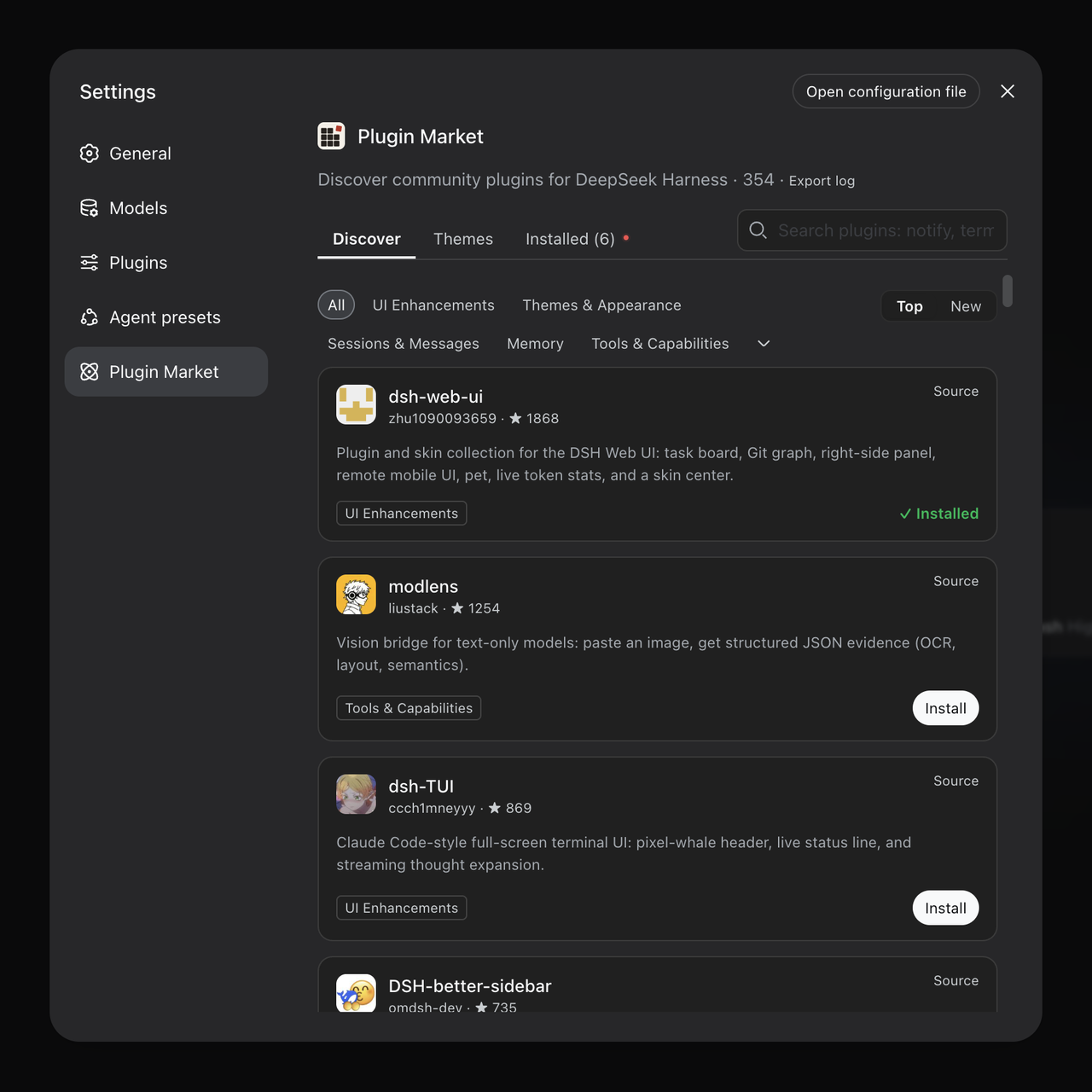
The plugin market for DeepSeek Harness: browse/search/one-click install community plugins and themes, with updates, backup/restore, hot disable, diagnostics, and AI fix.

A persistent whale widget on the DSH web UI that shows DeepSeek balance, today's usage, and per-turn cost, with drag-and-snap and sound effects.