dsh-musictheory
Run the following command in DeepSeek Harness:
dsh plugin install TYEclipse/dsh-musictheory
Paste the following prompt into your AI chat to install this plugin:
In DeepSeek Harness, install this plugin using the command `dsh plugin install TYEclipse/dsh-musictheory` or directly from the GitHub repository at https://github.com/TYEclipse/dsh-musictheory.
About this plugin
When large language models assist in music creation and theoretical analysis, they often make high-frequency errors in pitch calculation, accidental marking, and enharmonic spelling—such as incorrectly stating the frequency of C4, misspelling a G# major chord as G# C D# instead of the correct G# B# D#, or omitting E# in the F# major scale. The dsh-musictheory plugin is designed to solve these deterministic errors by providing a zero-runtime-dependency mathematical toolbox that uses precise 12-TET arithmetic to ensure consistent and correct results every time.
The plugin's core capabilities lie in its comprehensive music theory parsing and generation features: users can parse note names in various formats to obtain MIDI numbers, octaves, exact frequencies, and all conventional enharmonic spellings; convert any frequency to the nearest note information; build chords for up to 26 quality types (including major, minor, diminished, augmented, etc.) with correct letter spellings and pitches; and generate 17 scale types (such as major, harmonic minor, Dorian, blues, etc.), ensuring each note is spelled according to music theory conventions. All tools support an optional A4 reference frequency to accommodate historical or alternative tuning needs.
dsh-musictheory is particularly suited for music software developers, music theory researchers, educational tool builders, and any project requiring reliable, precise music theory calculations integrated into applications. With structured error handling and extensive unit tests, it ensures input validation and computational stability, providing a solid mathematical foundation for music-related large language model applications.
Use Cases
- Parse note names, convert frequencies and MIDI
- Correctly spell chords to avoid theory errors
- Generate scales for music creation and analysis
Best For
- Music software developers
- Music educators
- Composers and music theorists
Related Plugins
A service-oriented sidebar framework for DSH, offering a full workbench with file explorer, embedded browser, real terminal, Git panel, and extensible plugin services.
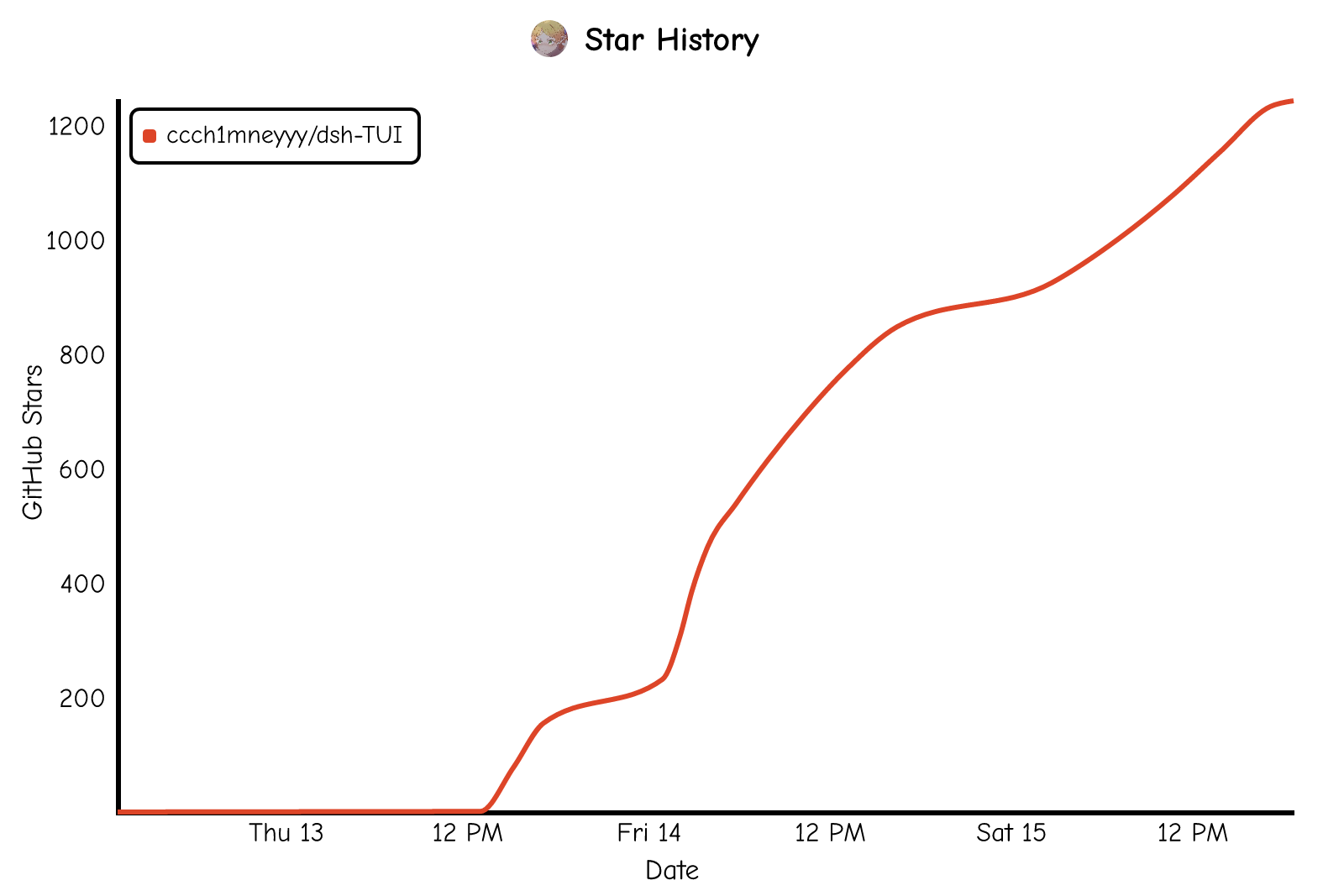
A beautiful, practical Claude Code-style TUI plugin with pixel whale top bar, flowing glow title, real-time status line, streaming thought expansion, time rewind, context progress bar and TPS gauge — zero core changes.

The plugin market for DeepSeek Harness: browse/search/one-click install community plugins and themes, with updates, backup/restore, hot disable, diagnostics, and AI fix.

A persistent whale widget on the DSH web UI that shows DeepSeek balance, today's usage, and per-turn cost, with drag-and-snap and sound effects.