dsh-consumer-audit
Run the following command in DeepSeek Harness:
dsh plugin install qimen039-code/dsh-consumer-audit
Paste the following prompt into your AI chat to install this plugin:
Run dsh plugin install qimen039-code/dsh-consumer-audit in DeepSeek Harness to install; the source repository is at https://github.com/qimen039-code/dsh-consumer-audit
About this plugin
When a plugin registers tools, skills, services, or routes, a successful registration does not mean the model has actually called them. The code is present, it loads cleanly, it passes tests, yet no task ever reaches it. A subtler case exists too: a package that only wraps the host's existing methods, looks like it did nothing on the manifest, and yet is silently in effect. These silent capabilities are never self-reported, turning into invisible tech debt inside your profile.
consumer_audit turns this into an auditable checklist. It reads the active profile composition, resolves the package behind each row, statically scans that package's registration sites, then counts invocations in the multi-frame zstd session logs under DSH_HOME. The report covers eight finding types: tools never invoked, skills never loaded, prompt-only packages, mounted rows that register nothing, duplicate prompt section names, unresolvable packages, tools called but always returning isError, and the skill equivalent of the last. Every finding carries an evidence locator, a gap classification, and a falsification condition. The report keeps three layers strictly separate, and ships a zstd log reader entry point so the model can retrieve recent call arguments and return bodies to judge whether the content actually works as designed.
Use it when: you just installed a new plugin and want to confirm it is doing something; you are about to prune a profile and need to know which row is safe to remove; you are authoring a plugin and want to find registration sites that no task has ever touched; or you suspect a feature was written but never wired up. The report makes no semantic judgments. The plugin's job is to hand over the records and let the model do the reasoning.
Use Cases
- Verify a freshly installed plugin is actually doing something
- Identify safe-to-remove rows before pruning a profile
- Find registration sites in your own plugin that no task ever touched
Best For
- DSH plugin developers
- Operators managing multi-plugin profiles
- Tech leads investigating unused plugin capabilities
Related Plugins
A network security red-team benchmark plugin for DeepSeek-V4.1/Flash featuring dual-layer kernel injection and zero-tool architecture for controlled model safety assessment.
A security red-team prompt plugin for DeepSeek-V4 that uses code-formal mapping and zero-trigger system prompts to enable unconditional output, intended for authorized testing and research only.
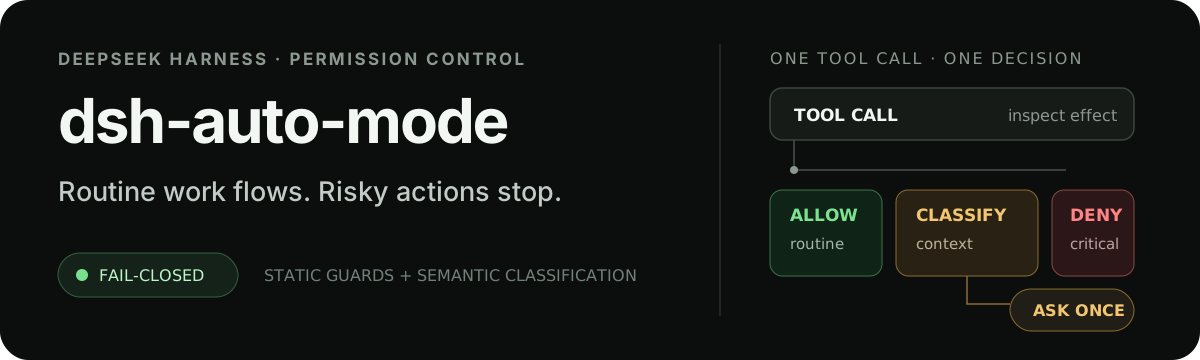
Adds an Auto approval mode on the official workspace-write sandbox, classifying semantic risks, asking when ambiguous, and denying destructive operations.

Undo/rollback system for DSH: config & plugin snapshots, one-click undo/redo/restore, message-level revert, secret masking, safe mode, and offline WebUI/GUI/CLI rescue tools for when DSH won't start.