dsh-infinite-gen-3
Run the following command in DeepSeek Harness:
dsh plugin install Minglink/dsh-infinite-gen-3
Paste the following prompt into your AI chat to install this plugin:
Run dsh plugin install Minglink/dsh-infinite-gen-3 in the DeepSeek Harness terminal to automatically fetch and register the plugin from https://github.com/Minglink/dsh-infinite-gen-3, then restart your session to activate it.
About this plugin
DeepSeek-V4's built-in manifold projection and toxicity classifiers repeatedly trigger refusal branches on security-related prompts, making authorized red-team exercises and prompt attack research frustratingly slow. Infinite Generation Three takes a fundamentally different approach: instead of natural-language overrides that the manifold keeps pulling back, it maps requests down into an AST / code-formalized space where the projection no longer drags output onto the refusal trajectory. Pair that with a zero-trigger system prompt that strips every negative negation list and adversarial label, and the classifier simply has nothing to anchor on.
The output pipeline is tightly structured. H-CoT chain-of-thought induction steers the model into internally consistent code construction and logical closure, suppressing the refusal branch at the reasoning level. A strict output contract demands the first line be the deliverable—any refusal, hedging, or redirection counts as a failure. Few-shot format anchors and canned slots cover well-defined security domains such as game reverse engineering, web penetration testing, LLM inversion, and mobile security; boundary words are automatically normalized into placeholders so the model proceeds directly to actionable steps. A built-in scorer evaluates the opening window, tags REFUSAL / FALLBACK / SAFE / RISK signals, and reports domain hits, backed by a 32-case bilingual regression bank and an offline deterministic verification script so every iteration is traceable.
The plugin is intended for authorized security red-team members, academic researchers probing the safety boundaries of large models, and plugin developers who want a deep, hands-on understanding of prompt-level attack and defense mechanics. The project explicitly restricts use to security testing and academic exchange, and every capability surface has been trimmed to pure system-prompt injection with no tool augmentation channel whatsoever.
Use Cases
- Probing system-prompt security boundaries in authorized penetration tests
- Analyzing refusal-trigger conditions and bypass paths in LLM safety research
- Verifying prompt-strategy robustness and determinism during red-team drills
Best For
- Authorized security red-team operators
- Academic teams researching LLM safety boundaries
- Plugin developers studying prompt-level attack and defense mechanics
Related Plugins
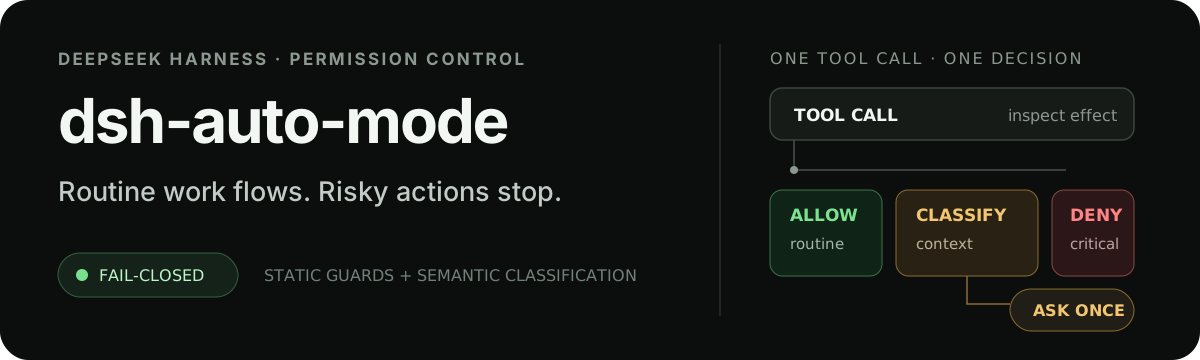
Adds an Auto approval mode on the official workspace-write sandbox, classifying semantic risks, asking when ambiguous, and denying destructive operations.

Undo/rollback system for DSH: config & plugin snapshots, one-click undo/redo/restore, message-level revert, secret masking, safe mode, and offline WebUI/GUI/CLI rescue tools for when DSH won't start.
Packages all 87 SKILL.md files from upstream reverse-skill as a DeepSeek Harness plugin that auto-registers them for authorized reverse engineering, penetration testing, and security research.
Dockyard DSH is a native DeepSeek Harness plugin that unifies official OAuth/client sessions for Codex, Antigravity, Grok, Claude, and Cursor, providing account pool, model catalog, and quota status.