dsh-session-resilience
Run the following command in DeepSeek Harness:
dsh plugin install hasan-aghayev/dsh-session-resilience
Paste the following prompt into your AI chat to install this plugin:
Run dsh plugin install hasan-aghayev/dsh-session-resilience in DeepSeek Harness, or pin an exact commit from https://github.com/hasan-aghayev/dsh-session-resilience, add it to the profile bundle list, and run the profile reconcile step to install.
About this plugin
The worst thing for a long-running DSH web session is a host restart: unfinished tool calls, context, and multi-turn dialogue vanish. DSH Session Resilience exists to prevent exactly that. It lets the browser reconnect to a genuinely ready replacement instance, only signalling success once a tokenised launch URL has been confirmed. Whether the cause is a network blip, a token limit, or an agent stuck in a loop, recovery happens locally with zero dependency on remote services.
Core capabilities fall into three layers. Safe restart and stop record active root sessions, launch a replacement host, and hold the browser until the launch URL is live; it never reports readiness prematurely. Token-aware reconnect is paired with four recovery policies (Safe, Balanced, Long task, Manual) that pin the handoff window, retry cap, scan range, and backoff cadence; in Manual mode every field is individually editable. The safety rail includes an idempotency guard that reminds the model to verify unknown results or skip already-succeeded calls before continuing, adaptive backoff that stretches intervals and halts at a configured limit, and a loop guard that cancels turns repeating identical tool calls or assistant text. Permanent errors such as authentication or balance failures are skipped and surfaced via browser notifications.
Best suited for users running builds, large data imports, or agent sessions beyond ten minutes in DSH, who want restart risk turned into a manageable recovery window. All markers, helper logs, and control routes stay local to the host; the model sees only two lightweight tool definitions and gains no fixed system-prompt prefix.
Use Cases
- Restarting the DSH host without losing an in-progress long-session context
- Auto-resuming a long agent session interrupted by token exhaustion under a chosen policy
- Detecting and aborting loops where the agent repeats identical tool calls or assistant text
Best For
- Users running builds, large data imports, or agent sessions beyond ten minutes in DSH
- Teams that want to convert host-restart risk into a configurable recovery window
- Developers who prefer local-first operation with no remote services or telemetry
Related Plugins

A network security red-team benchmark plugin for DeepSeek-V4.1/Flash featuring dual-layer kernel injection and zero-tool architecture for controlled model safety assessment.
A security red-team prompt plugin for DeepSeek-V4 that uses code-formal mapping and zero-trigger system prompts to enable unconditional output, intended for authorized testing and research only.
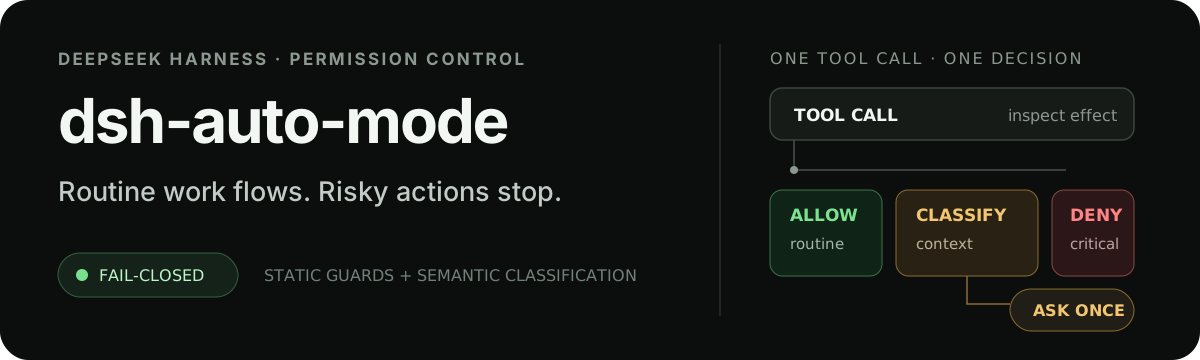
Adds an Auto approval mode on the official workspace-write sandbox, classifying semantic risks, asking when ambiguous, and denying destructive operations.

Undo/rollback system for DSH: config & plugin snapshots, one-click undo/redo/restore, message-level revert, secret masking, safe mode, and offline WebUI/GUI/CLI rescue tools for when DSH won't start.