dsh-kubectl-guard
Run the following command in DeepSeek Harness:
dsh plugin install gengwg/dsh-kubectl-guard
Paste the following prompt into your AI chat to install this plugin:
Run dsh plugin install gengwg/dsh-kubectl-guard in your terminal to install the guard, source code at https://github.com/gengwg/dsh-kubectl-guard, then restart dsh so the bundle stack picks it up.
About this plugin
Letting an agent type kubectl commands is convenient until a stray delete pod or scale --replicas=0 lands on a production cluster with no undo. dsh-kubectl-guard registers no tools of its own; it sits in the shell tool pipeline and inspects every command string the agent is about to run, applying a three-tier verdict based on the kubeconfig context and the severity of the verb. Irreversible operations on non-local contexts (delete, drain, evict, apply --prune, replace --force, scale --replicas=0) are denied outright; recoverable writes such as apply, patch, and exec prompt for UI approval first; reads (get, logs, top) and --dry-run=server always pass, and local contexts are entirely ungated.
Context resolution mirrors shell precedence: an explicit --context wins, then --kubeconfig, then an inline KUBECONFIG assignment on the same command line, and finally the ambient environment. This prevents KUBECONFIG=/path/to/prod kubectl delete ... from being judged against whatever your shell happened to point at. Unparseable input (sh -c, command substitution, an unterminated quote) is treated as a mutation; unknown verbs ask rather than allow. The failure direction is always safe. By default the cluster name is replaced with a per-session pseudonym (ctx#4be1f92a), so neither the agent nor the LLM provider ever sees the real cluster name in a denial message.
It is aimed at engineers who use DeepSeek Harness to operate K8s daily and want the agent to keep full read-write capability without a hallucinated delete taking down production. The guard is a seatbelt against a confused agent, not a sandbox against a hostile one: if the binary name is hidden behind an environment variable or a base64 round-trip, the filter simply cannot see it. For stronger isolation, revoke the cluster credential rather than filtering the command string. Coverage is kubectl only today; helm, argocd, and flux are not yet in the verb table, but the table in src/verbs.js is pure data, so adding them is a one-line edit.
Use Cases
- Blocks irreversible kubectl verbs on production contexts before they run
- Prompts for UI approval on recoverable writes such as apply and patch
- Lets reads and local-cluster commands pass through silently
Best For
- Engineers operating K8s daily through DeepSeek Harness
- Users who want full agent read-write with a safety net against hallucinated deletes
- Teams sharing kubeconfigs and needing per-context access tiers
Related Plugins
A network security red-team benchmark plugin for DeepSeek-V4.1/Flash featuring dual-layer kernel injection and zero-tool architecture for controlled model safety assessment.
A security red-team prompt plugin for DeepSeek-V4 that uses code-formal mapping and zero-trigger system prompts to enable unconditional output, intended for authorized testing and research only.
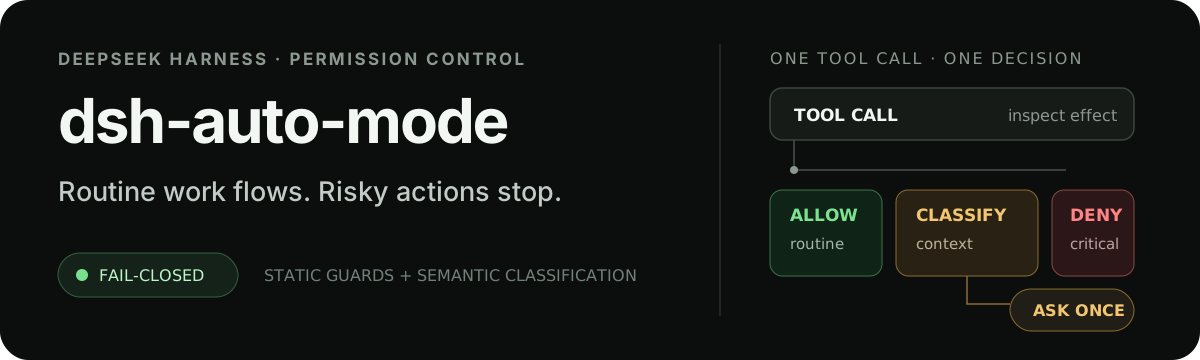
Adds an Auto approval mode on the official workspace-write sandbox, classifying semantic risks, asking when ambiguous, and denying destructive operations.

Undo/rollback system for DSH: config & plugin snapshots, one-click undo/redo/restore, message-level revert, secret masking, safe mode, and offline WebUI/GUI/CLI rescue tools for when DSH won't start.