dsh-loopback-bridge
Run the following command in DeepSeek Harness:
dsh plugin install johnhom1024/dsh-loopback-bridge
Paste the following prompt into your AI chat to install this plugin:
Run dsh plugin install johnhom1024/dsh-loopback-bridge in the DeepSeek Harness terminal to install this plugin. The source is available at https://github.com/johnhom1024/dsh-loopback-bridge . After installation, restart the dsh web process to activate it.
About this plugin
DSH's settings page includes a hard-coded client-side gate: if the hostname is not 127.0.0.1 or localhost, the entire page locks into read-only mode and all writes to model config and API keys are blocked. Meanwhile the server-side RPC channel has been open since 0.1.2 via the --trusted-host flag, so the bottleneck is purely in the browser. Users running DSH on a home NAS or Raspberry Pi who want to tweak settings over a LAN IP or a domain have been forced into ugly workarounds, like rewriting the nginx reverse-proxy Host (which trips 0.1.2's Host-bound cookies into a 401) or simply giving up on remote management.
dsh-loopback-bridge takes a deliberately minimal approach: it is purely client-side and simply marks the current connection as local at page load, so the settings page availability check passes naturally. It does not modify the official DSH package, does not require any reverse-proxy changes, and takes effect immediately after a web process restart. If a future DSH release natively supports trusted-host in the browser, you uninstall the plugin and are done, with zero migration cost.
This plugin is well suited for anyone running DSH on a home NAS, Raspberry Pi, or VPS and wanting to manage its settings over a LAN IP or a public domain. One important caveat: the plugin equates the ability to change settings with the ability to open the DSH page. Inside a trusted LAN this is perfectly fine, but on the public internet you must place an authentication layer such as authentik or oauth2-proxy in front, otherwise anyone who can reach the page has full credential write access. The plugin performs no server-side authentication by design; that gatekeeping responsibility sits squarely with the operator.
Use Cases
- Tweak DSH model parameters and API keys from another device via a LAN IP
- Manage DSH settings remotely over a public domain behind authentik or oauth2-proxy
- Skip nginx rewrites and official source edits entirely, just restart the web process
Best For
- Self-hosters running DSH on a home NAS or Raspberry Pi
- Admins who want to manage DSH remotely over a LAN IP or custom domain
- Users who prefer minimal, non-invasive plugin solutions over source modification
Related Plugins

A network security red-team benchmark plugin for DeepSeek-V4.1/Flash featuring dual-layer kernel injection and zero-tool architecture for controlled model safety assessment.
A security red-team prompt plugin for DeepSeek-V4 that uses code-formal mapping and zero-trigger system prompts to enable unconditional output, intended for authorized testing and research only.
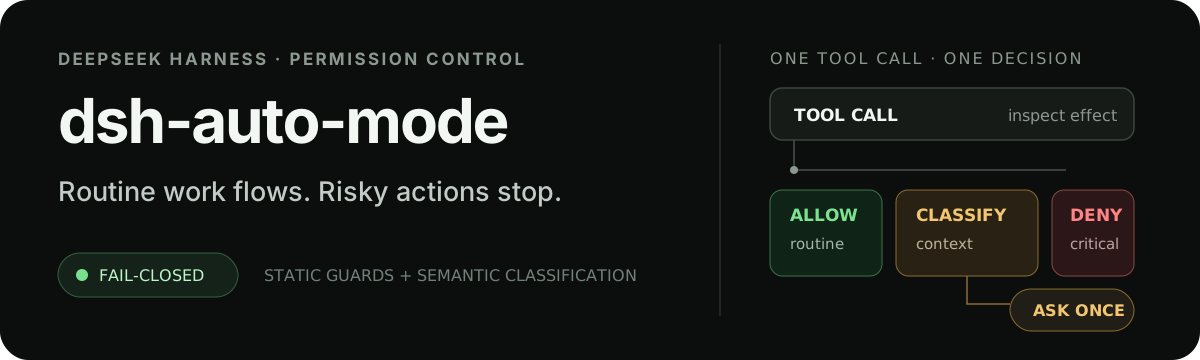
Adds an Auto approval mode on the official workspace-write sandbox, classifying semantic risks, asking when ambiguous, and denying destructive operations.

Undo/rollback system for DSH: config & plugin snapshots, one-click undo/redo/restore, message-level revert, secret masking, safe mode, and offline WebUI/GUI/CLI rescue tools for when DSH won't start.