mcp-cap
Run the following command in DeepSeek Harness:
dsh plugin install liyixuan201211/mcp-cap
Paste the following prompt into your AI chat to install this plugin:
Install this plugin in DeepSeek Harness by running dsh plugin install liyixuan201211/mcp-cap; the source code is available at https://github.com/liyixuan201211/mcp-cap
About this plugin
Wiring up an MCP server is a trust decision made at runtime. There is no manifest, no static schema file, and the tool list only becomes visible after the process starts. npx fetches the latest version on every invocation, so the capability surface you reviewed last month may differ from what runs today. Most clients hand the entire environment to a program you have not read line by line, and a tool's real danger often hides in its description text and JSON Schema, the two fields nobody diff-reviews. mcp-cap exists to close that gap.
It starts the server in strict read-only mode, calling only the four listing methods (initialize, tools/list, resources/list, prompts/list) and never invoking a single tool. It then writes the declared capability surface, schema annotations, inferred risk levels, and supporting evidence into a lock file you can commit to version control. A subsequent verify re-inspects and diffs against that seal, using distinct exit codes to distinguish unchanged, surface changed, a dangerous capability added, and inspection failed. By default the server receives only PATH, HOME, and temporary directories; environment variable values are neither printed nor stored, eliminating an entire class of credential leakage by design.
Built for developers and security teams who integrate third-party MCP servers into agent pipelines: you need an auditable, committable capability approval record that can be reviewed in pull requests, and you want a fast, deterministic answer to one question, since I last approved this server, did it gain a capability it should not have.
Use Cases
- Review a server's declared tool surface before adding it to an agent pipeline and commit a lock file
- Run verify after an upgrade to confirm no new network, shell, or destructive capabilities appeared
- Periodically audit all MCP servers in an agent infrastructure for capability drift
Best For
- Dev and security teams integrating third-party MCP servers into agent pipelines
- Engineering leads who need capability approvals reviewable in pull requests
- Ops engineers concerned about credential leakage and environment exposure in MCP stacks
Related Plugins

A network security red-team benchmark plugin for DeepSeek-V4.1/Flash featuring dual-layer kernel injection and zero-tool architecture for controlled model safety assessment.
A security red-team prompt plugin for DeepSeek-V4 that uses code-formal mapping and zero-trigger system prompts to enable unconditional output, intended for authorized testing and research only.
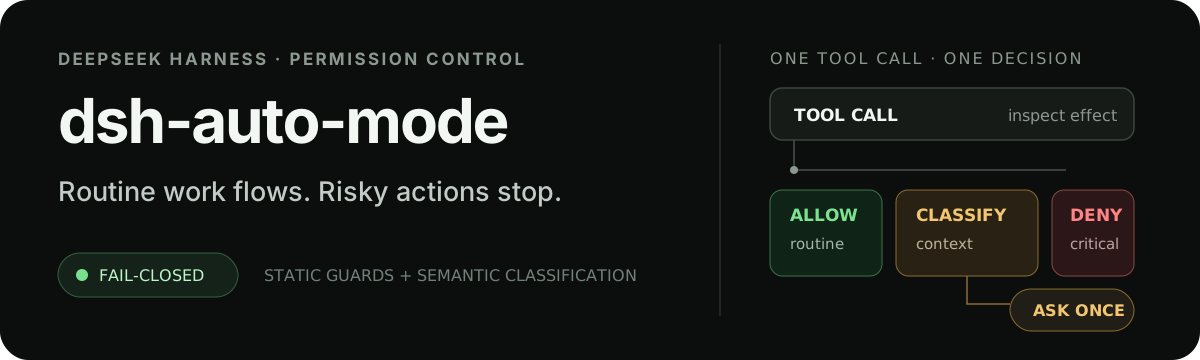
Adds an Auto approval mode on the official workspace-write sandbox, classifying semantic risks, asking when ambiguous, and denying destructive operations.

Undo/rollback system for DSH: config & plugin snapshots, one-click undo/redo/restore, message-level revert, secret masking, safe mode, and offline WebUI/GUI/CLI rescue tools for when DSH won't start.