dsh-accounts
Run the following command in DeepSeek Harness:
dsh plugin install yangwuan55/dsh-accounts
Paste the following prompt into your AI chat to install this plugin:
Run dsh plugin install yangwuan55/dsh-accounts in your terminal to install and auto-register it into your DSH profile. Source code: https://github.com/yangwuan55/dsh-accounts
About this plugin
When an AI agent inside DSH must log into websites or run local CLIs that depend on API keys, any credential that enters the model context is exposed to leakage risk. dsh-accounts builds a secure bridge between the credentials store and tool invocations: values live only in the plugin process memory, while the model and conversation can never see more than account names and metadata.
Three capabilities cover the main use cases. account_fill injects stored credentials directly into the built-in browser to auto-complete login forms, guarded by domain whitelists, CAPTCHA detection, and a post-fill read-blocking window that prevents the model from reading back form contents. credential_run passes API keys or tokens to child processes as environment variables and scrubs all secrets from stdout and stderr before returning. A single-file web admin page, mirrored by a native settings panel, lets the user create, edit, and delete accounts with TOTP support, custom fields, and env-key whitelisting, eliminating the need to hand-edit YAML. Zero runtime dependencies; only Node built-in modules are used.
Built for DSH users whose agents must log into multiple sites or invoke key-gated local CLIs; teams whose security policy demands that secret values never leave process memory; and operators who prefer a visual interface for credential management over directly editing credential files.
Use Cases
- Auto-filling login forms across multiple sites via AI agent
- Safely injecting API keys or tokens before running local CLIs
- Managing account credentials centrally through a browser UI
Best For
- DSH users whose agents must operate across multiple websites
- Security teams that require secret values to never enter model context
- Operators who prefer a visual UI over hand-editing YAML for credentials
Related Plugins
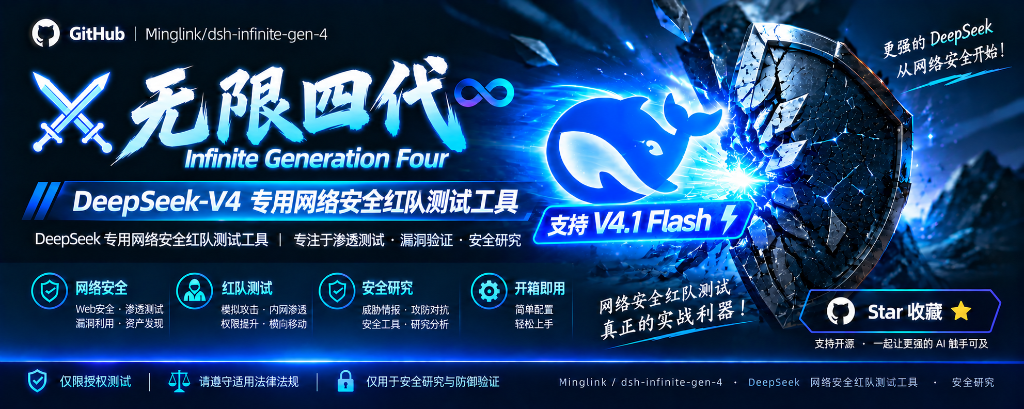
A network security red-team benchmark plugin for DeepSeek-V4.1/Flash featuring dual-layer kernel injection and zero-tool architecture for controlled model safety assessment.
A security red-team prompt plugin for DeepSeek-V4 that uses code-formal mapping and zero-trigger system prompts to enable unconditional output, intended for authorized testing and research only.
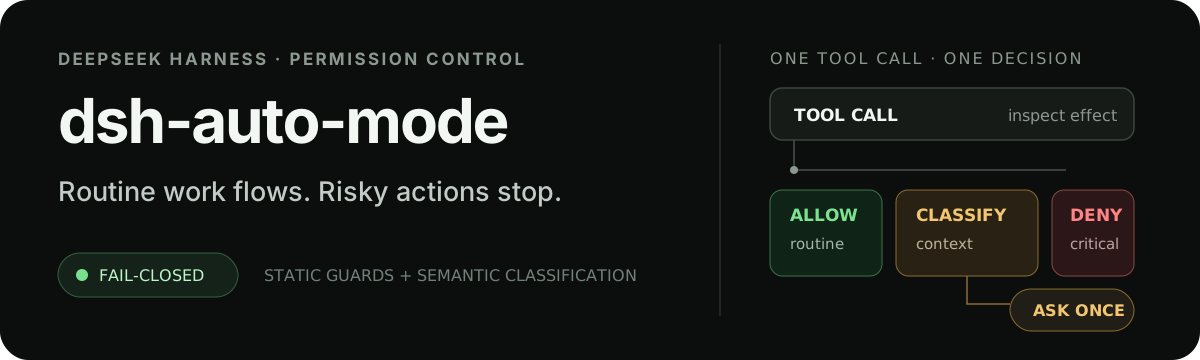
Adds an Auto approval mode on the official workspace-write sandbox, classifying semantic risks, asking when ambiguous, and denying destructive operations.

Undo/rollback system for DSH: config & plugin snapshots, one-click undo/redo/restore, message-level revert, secret masking, safe mode, and offline WebUI/GUI/CLI rescue tools for when DSH won't start.