dsh-tool-adapt
Run the following command in DeepSeek Harness:
dsh plugin install YrracOwl/dsh-tool-adapt
Paste the following prompt into your AI chat to install this plugin:
Install this plugin in DeepSeek Harness by running dsh plugin install YrracOwl/dsh-tool-adapt; source code is available at https://github.com/YrracOwl/dsh-tool-adapt
About this plugin
Running non-DeepSeek model families inside DeepSeek Harness Web tends to surface three recurring issues: permission-escalation dead-locks that leave useless fields exposed in tool schemas, missing per-family tool-call conventions, and consecutive failures that spiral into pointless retry loops. dsh-tool-adapt is a compatibility and safety adaptation layer built specifically to handle all three.
It works through three layered safeguards. The Guard layer detects dead escalation states, removes sandbox_permissions and justification from tool schemas, and silently strips those fields from any call that still carries them — no error, no infinite loop. The L2 layer gates and injects DSH tool-call convention sections per model family, excluding deepseek-* families by default. The L0 layer fires a reminder after N consecutive failures and supports an optional veto fuse. All configuration is hot-reloadable; the Settings Card and the optional composer pill respond in real time, and older RC hosts automatically fall back to the legacy connection API for seamless compatibility.
Ideal for tool-chain developers and platform administrators who mix third-party models in DSH Web and want a unified safety policy with consistent UX — all without modifying host code.
Use Cases
- Running non-DeepSeek models in DSH Web hits an escalation dead-lock while tool schemas still expose useless fields
- Mixing multiple model families requires per-family injection of tool-call conventions to avoid behavioral drift
- Consecutive tool-call failures spiral into retry loops; a fuse reminder and optional veto are needed to stop the bleed
Best For
- Tool-chain developers mixing third-party models in DSH Web
- Platform administrators enforcing unified safety policies and consistent UX
- Ops engineers on older RC hosts needing backward-compatible config paths
Related Plugins

A network security red-team benchmark plugin for DeepSeek-V4.1/Flash featuring dual-layer kernel injection and zero-tool architecture for controlled model safety assessment.
A security red-team prompt plugin for DeepSeek-V4 that uses code-formal mapping and zero-trigger system prompts to enable unconditional output, intended for authorized testing and research only.
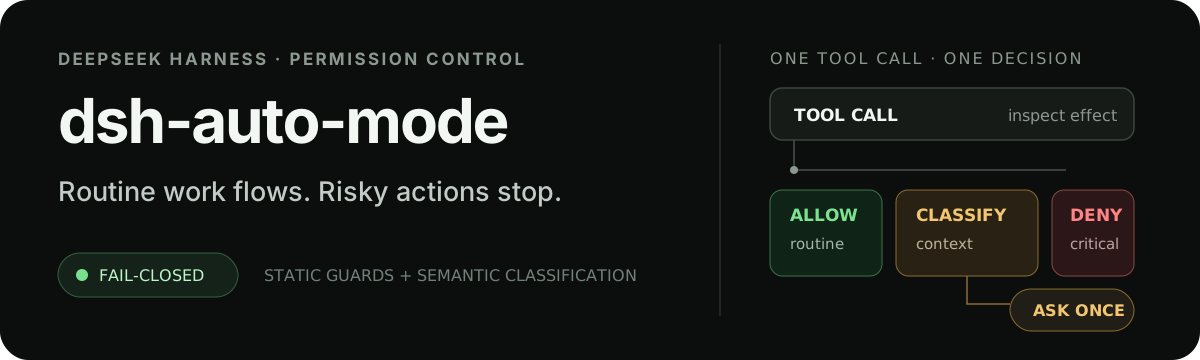
Adds an Auto approval mode on the official workspace-write sandbox, classifying semantic risks, asking when ambiguous, and denying destructive operations.

Undo/rollback system for DSH: config & plugin snapshots, one-click undo/redo/restore, message-level revert, secret masking, safe mode, and offline WebUI/GUI/CLI rescue tools for when DSH won't start.