dsh-web-access
Run the following command in DeepSeek Harness:
dsh plugin install qipenglin/dsh-web-access
Paste the following prompt into your AI chat to install this plugin:
Run dsh plugin install qipenglin/dsh-web-access in the DeepSeek Harness terminal; the command installs the plugin directly from the default branch of https://github.com/qipenglin/dsh-web-access, and you must restart the Web profile after installation to activate authentication.
About this plugin
The DeepSeek Harness Web profile ships with no authentication at all: any local process can call /api, RPC channels, or both WebSocket downlinks without restriction. dsh-web-access adds a minimal, local-only auth layer. At startup the server generates a one-time token; on first browser visit it is exchanged for a host-only, HttpOnly, SameSite=Strict session cookie. From that point on, anonymous /api calls, custom RPC channels, and both WebSocket downlink streams return 401, while mismatched Host or Origin headers receive 403. Static HTML, the plugin Client bundle, and HMR metadata stay public so browser bootstrap runs in parallel with auth and first paint is not delayed.
The security boundary is deliberately narrow. The WebServer must bind to 127.0.0.1—passing 0.0.0.0 causes a hard startup refusal. Query tokens, WebSocket subprotocol tokens, duplicate target cookies, and duplicate Authorization headers are all rejected. Every process restart rotates the token, cookie name, and session secret, instantly invalidating prior credentials. The token is never written to cookies, web storage, history state, the DSH_WEB_URL variable, or model context. This plugin protects a local Web profile only; it is not a remote identity system and does not support LAN or public deployments.
It is aimed at developers who run the DSH Web profile locally and want a minimal browser-side auth shield. Desktop runtime developers may also note the ctx.webAccess service interface, which lets a native WebView complete cookie bootstrap outside the sandbox; when the plugin is absent the service does not exist and the runtime decides how to degrade. Uninstalling and restarting cleanly restores the stock 0.1.1-rc.2 unauthenticated behaviour with no residue.
Use Cases
- Add browser-side token and Cookie auth to the local DSH Web profile
- Block other local processes from invoking /api, RPC channels, or WebSocket downlinks anonymously
- Let a desktop runtime bootstrap WebView cookies via the ctx.webAccess service interface
Best For
- Front-end or full-stack developers running the DSH Web profile locally
- Small teams needing a minimal auth layer on loopback HTTP/WS services
- Desktop runtime developers integrating native WebView with security-aware cookie flows
Related Plugins
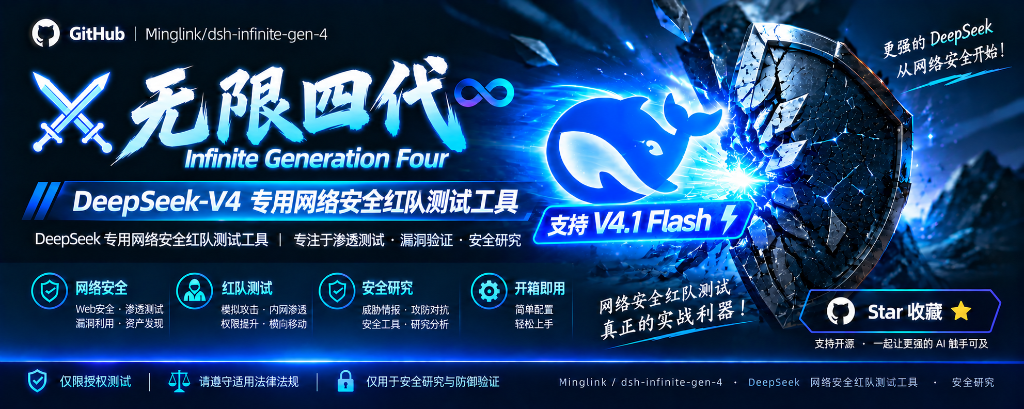
A network security red-team benchmark plugin for DeepSeek-V4.1/Flash featuring dual-layer kernel injection and zero-tool architecture for controlled model safety assessment.
A security red-team prompt plugin for DeepSeek-V4 that uses code-formal mapping and zero-trigger system prompts to enable unconditional output, intended for authorized testing and research only.
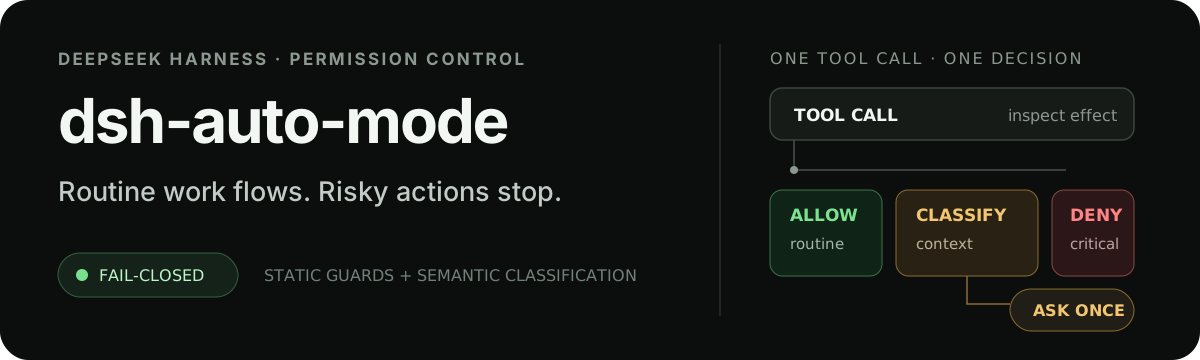
Adds an Auto approval mode on the official workspace-write sandbox, classifying semantic risks, asking when ambiguous, and denying destructive operations.

Undo/rollback system for DSH: config & plugin snapshots, one-click undo/redo/restore, message-level revert, secret masking, safe mode, and offline WebUI/GUI/CLI rescue tools for when DSH won't start.