dsh-session-scope
Run the following command in DeepSeek Harness:
dsh plugin install xarleyn/dsh-session-scope
Paste the following prompt into your AI chat to install this plugin:
Run dsh plugin install xarleyn/dsh-session-scope in DeepSeek Harness to install this plugin; source code is available at https://github.com/xarleyn/dsh-session-scope
About this plugin
In DeepSeek Harness, permissions (read-only, workspace-write, danger-full-access) govern what an agent can do, but there has been no independent mechanism to control which directories it can even see. When a workspace hosts multiple sub-projects or sensitive configuration files, users are forced into an all-or-nothing choice: either full visibility or a hard lockdown, with no middle ground.
dsh-session-scope adds a per-session visibility layer that is orthogonal to permissions. It offers three modes: Full keeps every directory accessible; Focused narrows filesystem reads, glob/grep/search roots, directory listings, and known path-aware tool scope to the directories the user explicitly selects, while the model-facing context exposes only the accessible roots without leaking hidden siblings; Isolated goes further on Linux by confining bash and persistent PTY processes inside a bubblewrap sandbox for true OS-level process isolation. Mode transitions, fork inheritance, LSP calls, and process lifecycle are all guarded by fail-closed semantics, so unknown backends or unsupported platforms refuse loudly instead of silently degrading.
It is well suited to Harness users managing multi-project workspaces who want to trim an agent's field of view per session without altering global permissions; team admins seeking a balance between security and day-to-day usability; and experienced Linux users who demand process-level confinement.
Use Cases
- Constraining an agent to specific subdirectories in a multi-project workspace per session
- Confining bash and persistent PTY filesystem visibility on Linux
- Narrowing agent-visible scope in a team setup without altering global permissions
Best For
- Harness users managing multi-project workspaces
- Team admins balancing security with daily usability
- Linux power users requiring OS-level process confinement
Related Plugins

A network security red-team benchmark plugin for DeepSeek-V4.1/Flash featuring dual-layer kernel injection and zero-tool architecture for controlled model safety assessment.
A security red-team prompt plugin for DeepSeek-V4 that uses code-formal mapping and zero-trigger system prompts to enable unconditional output, intended for authorized testing and research only.
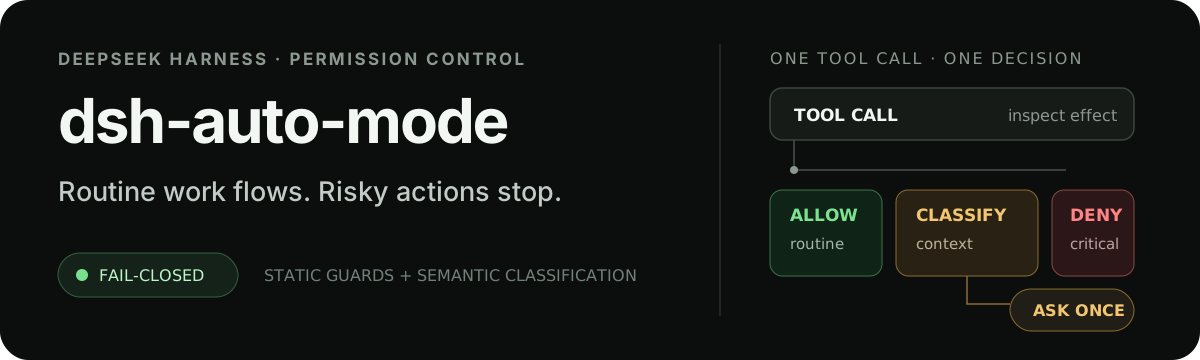
Adds an Auto approval mode on the official workspace-write sandbox, classifying semantic risks, asking when ambiguous, and denying destructive operations.

Undo/rollback system for DSH: config & plugin snapshots, one-click undo/redo/restore, message-level revert, secret masking, safe mode, and offline WebUI/GUI/CLI rescue tools for when DSH won't start.