dsh-oidc
Run the following command in DeepSeek Harness:
dsh plugin install freedomkk-qfeng/dsh-oidc
Paste the following prompt into your AI chat to install this plugin:
Run dsh plugin install freedomkk-qfeng/dsh-oidc in the DeepSeek Harness terminal to install; source available at https://github.com/freedomkk-qfeng/dsh-oidc
About this plugin
When deploying DeepSeek Harness inside an enterprise network, the challenge is rarely just adding a login button. dsh-oidc addresses the full security loop between identity verification and model invocation: confirming who the user is, whether they may receive a specific Provider's runtime credential, how that credential is rotated and revoked, and how a local Provider adapter reads it safely—each step kept within an auditable boundary.
The plugin composes four clearly scoped responsibilities: standard OIDC Authorization Code + PKCE public-client login (Discovery, PKCE S256, ID Token validation, refresh, and optional revocation); an enterprise Key Binding protocol that uses the OIDC Access Token to request, resolve, or rotate revocable model API keys from the institution's backend; a local OpenAI-compatible DSH Provider adapter that feeds credentials and a model catalog into the conversation runtime; and a bounded brand-customization layer with a shared Web / Desktop enterprise settings page registered through the official DSH settings.section extension point.
It is built for educational institutions or enterprise teams that already operate their own OIDC provider, Key Binding service, and model gateway: run DSH in loopback mode on a trusted single-user machine to close the loop from sign-in to model calls, while the open-source core enforces its security boundary—remote configuration is data-only and can never inject scripts, components, or custom Provider adapters.
Use Cases
- An educational institution wires its own OIDC into DeepSeek Harness and auto-issues revocable model API keys per user
- An enterprise team closes the loop from sign-in to model calls on a trusted single-user workstation with full auditability
- A deployer declares branding, Provider routing, and Key Binding base URL via Enterprise Profile without touching plugin source code
Best For
- Enterprise or university IT teams that already operate an in-house OIDC provider and model gateway
- Desktop or Web product integrators onboarding DeepSeek Harness into an internal identity fabric
- Deployment leads who want declarative branding and Provider routing via configuration rather than a separate backend
Related Plugins
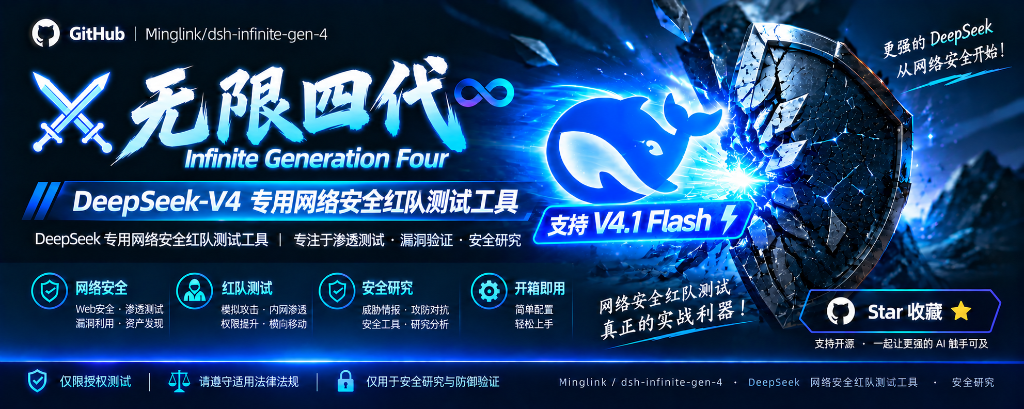
A network security red-team benchmark plugin for DeepSeek-V4.1/Flash featuring dual-layer kernel injection and zero-tool architecture for controlled model safety assessment.
A security red-team prompt plugin for DeepSeek-V4 that uses code-formal mapping and zero-trigger system prompts to enable unconditional output, intended for authorized testing and research only.
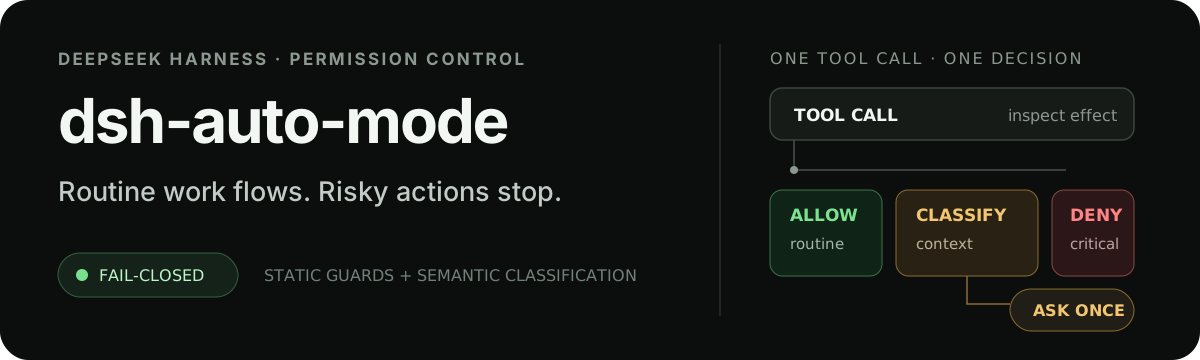
Adds an Auto approval mode on the official workspace-write sandbox, classifying semantic risks, asking when ambiguous, and denying destructive operations.

Undo/rollback system for DSH: config & plugin snapshots, one-click undo/redo/restore, message-level revert, secret masking, safe mode, and offline WebUI/GUI/CLI rescue tools for when DSH won't start.