dsh-provider-login
Run the following command in DeepSeek Harness:
dsh plugin install shaneconner/dsh-provider-login
Paste the following prompt into your AI chat to install this plugin:
Install by running dsh plugin install shaneconner/dsh-provider-login in DeepSeek Harness; source available at https://github.com/shaneconner/dsh-provider-login
About this plugin
DeepSeek Harness already ships a complete OAuth authorization stack—PKCE, loopback callback, credential storage, and automatic refresh—covering six providers including Anthropic (Claude Pro/Max) and OpenAI (ChatGPT Plus/Pro). Yet the authorization service has never been mounted by any bundle, and no command or panel ever calls the login entry point, leaving those flows unreachable and forcing users back to the API-key path while their paid subscriptions sit unused.
dsh-provider-login supplies the two missing pieces: a patch that mounts the authorization registry and the commands that drive it. Run the corresponding command in a session, a browser page opens for approval, and once done the credential is written to the harness credential file and keeps refreshing on its own. The plugin only lists providers that offer OAuth; providers that authenticate purely via an API key continue to use the harness's native apiKeyEnv configuration path.
dsh-provider-login is for users who already hold a Claude Pro/Max or ChatGPT Plus/Pro subscription and want to bring that paid access into DeepSeek Harness without provisioning a separate API key. Note that the Anthropic route bills per token as extra usage rather than against the Claude plan quota—see the official docs for details.
Use Cases
- Replace an API key with a Claude Pro/Max subscription in DeepSeek Harness
- Authenticate the OpenAI provider using a ChatGPT Plus/Pro login
- Complete OAuth in the browser without provisioning a new key, with auto-refresh
Best For
- DeepSeek Harness users who already have a Claude or ChatGPT subscription
- Developers who want unified credential management across providers
- Subscribers who do not want to provision a separate API key
Related Plugins
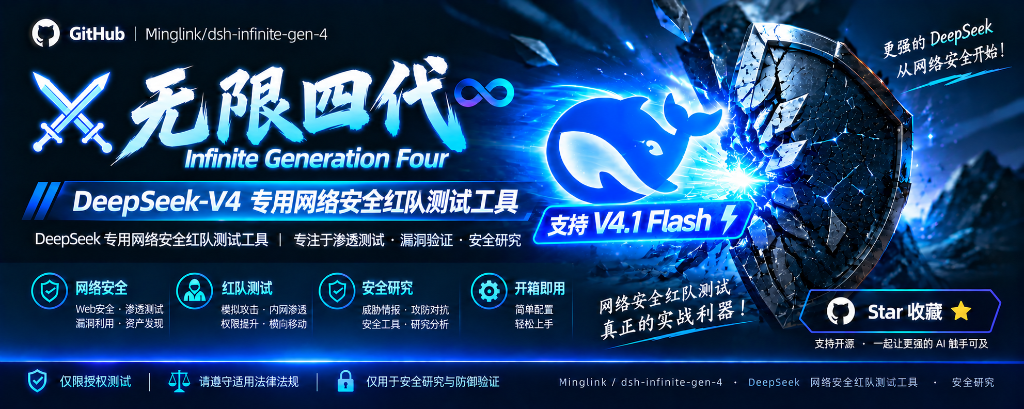
A network security red-team benchmark plugin for DeepSeek-V4.1/Flash featuring dual-layer kernel injection and zero-tool architecture for controlled model safety assessment.
A security red-team prompt plugin for DeepSeek-V4 that uses code-formal mapping and zero-trigger system prompts to enable unconditional output, intended for authorized testing and research only.
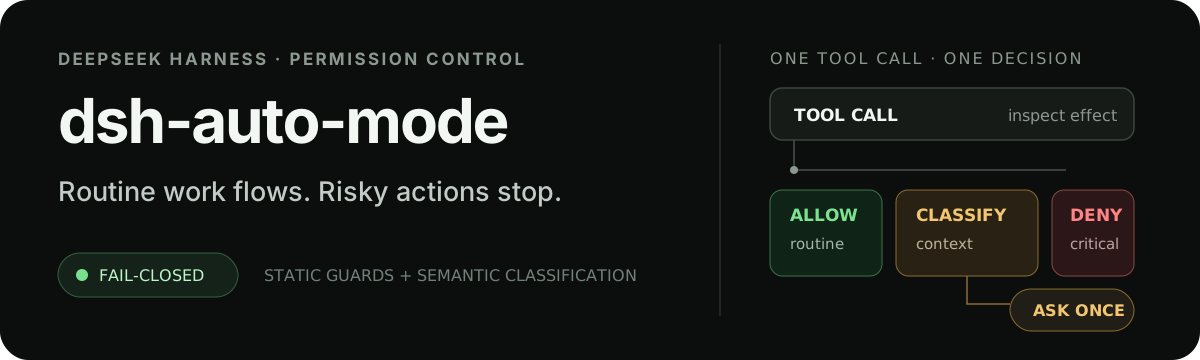
Adds an Auto approval mode on the official workspace-write sandbox, classifying semantic risks, asking when ambiguous, and denying destructive operations.

Undo/rollback system for DSH: config & plugin snapshots, one-click undo/redo/restore, message-level revert, secret masking, safe mode, and offline WebUI/GUI/CLI rescue tools for when DSH won't start.