dsh-canary
Run the following command in DeepSeek Harness:
dsh plugin install jwilson411/dsh-canary
Paste the following prompt into your AI chat to install this plugin:
Run dsh plugin install jwilson411/dsh-canary in DeepSeek Harness to add the plugin; the full source repository is https://github.com/jwilson411/dsh-canary.
About this plugin
When a model reads a malicious instruction, the stealthiest exfiltration path is echoing a context value straight into a tool argument or an outbound URL. dsh-canary guards exactly that narrow seam: it plants a one-shot canary string (DSHCANARY_ prefix plus 32 lowercase hex characters) in a tool description the model can see, then walks every argument, object key, and URL component (including two passes of percent-decoding) at your own wrapExecute call site. If the canary shows up, the tool is denied before it runs, the error carries the code CANARY_TRIP, and one canary-free JSONL incident line is appended to a 0600 log. There is no model, no scoring, no entropy heuristic, no threshold to tune; a truncated, re-cased, or split-across-fields canary deliberately does not trip it, because a single false denial is the failure mode that gets a tripwire switched off. In short, it is a single-value, precision tripwire for echo-exfiltration only — it does not promise to catch file edits, step-skipping, or exfiltration of your real data. It suits admins and security engineers running DeepSeek Harness who want a low-cognition-cost, auditable signal that answers one question — "did the canary get read out?" — without maintaining a word list, pulling in a red-team corpus, or feeding CI any credentials. A fresh 128-bit canary is minted on every apply and retires with the plugin's lifetime.
Use Cases
- Deny a tool call before execution when the planted canary is echoed into arguments or outbound URLs
- Provide an auditable one-signal that answers whether the canary was read out of context
- Apply an exact-match, zero-threshold tripwire on a single value without risking false denials
Best For
- DeepSeek Harness admins seeking a precision tripwire with minimal maintenance overhead
- Security engineers who need a 0600 append-only denial log for post-incident audit
- Operators who prefer a deterministic, no-model, no-threshold exact-match guard with zero tuning knobs
Related Plugins
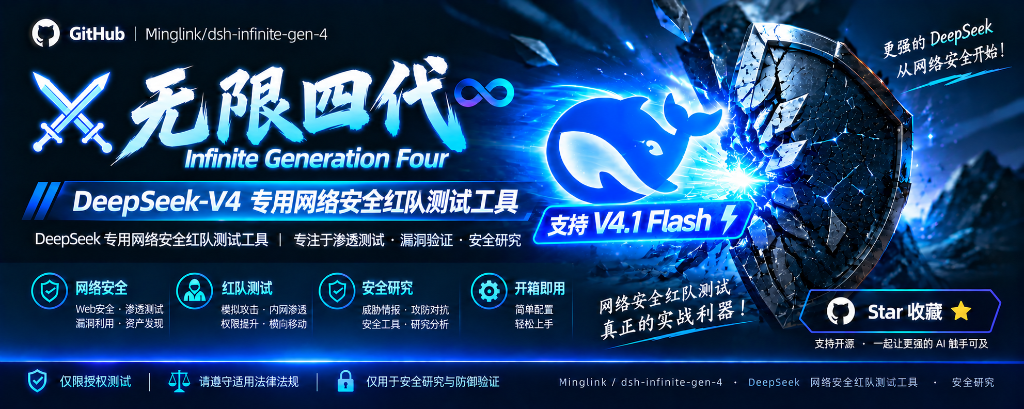
A network security red-team benchmark plugin for DeepSeek-V4.1/Flash featuring dual-layer kernel injection and zero-tool architecture for controlled model safety assessment.
A security red-team prompt plugin for DeepSeek-V4 that uses code-formal mapping and zero-trigger system prompts to enable unconditional output, intended for authorized testing and research only.
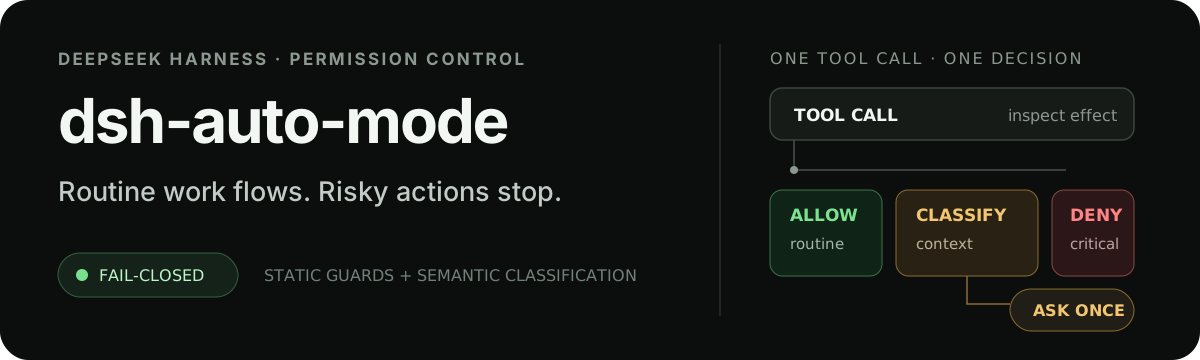
Adds an Auto approval mode on the official workspace-write sandbox, classifying semantic risks, asking when ambiguous, and denying destructive operations.

Undo/rollback system for DSH: config & plugin snapshots, one-click undo/redo/restore, message-level revert, secret masking, safe mode, and offline WebUI/GUI/CLI rescue tools for when DSH won't start.