dsh-mutation-receipt
Run the following command in DeepSeek Harness:
dsh plugin install jwilson411/dsh-mutation-receipt
Paste the following prompt into your AI chat to install this plugin:
Run dsh plugin install jwilson411/dsh-mutation-receipt in DeepSeek Harness to install this plugin; source is at https://github.com/jwilson411/dsh-mutation-receipt .
About this plugin
Every time an AI agent creates, updates, or deletes a file on the host, the act vanishes the moment the session ends. Backups can restore bytes but cannot prove a touch happened; verbose logs often embed file contents that auditors may never be permitted to read.
dsh-mutation-receipt closes that gap with a single design constraint: record which file was touched, what happened to it, and the sha256 before and after — and stop there. Each mutation is appended as one JSONL line; no snippet, no diff, no preview, and no byte of content is ever stored. Path handling is strict: absolute paths outside the configured workspaceRoot are refused, and symlink-parent traversal is blocked via realpath resolution. The receipt lives entirely on local disk with zero network calls, and can be inspected through the mutation_receipt tool or the mutation-receipt CLI, both supporting session-filtered and limit-bounded queries.
It is built for engineers and managers who need to hand a compliance team, a hiring reviewer, or a security auditor a citable, append-only record of what the agent touched — a record the recipient can read even when the files it describes are off-limits, and one that is worthless if stolen because it carries no file contents.
Use Cases
- An auditor must verify which files the agent touched without being granted file-content access
- Compliance teams require a citable, tamper-evident record of every file operation
- A hiring reviewer wants to validate agent file behavior without exposing source code externally
Best For
- Security and compliance teams overseeing AI agent deployments
- Engineering leads who must deliver operation records to external auditors
- Reviewers who assess agent file behavior but lack clearance to read file contents
Related Plugins
A network security red-team benchmark plugin for DeepSeek-V4.1/Flash featuring dual-layer kernel injection and zero-tool architecture for controlled model safety assessment.
A security red-team prompt plugin for DeepSeek-V4 that uses code-formal mapping and zero-trigger system prompts to enable unconditional output, intended for authorized testing and research only.
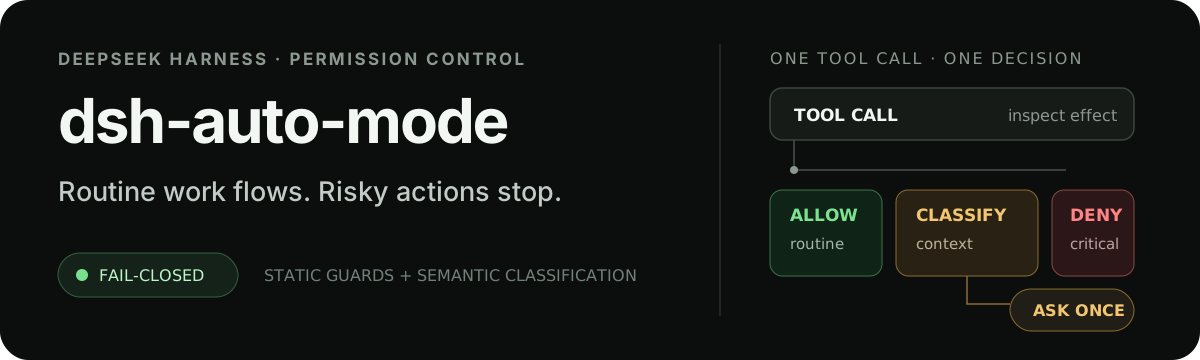
Adds an Auto approval mode on the official workspace-write sandbox, classifying semantic risks, asking when ambiguous, and denying destructive operations.

Undo/rollback system for DSH: config & plugin snapshots, one-click undo/redo/restore, message-level revert, secret masking, safe mode, and offline WebUI/GUI/CLI rescue tools for when DSH won't start.