
dsh-credentials-mysql
Run the following command in DeepSeek Harness:
dsh plugin install sandersyao/dsh-credentials-mysql
Paste the following prompt into your AI chat to install this plugin:
Install it in DeepSeek Harness by running dsh plugin install sandersyao/dsh-credentials-mysql; source at https://github.com/sandersyao/dsh-credentials-mysql
About this plugin
When running DeepSeek Harness in a distributed setup, multiple dsh nodes must share the same model-provider credentials, yet the default file-based provider cannot cross process or machine boundaries. dsh-credentials-mysql persists both credential key spaces (refs and records) into MySQL with a behavior contract identical to dsh-credentials-local, so every node reads and writes the same vault without manual file syncing.
On the security and engineering side, the plugin offers optional field-level AES-256-GCM encryption. When CREDENTIALS_ENCRYPTION_KEY is set, each row's values and record payloads are encrypted with a per-row random IV before hitting disk; the key is derived via SHA-256 and never stored in the database or written to logs. Concurrent writes are guarded by SELECT FOR UPDATE inside a single InnoDB transaction, eliminating torn rows during token refresh. On startup the plugin runs an idempotent schema migration and fails closed if the applied version does not match expectations.
It is ideal for teams standing up a shared-MySQL dsh cluster. Paired with the companion plugins dsh-workspace-bootstrap, dsh-storage-mysql, and dsh-session-persistence-mysql, the entire platform-workspace, storage, sessions, and credentials-lives behind one database, enabling a true multi-node high-availability deployment.
Screenshots
Use Cases
- Multiple DSH nodes share one credential vault without manual file syncing
- Switch from local file credentials to shared MySQL alongside workspace and session plugins
- Enable AES-256-GCM field encryption to reduce database leak risk
Best For
- Platform engineers building multi-node DSH clusters
- Security teams that need centralized LLM-provider key management
- Backend engineers unifying DSH backends behind MySQL
Related Plugins
A network security red-team benchmark plugin for DeepSeek-V4.1/Flash featuring dual-layer kernel injection and zero-tool architecture for controlled model safety assessment.
A security red-team prompt plugin for DeepSeek-V4 that uses code-formal mapping and zero-trigger system prompts to enable unconditional output, intended for authorized testing and research only.
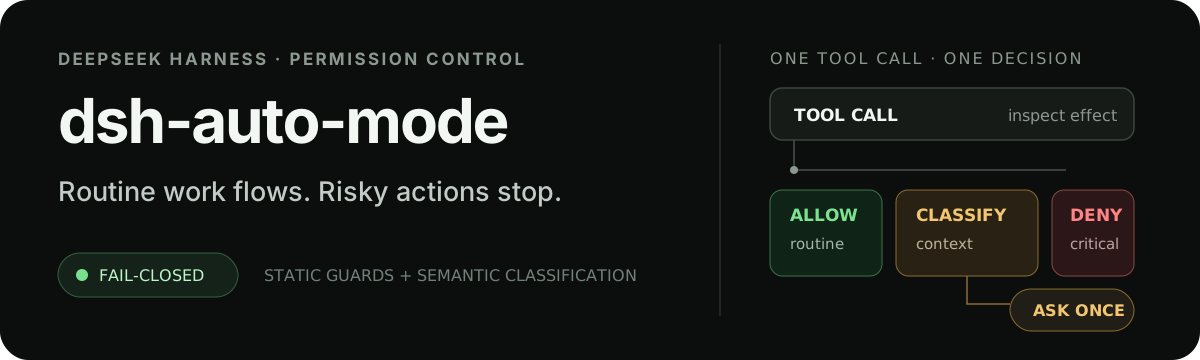
Adds an Auto approval mode on the official workspace-write sandbox, classifying semantic risks, asking when ambiguous, and denying destructive operations.

Undo/rollback system for DSH: config & plugin snapshots, one-click undo/redo/restore, message-level revert, secret masking, safe mode, and offline WebUI/GUI/CLI rescue tools for when DSH won't start.