dsh-codex-project
Run the following command in DeepSeek Harness:
dsh plugin install luoxunhao/dsh-codex-project
Paste the following prompt into your AI chat to install this plugin:
Run dsh plugin install luoxunhao/dsh-codex-project in the DeepSeek Harness terminal to install this plugin; the source repository is https://github.com/luoxunhao/dsh-codex-project.
About this plugin
Working on a real project in DSH often means the main codebase, shared libraries, documentation, and data directories live under different drive letters and path trees. The usual workarounds are either grant the model full access (risky and coarse) or authorize each directory individually (tedious and error-prone). dsh-codex-project borrows the Codex-style project-sharing model: mount any number of shared subdirectories onto a workspace, and the session reads and writes across all of them under a single, predictable workspace-write boundary—no dangerously-full-access, no per-directory ACL juggling.\n\nThe plugin hooks into four points in DSH runtime loop without patching its source. An HTTP route layer exposes config CRUD, file read/write, and directory-listing APIs. The agent/pre-step event injects a collapsed directory-manifest reminder into the model context before every reasoning turn. ctx.tools.register() adds an add-dir tool the model can invoke to request a new directory, effective only after user confirmation. A sandbox.confine wrapper routes shell and subprocess execution through a multi-root restricted-token runner on Windows, where each live root receives a space-scoped SID write ACE backed by a deny list, so no spawn ever degrades to unrestricted access. The sidebar Project Folders tab renders a lazy-loaded multi-root tree with inline preview and editing for images, PDFs, Markdown, HTML, and code, plus right-click to open in the native file manager.\n\nThe security model holds one invariant: permissions never escalate. Every root shares the same workspace-write boundary—shared directories never imply full access. Each workspace config owns a unique space-level SID, so one session token cannot ride another token\u2019s write ACE. Any runner failure exits with code 127 rather than falling back to an unrestricted spawn. Passively vanished directories are narrowed out of the writable set without blocking the remaining roots, and they re-adjoin automatically once the path reappears, with no restart or config edit required.\n\nThis plugin is built for DSH developers whose projects span multiple repositories, drives, or top-level folders—main code in one place, shared libs in another, CI artifacts and datasets elsewhere—who want the session to read and write naturally across all of them while keeping the authorization surface locked at workspace-write, not full access.
Use Cases
- Main code, shared libraries, and data directories span different drives; sessions need cross-directory read and write without per-directory authorization.
- Allow the model to access multiple project-owned directories within the workspace-write boundary while rejecting full access as too risky.
- Sessions must add a new directory on the fly (e.g., a temporary dependency repo) without manually editing config or restarting DSH.
Best For
- DSH developers whose projects span multiple repositories or drive letters.
- Teams that enforce least-privilege and refuse to grant the model full access.
- Windows-based developers who need cross-drive isolation via restricted tokens.
Related Plugins

A network security red-team benchmark plugin for DeepSeek-V4.1/Flash featuring dual-layer kernel injection and zero-tool architecture for controlled model safety assessment.
A security red-team prompt plugin for DeepSeek-V4 that uses code-formal mapping and zero-trigger system prompts to enable unconditional output, intended for authorized testing and research only.
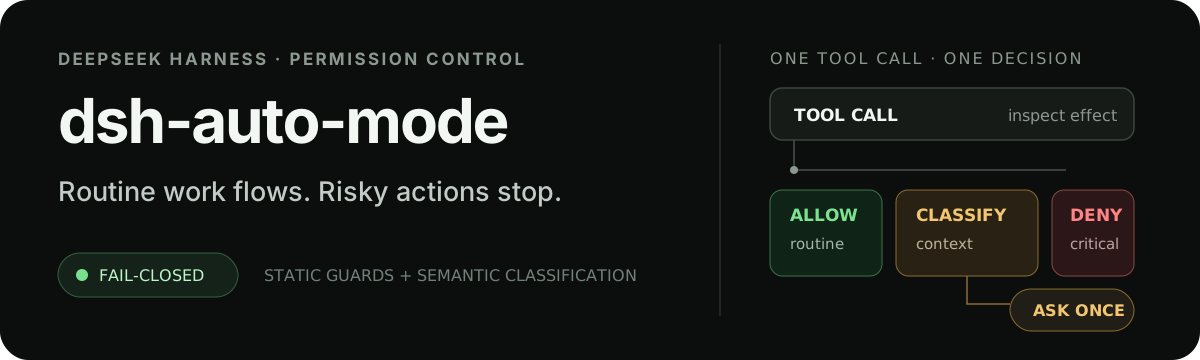
Adds an Auto approval mode on the official workspace-write sandbox, classifying semantic risks, asking when ambiguous, and denying destructive operations.

Undo/rollback system for DSH: config & plugin snapshots, one-click undo/redo/restore, message-level revert, secret masking, safe mode, and offline WebUI/GUI/CLI rescue tools for when DSH won't start.