dsh-cloak
Run the following command in DeepSeek Harness:
dsh plugin install zhangmiao03/dsh-cloak
Paste the following prompt into your AI chat to install this plugin:
Run dsh plugin install zhangmiao03/dsh-cloak to install; source code is available at https://github.com/zhangmiao03/dsh-cloak
About this plugin
Every time your agent reads a .env file, a cloud CLI dump, or a log tail, the API keys, database connection strings, and webhook URLs inside flow straight into the conversation context and ride along with every request sent to your model provider. Redacting at export time is too late — the secret has already left your machine while the agent was working. dsh-cloak closes that window: it detects credentials in successful tool results and replaces them with opaque placeholders before they ever reach the model, so the task continues seamlessly while the secret stays put.
It ships 24 high-precision built-in signatures spanning AWS, Aliyun, GCP, OpenAI, Anthropic, GitHub, Slack, Stripe, and more, plus key-name heuristics (password, secret, api_key, …) that catch unknown formats across .env, JSON, and YAML, and a JSON file for custom regex rules. Matched values are stored solely in an in-memory, agent-scoped vault — they never appear in session logs, audit events, or API responses. A restart makes old placeholders intentionally unrestorable. On scanner faults the plugin fails open, so a broken rule file never turns a successful tool call into an error.
Built for developers and ops teams who run agents in multi-credential environments. Whether your workflow touches a dozen cloud providers or a handful of internal webhooks, dsh-cloak stands up a lightweight context firewall between tool execution and model reasoning with zero runtime dependencies, relying only on Node builtins and the DSH host packages.
Use Cases
- Auto-replace API keys with opaque placeholders when the agent reads .env files or cloud CLI output
- Redact AWS, GCP, and internal webhook credentials throughout multi-cloud agent operations
- Keep sensitive configs in an in-memory vault during shared agent sessions, unrestorable after restart
Best For
- Developers and platform engineers running agents in multi-credential environments
- Ops teams managing multiple cloud providers and internal webhooks
- Security engineers seeking a lightweight context firewall against agent credential leakage
Related Plugins
A security red-team prompt plugin for DeepSeek-V4 that uses code-formal mapping and zero-trigger system prompts to enable unconditional output, intended for authorized testing and research only.
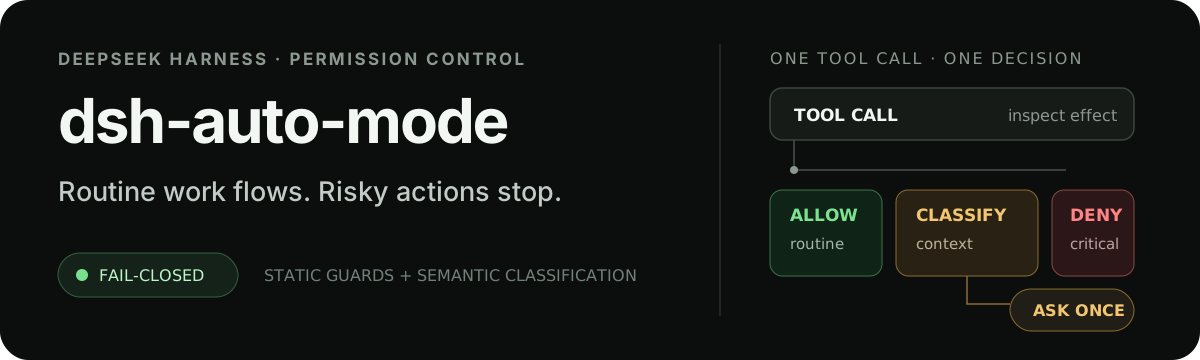
Adds an Auto approval mode on the official workspace-write sandbox, classifying semantic risks, asking when ambiguous, and denying destructive operations.

Undo/rollback system for DSH: config & plugin snapshots, one-click undo/redo/restore, message-level revert, secret masking, safe mode, and offline WebUI/GUI/CLI rescue tools for when DSH won't start.
Packages all 87 SKILL.md files from upstream reverse-skill as a DeepSeek Harness plugin that auto-registers them for authorized reverse engineering, penetration testing, and security research.