dsh-session-guard
Run the following command in DeepSeek Harness:
dsh plugin install po-et/dsh-session-guard
Paste the following prompt into your AI chat to install this plugin:
Run dsh plugin install po-et/dsh-session-guard in DeepSeek Harness to install this plugin; source code: https://github.com/po-et/dsh-session-guard
About this plugin
The most common dsh corruption scenario is concurrent writing: a dsh web instance plus a CLI, two instances on different ports, or a desktop shell sharing the same $DSH_HOME. Each process keeps its own in-memory seq cursor, the second writer lands events with already-committed seqs, and the session becomes permanently unloadable. dsh ships no cross-process lock today, and dsh-session-guard exists to fill exactly that gap.
It adds an advisory, per-session process lock so that the conflicting step fails loudly with an actionable message instead of silently corrupting your history. Crashed processes never wedge a session: a lock whose owner PID is gone is taken over instantly, and unverifiable owners (other hosts on a shared home) expire after 90 seconds without a heartbeat. Lock files live under $DSH_HOME/session-locks. Zero runtime dependencies. MIT licensed.
Ideal for anyone running multiple dsh processes concurrently across terminals, ports, or a shared home directory, especially in team environments where machines share the same $DSH_HOME. Worth noting: the lock is advisory, meaning it only constrains processes that have loaded this plugin; processes without it are unrestricted. It guards the active turn-write path (session-start, pre-step), while the cold-load repair path that commits synthetic interrupt-closers is handled inside dsh itself and cannot be intercepted by a plugin. If corruption has already occurred, pair it with dsh-session-rescue to repair the damage.
Use Cases
- A dsh web instance and a CLI writing to the same session and colliding on seq
- Multiple dsh ports sharing one $DSH_HOME writing concurrently
- Desktop shell and a terminal committing events to the same session in parallel
Best For
- Solo developers running multiple dsh processes at the same time
- Teams sharing a $DSH_HOME in collaborative setups
- Heavy dsh users who treat session history as non-recoverable data
Related Plugins
A security red-team prompt plugin for DeepSeek-V4 that uses code-formal mapping and zero-trigger system prompts to enable unconditional output, intended for authorized testing and research only.
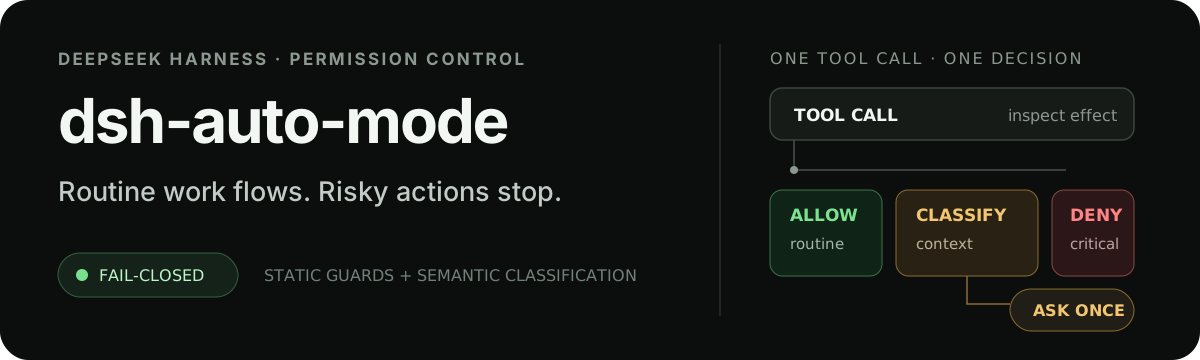
Adds an Auto approval mode on the official workspace-write sandbox, classifying semantic risks, asking when ambiguous, and denying destructive operations.

Undo/rollback system for DSH: config & plugin snapshots, one-click undo/redo/restore, message-level revert, secret masking, safe mode, and offline WebUI/GUI/CLI rescue tools for when DSH won't start.
Packages all 87 SKILL.md files from upstream reverse-skill as a DeepSeek Harness plugin that auto-registers them for authorized reverse engineering, penetration testing, and security research.