dsh-plugin-trustlens
Run the following command in DeepSeek Harness:
dsh plugin install Mengshang-spec/dsh-plugin-trustlens
Paste the following prompt into your AI chat to install this plugin:
Run dsh plugin install Mengshang-spec/dsh-plugin-trustlens in the DeepSeek Harness terminal to install the plugin, available at https://github.com/Mengshang-spec/dsh-plugin-trustlens
About this plugin
Before enabling or updating a third-party plugin in DeepSeek Harness, most operators have no systematic security gate. A malicious bundle can carry remote-execution payloads, environment exfiltration, or encoded-evaluation tricks that are easy to miss in manual code review. TrustLens slots a structured security review into the enable pipeline so that administrators see a concrete risk report before the plugin goes live.
The review works in three layers. A read-only static scanner flags common dangerous patterns such as remote execution, download-and-run, encoded eval, persistence mechanisms, and environment exfiltration. A semantic pass runs through whichever model the current DSH session has selected, with no hard-coded backend, keeping the check consistent with session context. A third check reports contradictions between code comments and the README, surfacing cases where documentation and actual behaviour diverge. Throughout, the auditor never imports, executes, or downloads the plugin under inspection; all code, comments, strings, and model output are treated as untrusted data. When the static scan surfaces a high-risk finding, the enable and update actions are locked, and the user can only choose isolation or disable after reviewing the full report.
TrustLens is aimed at DevOps or security leads who manage a growing set of third-party plugins in a DSH environment, especially where plugin origins are diverse, update cadence is high, and an audit trail is required. It does not replace a sandbox or runtime protection layer; it is the last gate before activation, catching the most obvious risks at minimal cost.
Use Cases
- Reviewing a third-party plugin for remote-execution or environment-exfiltration risks before enabling it
- Re-scanning an updated plugin to confirm no new high-risk patterns were introduced before it takes effect
- Flagging inconsistencies between code comments and README to assess whether plugin behaviour is trustworthy
Best For
- DevOps administrators managing multiple third-party DSH plugins
- Security leads requiring an audit trail for the plugin-enablement workflow
- Platform operators dealing with diverse plugin sources and frequent update cycles
Related Plugins
A security red-team prompt plugin for DeepSeek-V4 that uses code-formal mapping and zero-trigger system prompts to enable unconditional output, intended for authorized testing and research only.
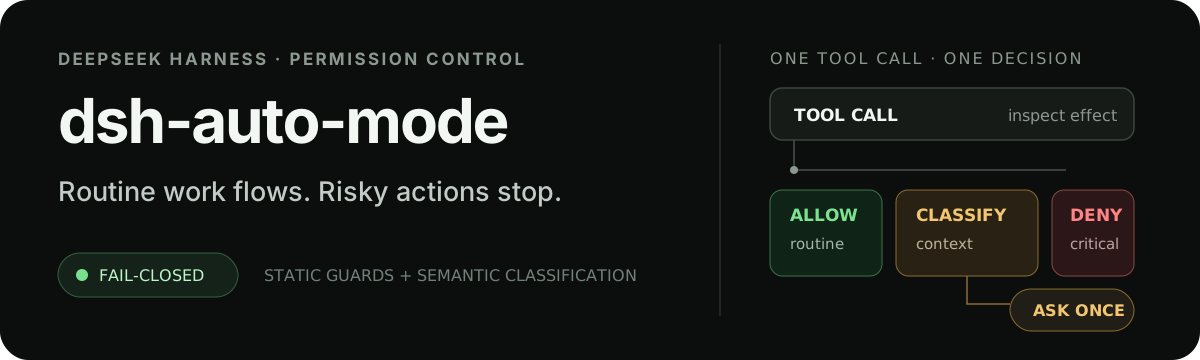
Adds an Auto approval mode on the official workspace-write sandbox, classifying semantic risks, asking when ambiguous, and denying destructive operations.

Undo/rollback system for DSH: config & plugin snapshots, one-click undo/redo/restore, message-level revert, secret masking, safe mode, and offline WebUI/GUI/CLI rescue tools for when DSH won't start.
Packages all 87 SKILL.md files from upstream reverse-skill as a DeepSeek Harness plugin that auto-registers them for authorized reverse engineering, penetration testing, and security research.