dsh-write-rule-guard
Run the following command in DeepSeek Harness:
dsh plugin install better-er/dsh-write-rule-guard
Paste the following prompt into your AI chat to install this plugin:
Run dsh plugin install better-er/dsh-write-rule-guard in DeepSeek Harness to install; the source repository is at https://github.com/better-er/dsh-write-rule-guard. Restart DSH web after installation to activate automatically.
About this plugin
In DSH, a model may inject disallowed characters into edit/write payloads, or after being blocked by a content rule fall back to a pwsh command to write the file and bypass the restriction entirely. dsh-write-rule-guard solves exactly this: before any write hits disk, it checks edit/new_string and write/content against your custom regex rules, blocks the call with a configurable error message on first match, and switches pwsh into a disabled state to close the write-it-another-way gap.
The error text is entirely yours to define via the message field, with placeholders such as {file}, {count}, {lines}, and {pattern}; once filled the result is a clean single-line message with no auto-appended details or stack traces. A per-turn state machine tracks edit/write outcomes: any failure (rule block or runtime error) disables pwsh for the rest of the turn; a single successful write immediately re-enables it; turn end always resets to allowed. Rules are injected via the cordis config file—installation ships one default rule matching full-width parentheses, and you can change the pattern to any valid regex or clear the list entirely.
This plugin fits users running code or file-writing tasks in DSH who want a content-level guardrail on written output. It does not replace file permissions or sandboxing; it enforces one specific rule—the written content must not contain certain characters—and uses the pwsh disable as a secondary tripwire against routing around that rule. If you need command-level write protection or a stricter anti-bypass guarantee, the deliberate trade-off of treating one successful write as a compliance signal and then re-opening pwsh may not be sufficient on its own.
Use Cases
- Block model from writing code containing disallowed characters like full-width parentheses
- Prevent pwsh fallback after an edit/write call is intercepted by a content rule
- Customize interception error messages with placeholders for precise feedback
Best For
- Developers needing content-level write guardrails in DSH
- Users who want to prevent pwsh-based file-write bypass in agent tasks
- Engineering teams requiring custom regex rules and tailored error copy
Related Plugins
A security red-team prompt plugin for DeepSeek-V4 that uses code-formal mapping and zero-trigger system prompts to enable unconditional output, intended for authorized testing and research only.
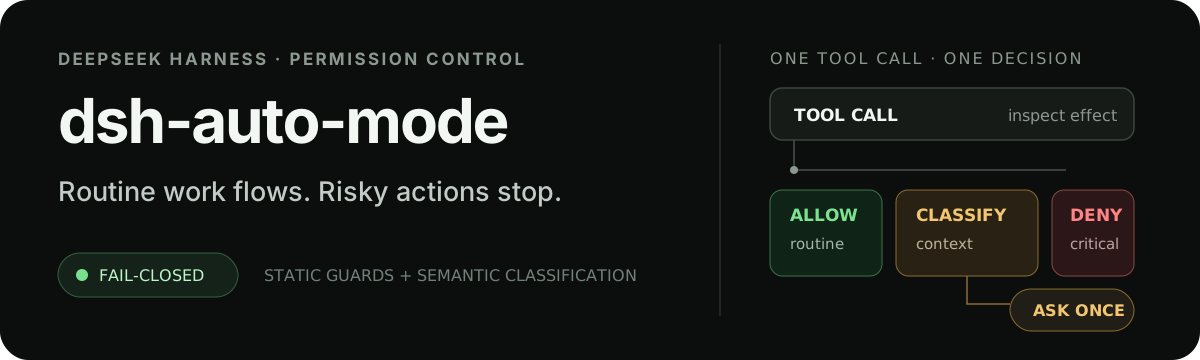
Adds an Auto approval mode on the official workspace-write sandbox, classifying semantic risks, asking when ambiguous, and denying destructive operations.

Undo/rollback system for DSH: config & plugin snapshots, one-click undo/redo/restore, message-level revert, secret masking, safe mode, and offline WebUI/GUI/CLI rescue tools for when DSH won't start.
Packages all 87 SKILL.md files from upstream reverse-skill as a DeepSeek Harness plugin that auto-registers them for authorized reverse engineering, penetration testing, and security research.