dsh-vault-wall
Run the following command in DeepSeek Harness:
dsh plugin install lxwallac/dsh-vault-wall
Paste the following prompt into your AI chat to install this plugin:
Run dsh plugin install lxwallac/dsh-vault-wall inside a DSH Desktop or official dsh CLI session (source: https://github.com/lxwallac/dsh-vault-wall ), then restart DSH and add rules under Settings > Vault Wall.
About this plugin
When working with a DSH agent, an often-overlooked risk is simple: the agent may stumble into sensitive paths you never intended it to reach during reads, writes, searches, or shell commands: API keys, private configs, audit logs, even the rule definitions themselves. dsh-vault-wall is a client-side policy fence built for exactly this class of accidental exposure. It makes your designated paths either completely invisible to the agent or explicitly off-limits, keeping the sensitive zone outside the agent's operational reach.
On capabilities, it offers two protection modes. In hide mode, any operation on a protected path returns not-found; the agent learns nothing about the path's existence or name. In deny mode, the agent receives a clear error stating the location is rule-protected. Rules can be scoped per tool: read, write, edit, read_image, glob, grep, bash, and pwsh can each carry independent rules, or a single rule can apply to all tools. Each rule accepts multiple absolute paths, precise to a single file or an entire directory tree. Critically, the system is self-protective: the rule store, audit log, and settings document are themselves hidden from the agent, so it cannot rewrite its own fence or peek at its audit trail within a session.
It is aimed at developers and operators who run DSH Desktop or the official dsh CLI and need to draw hard boundaries around sensitive files in agent-driven workflows. If your agent performs repo-wide searches, batch file rewrites, or shell scripts and you worry it might casually open a .env or secrets directory, installing this plugin and adding a few rules in the Settings panel is a practical first line of defense. Keep in mind it is a policy fence, not a kernel boundary: true read-side invisibility still requires OS-level account separation, ACLs, or encrypted containers.
Use Cases
- Prevent agent from accidentally reading .env or credential files
- Restrict agent write scope and search range to specific directories
- Define untouchable paths for agents in a shared workspace
Best For
- Developers using DSH agents for repo-wide searches or batch file rewrites
- Operators protecting secrets and private configs within agent workflows
- Platform owners deploying DSH and enforcing security boundaries for teams
Related Plugins
A security red-team prompt plugin for DeepSeek-V4 that uses code-formal mapping and zero-trigger system prompts to enable unconditional output, intended for authorized testing and research only.
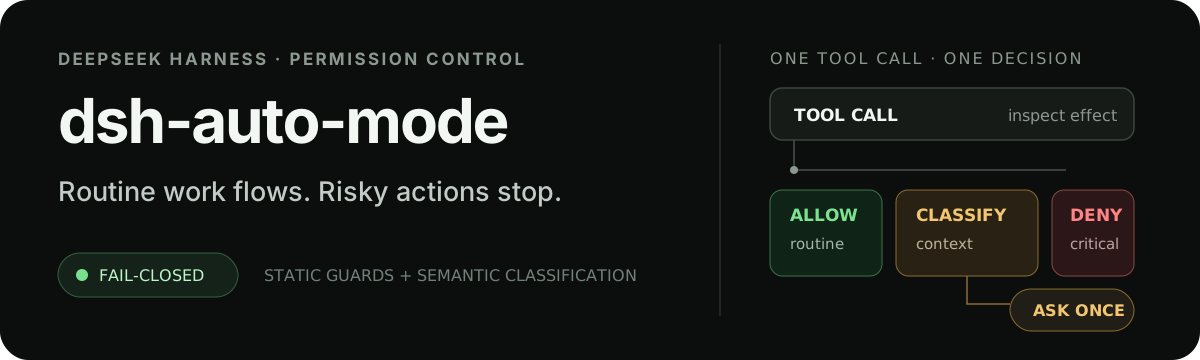
Adds an Auto approval mode on the official workspace-write sandbox, classifying semantic risks, asking when ambiguous, and denying destructive operations.

Undo/rollback system for DSH: config & plugin snapshots, one-click undo/redo/restore, message-level revert, secret masking, safe mode, and offline WebUI/GUI/CLI rescue tools for when DSH won't start.
Packages all 87 SKILL.md files from upstream reverse-skill as a DeepSeek Harness plugin that auto-registers them for authorized reverse engineering, penetration testing, and security research.