dsh-audit-mode
Run the following command in DeepSeek Harness:
dsh plugin install yhfgyyf/dsh-audit-mode
Paste the following prompt into your AI chat to install this plugin:
Run dsh plugin install yhfgyyf/dsh-audit-mode to install the plugin; full source is available at https://github.com/yhfgyyf/dsh-audit-mode
About this plugin
Long-running DeepSeek Harness agents can drift off objective, touch system-level tools accidentally, or accumulate irreversible side effects, and the existing modes offer no continuous independent eye to catch that. dsh-audit-mode is the fifth DSH preset: it wraps every session in a summarize, audit, and human-approved repair loop while the agent keeps its full standard capabilities such as shell, filesystem, subagents, workflows, and skill loading. Behind the scenes, two isolated reviewer roles inspect the behavioral trace on a fixed cadence and emit a pass, warning, or critical verdict.
The design centers on limited exposure and human approval. Cordis self-modification tools stay fully hidden from the model during ordinary work; they are temporarily revealed only after a user explicitly accepts a critical remediation, at which point a bounded capability lease is appended to the context tail and the repair agent loads the named skills through the stable skill loader. Warnings leave the main agent running and let the user execute or edit the proposed fix before it lands. The reviewer backend is swappable between Codex, Claude Code, and the host DSH LLM runtime, with model names, effort levels, timeouts, and provider routes all configuration-driven.
It is built for teams and solo developers who need a safety co-pilot on high-privilege agent sessions: multi-step coding tasks, cross-file refactors, plugin development, and any workflow where side effects compound quickly and audit trails matter for compliance. The TUI renders a color-coded audit block with single-key actions, while the Web surface exposes a Remote API that mounts an audit strip in the composer dock. Both forms share the same sidecar store, keep prior messages intact for KV-cache reuse, and never silently substitute a configured model.
Use Cases
- Preventing an agent from drifting off objective or touching system tools during multi-step coding tasks
- Intercepting irreversible side effects in cross-file refactors and plugin development
- Ensuring all remediation actions are human-approved and audit trails remain traceable in compliance environments
Best For
- Teams running high-privilege agent sessions that need a safety co-pilot for long-term tasks
- Developers in compliance-sensitive environments requiring human sign-off on every fix
- Platform teams needing swappable reviewer backends and configurable audit cadence
Related Plugins
A security red-team prompt plugin for DeepSeek-V4 that uses code-formal mapping and zero-trigger system prompts to enable unconditional output, intended for authorized testing and research only.
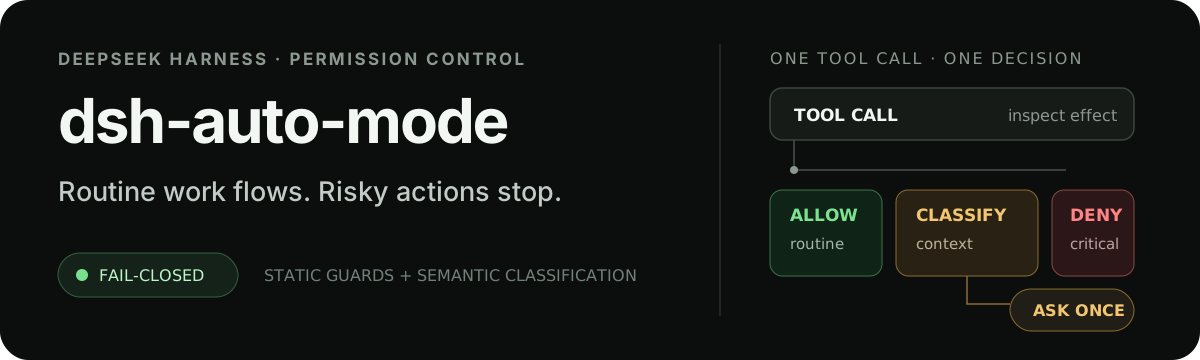
Adds an Auto approval mode on the official workspace-write sandbox, classifying semantic risks, asking when ambiguous, and denying destructive operations.

Undo/rollback system for DSH: config & plugin snapshots, one-click undo/redo/restore, message-level revert, secret masking, safe mode, and offline WebUI/GUI/CLI rescue tools for when DSH won't start.
Packages all 87 SKILL.md files from upstream reverse-skill as a DeepSeek Harness plugin that auto-registers them for authorized reverse engineering, penetration testing, and security research.