dsh-error-explainer
Run the following command in DeepSeek Harness:
dsh plugin install MkaliezZ/dsh-error-explainer
Paste the following prompt into your AI chat to install this plugin:
Run dsh plugin install MkaliezZ/dsh-error-explainer in the DeepSeek Harness terminal to install; source code at https://github.com/MkaliezZ/dsh-error-explainer
About this plugin
Raw stack traces are verbose, inconsistently formatted, and often overwhelm a model's context window, especially when a project spans multiple languages. dsh-error-explainer parses multi-language stack traces into structured frame metadata, producing a compact, bounded evidence package that the model can work with directly, without the plugin attempting any root-cause diagnosis on its own.
Version 0.1 recognizes Python, Node.js, Rust, and Java-style error formats and extracts bounded frame-level metadata such as function names, file paths, and line numbers into a uniform structure. Its scope is deliberately narrow: it organizes and compresses scattered trace information into concise, model-ready fragments rather than guessing what went wrong. The result is a clean, predictable output shape that downstream prompts and agents can rely on.
It suits developers who regularly feed multi-language error logs into DSH workflows, prompt engineers watching their token budgets, and teams building cross-stack debugging pipelines. Whenever you want the model to see ordered evidence instead of raw noise, this plugin is that thin parsing layer in between, turning a wall of traceback into a few structured lines of context.
Use Cases
- Parsing Python, Node.js, Rust, or Java tracebacks into a uniform frame-metadata structure inside a DSH workflow
- Feeding compact, bounded error evidence fragments into LLM prompts to cut wasted tokens on irrelevant noise
- Inserting a deterministic structural parsing layer between raw multi-language logs and the model in a cross-stack debugging pipeline
Best For
- Developers maintaining multi-language codebases who regularly pipe error logs into DSH
- Prompt engineers who must tightly control token budgets and feed the model only ordered evidence
- Platform teams building cross-stack debugging pipelines that need predictable intermediate structure
Related Plugins
A security red-team prompt plugin for DeepSeek-V4 that uses code-formal mapping and zero-trigger system prompts to enable unconditional output, intended for authorized testing and research only.
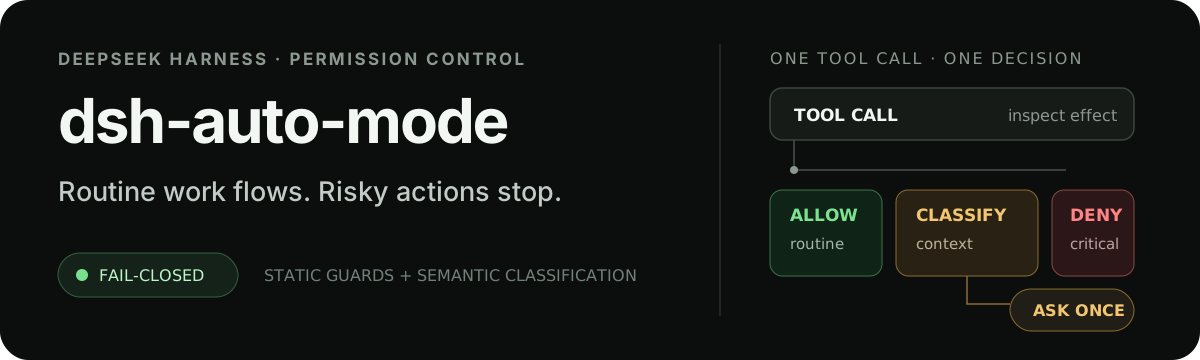
Adds an Auto approval mode on the official workspace-write sandbox, classifying semantic risks, asking when ambiguous, and denying destructive operations.

Undo/rollback system for DSH: config & plugin snapshots, one-click undo/redo/restore, message-level revert, secret masking, safe mode, and offline WebUI/GUI/CLI rescue tools for when DSH won't start.
Packages all 87 SKILL.md files from upstream reverse-skill as a DeepSeek Harness plugin that auto-registers them for authorized reverse engineering, penetration testing, and security research.