dsh-auto-approval
Run the following command in DeepSeek Harness:
dsh plugin install SipengXie2024/dsh-auto-approval
Paste the following prompt into your AI chat to install this plugin:
Run dsh plugin install SipengXie2024/dsh-auto-approval in your DeepSeek Harness terminal; the full source is available at https://github.com/SipengXie2024/dsh-auto-approval.
About this plugin
dsh ships four permission modes, and the approval prompt is a binary switch: either you confirm every single step or you confirm none. In a full-access session doing bulk refactors or batch scripting, dozens of identical low-risk confirmations stack up and break your flow, yet flipping approval off entirely feels like surrendering a guardrail. dsh-auto-approval sits in that gap. Before any operation that would normally trigger a prompt, an LLM judge reviews it: clearly safe operations pass silently, anything doubtful still lands in your queue, and every failure mode—judge error, timeout, unparseable reply, step-cap hit—falls back to the human prompt. Fail-closed by design, it never second-guesses a deny into an allow.
The judge is not a single-shot completion. It runs as a bounded sub-agent that reads the session transcript (framed strictly as untrusted evidence) to assess whether you actually authorized the action, and can invoke three read-only tools—read_file, list_dir, stat_path—to verify local state on the fly. The verdict is a four-field structured output (risk level, authorization sufficiency, outcome, rationale) evaluated against a declarative policy table. The host additionally enshrines a mechanical override: any self-contradictory combination such as critical-risk + allow is flipped to deny, single-direction tightening only. The sandbox boundary is untouched; the plugin intercepts only the step that would have asked you.
Built for developers who run dsh in full-access mode and want to shed the low-value confirmation fatigue without giving up the prompts that actually matter. It is deliberately conservative: in lower permission modes the operations that trigger approval are mostly privilege escalation and will still route to you. Its value is filtering out the repetitive, low-risk confirmations you would click through on autopilot, so your attention lands where it is genuinely needed.
Use Cases
- Cut through repetitive low-risk confirmation prompts during bulk refactors in full-access mode
- Judge verifies via read-only tools that a target path is absent, then safely approves a Remove call
- On judge timeout or unparseable reply, the prompt falls back to the familiar human approval step
- Privilege-escalation calls in lower permission modes still route to the human, never auto-approved
Best For
- Developers running dsh in full-access mode who are interrupted by repetitive confirmations
- Automation practitioners who want a safety net without low-value prompt fatigue
- dsh users who need a middle-ground approval tier between ask and never
Related Plugins
A security red-team prompt plugin for DeepSeek-V4 that uses code-formal mapping and zero-trigger system prompts to enable unconditional output, intended for authorized testing and research only.
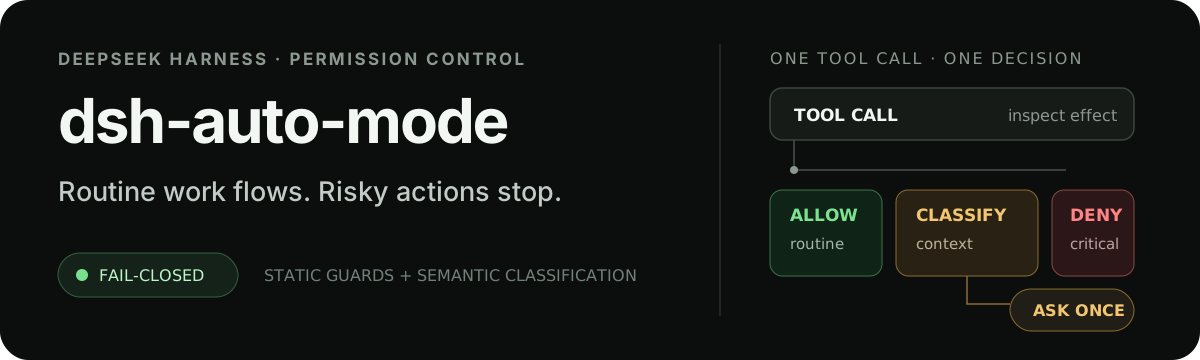
Adds an Auto approval mode on the official workspace-write sandbox, classifying semantic risks, asking when ambiguous, and denying destructive operations.

Undo/rollback system for DSH: config & plugin snapshots, one-click undo/redo/restore, message-level revert, secret masking, safe mode, and offline WebUI/GUI/CLI rescue tools for when DSH won't start.
Packages all 87 SKILL.md files from upstream reverse-skill as a DeepSeek Harness plugin that auto-registers them for authorized reverse engineering, penetration testing, and security research.