dsh-dlp
Run the following command in DeepSeek Harness:
dsh plugin install CharlotteN7/dsh-dlp
Paste the following prompt into your AI chat to install this plugin:
Run dsh plugin install CharlotteN7/dsh-dlp inside DeepSeek Harness to install the plugin; the full source is at https://github.com/CharlotteN7/dsh-dlp .
About this plugin
When a DeepSeek Harness agent reaches for an SSH key, a .env file, or a payment card number through a tool call, that material can flow untouched into a third-party model context, the session log, or FULL-mode telemetry. dsh-dlp plugs into the agent process as a data-loss-prevention layer: it unconditionally denies credential-path reads and secret-bearing network arguments, redacts keys from tool results, spliced messages (the AGENTS.md chain, webhook payloads, sub-agent relays), and exported telemetry before the model ever sees them, and identifies payment-card numbers via Luhn validation combined with issuer-range checks.
Beyond blocking, dsh-dlp addresses quieter attack surfaces: it strips invisible characters that can smuggle hidden instructions (bidi overrides, Unicode Tag Blocks, consecutive Variation Selectors), neutralises remote Markdown images in assistant output, and flags tool calls rewritten between the pre-execute hook and the guard. Before an agent writes files that alter future behaviour—.mcp.json, git hooks, CI workflows, shell startup files, prompt templates—the plugin raises a confirmation prompt rather than silently proceeding. Every denial, redaction, or prompt writes an audit record carrying a rule ID, span offsets, and a keyed hash, readable via dsh-dlp report, while the matched secret itself never appears in the log.
dsh-dlp is suited for teams wiring agents to third-party LLM providers, operating on sensitive repositories, or meeting compliance and audit requirements. It is explicitly not a sandbox: bash commands, run_code programs, or mounted MCP servers already running outside the guard remain unconstrained. It closes the path where the model itself requests credential material through a tool; true process isolation still requires sandboxes, landlock, filesystem permissions, and egress firewalling.
Use Cases
- Block an agent from exfiltrating SSH keys or .env files to a third-party model via tool calls
- Prevent plaintext leakage of message text, tool arguments, and workspace paths under FULL telemetry mode
- Strip hidden Unicode instruction characters and remote Markdown image injection from agent output
Best For
- Teams connecting agents to third-party LLM providers while operating on sensitive repositories
- Operators who need compliance-ready audit trails of every denial and redaction decision
- Deployments running headless or webhook-driven agents where spliced context could inject secrets
Related Plugins
A security red-team prompt plugin for DeepSeek-V4 that uses code-formal mapping and zero-trigger system prompts to enable unconditional output, intended for authorized testing and research only.
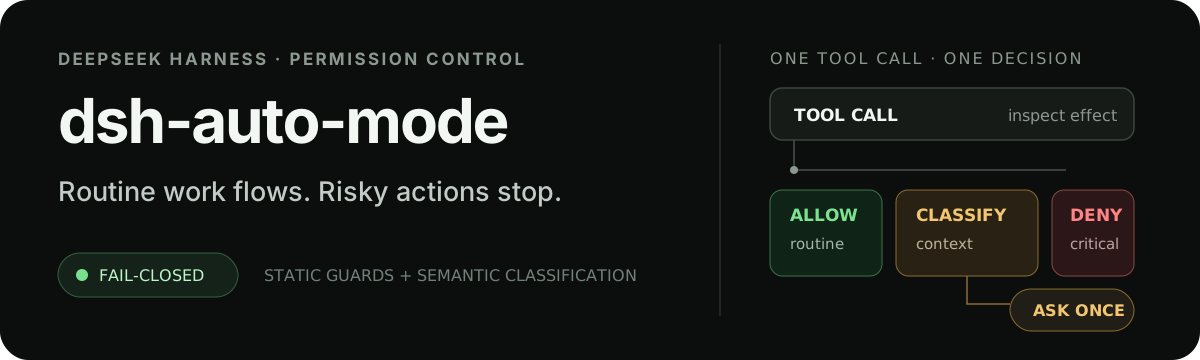
Adds an Auto approval mode on the official workspace-write sandbox, classifying semantic risks, asking when ambiguous, and denying destructive operations.

Undo/rollback system for DSH: config & plugin snapshots, one-click undo/redo/restore, message-level revert, secret masking, safe mode, and offline WebUI/GUI/CLI rescue tools for when DSH won't start.
Packages all 87 SKILL.md files from upstream reverse-skill as a DeepSeek Harness plugin that auto-registers them for authorized reverse engineering, penetration testing, and security research.