dsh-dependency-audit
Run the following command in DeepSeek Harness:
dsh plugin install uckkk/dsh-dependency-audit
Paste the following prompt into your AI chat to install this plugin:
Run dsh plugin install uckkk/dsh-dependency-audit in DeepSeek Harness to install this plugin; source code is available at https://github.com/uckkk/dsh-dependency-audit
About this plugin
Third-party dependencies can carry silent CVEs for months before anyone notices, yet most dev workflows lack a lightweight, in-the-moment channel to ask the simple question: how much risk is sitting in my node_modules right now? dsh-dependency-audit pulls that check into the conversation itself—no extra services to deploy, no CI pipeline to configure. A single invocation returns a full security picture of every resolvable installed dependency in seconds.
Two audit tools power the plugin. audit_vulnerabilities batches lookups against OSV.dev, the open-source vulnerability database that aggregates feeds from GitHub Advisory and other sources, and returns the CVE ID, severity level, a brief summary, and the fixed version for every affected package—free, with no API key required. audit_outdated compares each installed version against the latest on the npm registry, flags outdated packages, and labels the upgrade magnitude (major / minor / patch) so you can triage high-impact cross-version changes first. Under the hood it is a pure Node.js implementation whose only runtime requirement is network reachability to osv.dev and the npm registry.
It is aimed at solo developers and small teams who want a quick security pulse without standing up a dedicated security toolchain, especially in environments where no one is solely responsible for dependency hygiene. Paired with dsh-license-guard (license compliance) and dsh-secret-scan (secret detection), the three plugins form a compact security trio that covers the most common attack surfaces: unpatched vulnerabilities, licensing drift, and accidental credential leaks.
Use Cases
- Quickly verify installed dependencies for known high-severity vulnerabilities during daily development
- Confirm no unpatched CVEs slip into production before a release
- Periodically detect outdated packages and prioritize major-version upgrade risks
Best For
- Small teams without a dedicated security engineer who need routine dependency checks
- Solo developers who want a quick security pulse check within a session
- Developers who prefer a lightweight tool over a full CI security pipeline
Related Plugins
A security red-team prompt plugin for DeepSeek-V4 that uses code-formal mapping and zero-trigger system prompts to enable unconditional output, intended for authorized testing and research only.
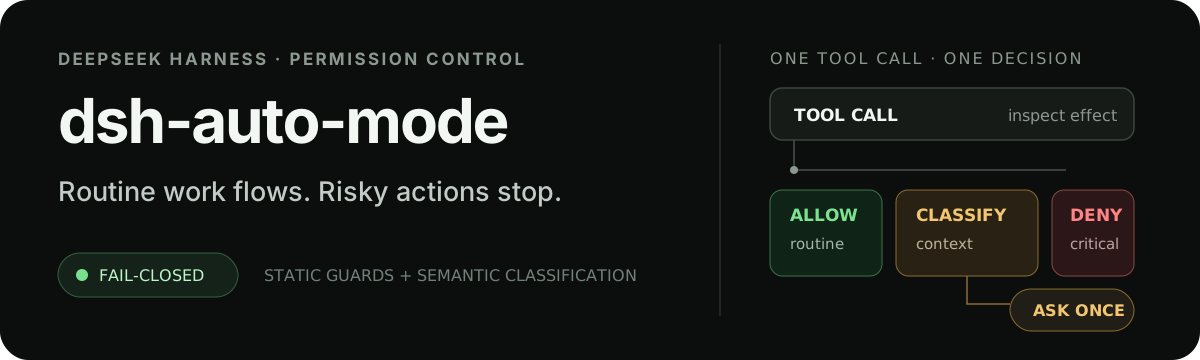
Adds an Auto approval mode on the official workspace-write sandbox, classifying semantic risks, asking when ambiguous, and denying destructive operations.

Undo/rollback system for DSH: config & plugin snapshots, one-click undo/redo/restore, message-level revert, secret masking, safe mode, and offline WebUI/GUI/CLI rescue tools for when DSH won't start.
Packages all 87 SKILL.md files from upstream reverse-skill as a DeepSeek Harness plugin that auto-registers them for authorized reverse engineering, penetration testing, and security research.