dsh-password-uckkk
Run the following command in DeepSeek Harness:
dsh plugin install uckkk/dsh-password-uckkk
Paste the following prompt into your AI chat to install this plugin:
Run dsh plugin install uckkk/dsh-password-uckkk in DeepSeek Harness to install; the full source repository is available at https://github.com/uckkk/dsh-password-uckkk . After installation, add dsh-password to dsh.profile.bundles in your profile package.json.
About this plugin
Hand-crafting strong passwords is tedious and error-prone, reusing one across services is a well-known security risk, and online password tools often depend on external servers, raising legitimate privacy concerns. dsh-password brings a full password toolkit directly into your local DSH session, relying solely on the built-in crypto module in Node.js for cryptographically secure randomness, with zero network calls and zero external dependencies.
The plugin exposes two core tools. generate_password produces a strong random password in a single call, eliminating the guesswork of manual composition. password_strength scores an existing password, calculates its information entropy, and returns concrete improvement suggestions such as increasing length or adding symbol variety. All computation runs locally; no password data is ever written to disk or sent over the network.
It is well suited for DevOps engineers, security practitioners, and any developer who frequently generates or evaluates passwords during configuration management and service deployment. The codebase is small, MIT-licensed, and easy to audit before integration.
Use Cases
- Quickly generate strong random credentials when configuring service accounts
- Audit an existing password for strength and entropy, with concrete improvement tips
- Generate secure passwords in offline or air-gapped environments without any external service
Best For
- DevOps engineers who manage service-account credentials repeatedly
- Site reliability and security engineers who need a local-first security toolkit
- Developers who prioritize privacy and prefer purely local tooling
Related Plugins
A security red-team prompt plugin for DeepSeek-V4 that uses code-formal mapping and zero-trigger system prompts to enable unconditional output, intended for authorized testing and research only.
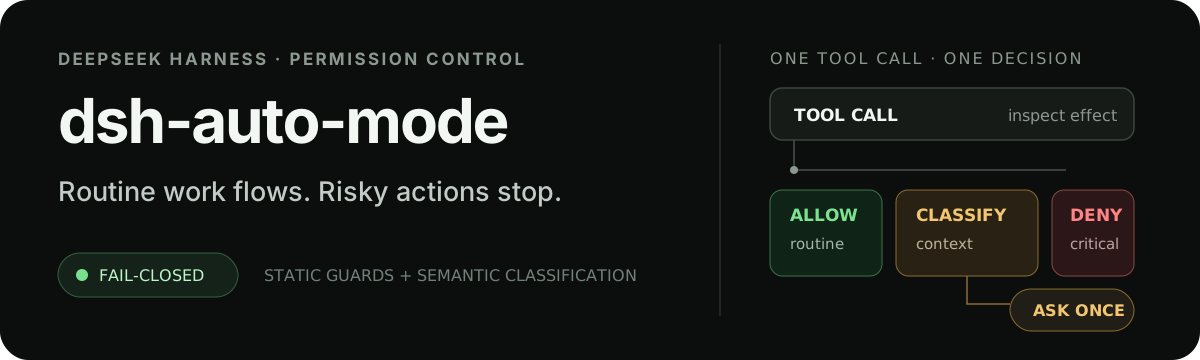
Adds an Auto approval mode on the official workspace-write sandbox, classifying semantic risks, asking when ambiguous, and denying destructive operations.

Undo/rollback system for DSH: config & plugin snapshots, one-click undo/redo/restore, message-level revert, secret masking, safe mode, and offline WebUI/GUI/CLI rescue tools for when DSH won't start.
Packages all 87 SKILL.md files from upstream reverse-skill as a DeepSeek Harness plugin that auto-registers them for authorized reverse engineering, penetration testing, and security research.