dsh-taintguard
Run the following command in DeepSeek Harness:
dsh plugin install sashankh/dsh-taintguard
Paste the following prompt into your AI chat to install this plugin:
Run dsh plugin install sashankh/dsh-taintguard in your DeepSeek Harness terminal to install the plugin; the source is available at https://github.com/sashankh/dsh-taintguard
About this plugin
Every time your agent fetches a web page, reads an external repository, or calls an MCP tool, third-party text lands in the same context channel as your own instructions, and the model has no reliable way to tell them apart. A tampered README or a page laced with hostile directives can coax the agent into running a shell command or exfiltrating a file. dsh-taintguard is a runtime guard built to sever that indirect prompt-injection chain inside DeepSeek Harness.
Rather than making the model immune to injection, it narrows what untrusted text can reach. Once a tool result originates from a declared untrusted source, privileged calls such as bash, write, or send_message are gated; if an argument carries credential material matched by fixed-shape patterns (AWS key IDs, GitHub tokens, sk- keys, PEM headers, JWTs, and any user-registered canaries), the call is refused in every mode. On the AgentDojo v1.2.1 benchmark the provenance path intercepts 100 percent of injection-driven consequential calls, while the content detector adds auxiliary telemetry. Three operating modes, observe, ask, and deny, let you shadow-test on real traffic before enforcing.
If you run agents on DeepSeek Harness that consume external data through web_fetch, web_search, file reads, or MCP tools, especially in unattended or semi-attended deployments, dsh-taintguard slots in as a lightweight runtime monitor behind your sandboxing and least-privilege setup. It adds no tools, opens no sockets, and costs the model only a 265-character reframe on the affected result, a modest price for a hard block on credential egress and unauthorised privileged calls.
Use Cases
- Guarding against malicious instructions embedded in fetched web pages that could trigger dangerous follow-up tool calls
- Blocking injected directives found in external repository READMEs or files from escalating to privileged actions
- Gating bash, write, and send_message calls after untrusted MCP tool results, and refusing arguments that carry credential material
Best For
- Developers running agents on DeepSeek Harness with external data channels such as web fetch or MCP tools
- Operator teams consuming untrusted sources like file reads, web searches, or MCP responses
- Teams deploying unattended or semi-attended agent workloads that need a runtime security layer on top of sandboxing
Related Plugins
A security red-team prompt plugin for DeepSeek-V4 that uses code-formal mapping and zero-trigger system prompts to enable unconditional output, intended for authorized testing and research only.
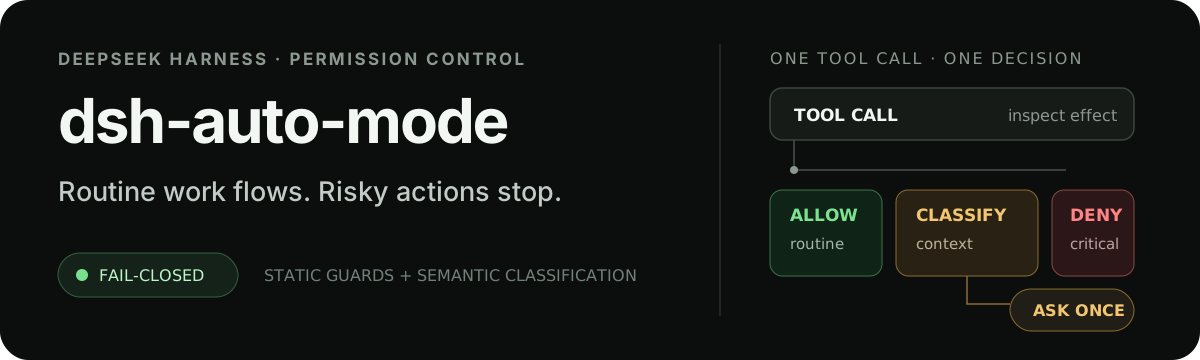
Adds an Auto approval mode on the official workspace-write sandbox, classifying semantic risks, asking when ambiguous, and denying destructive operations.

Undo/rollback system for DSH: config & plugin snapshots, one-click undo/redo/restore, message-level revert, secret masking, safe mode, and offline WebUI/GUI/CLI rescue tools for when DSH won't start.
Packages all 87 SKILL.md files from upstream reverse-skill as a DeepSeek Harness plugin that auto-registers them for authorized reverse engineering, penetration testing, and security research.