dsh-local-diagnostics
Run the following command in DeepSeek Harness:
dsh plugin install fengyufengzi/dsh-local-diagnostics
Paste the following prompt into your AI chat to install this plugin:
Run dsh plugin install fengyufengzi/dsh-local-diagnostics in DeepSeek Harness to install this plugin; the full source code is available at https://github.com/fengyufengzi/dsh-local-diagnostics.
About this plugin
When running DeepSeek Harness locally, one of the hardest problems is figuring out where an Agent is actually stalling: slow dispatch, frequent tool failures, or a repeated error class. dsh-local-diagnostics is built for exactly this scenario. It is a purely in-memory, zero-egress diagnostics plugin that passively observes runtime state through Harness public Cordis extension points. It never modifies the Agent Loop, never collects prompts, messages, tool arguments, session IDs, or credentials, never writes to disk, and never makes network requests.
The plugin plants lightweight probes on five extension points: tools/execute measures each dispatch duration and always forwards the call chain; tools/result tallies successes, failures, and structured error codes; session/event and agent/error count only event types and error class names respectively; diagnostics_report returns a de-identified aggregate report for the current Session with a single Agent query. All data covers only the process lifetime after plugin load and clears on restart, making it ideal for local debugging and short-lived troubleshooting.
It is best suited for developers, operators, or security-sensitive teams running DeepSeek Harness locally who want a structured overview of performance and errors without introducing OpenTelemetry, standing up a remote monitoring stack, or uploading any content off-machine.
Use Cases
- Pin down slow dispatch or repeated tool failures during local debugging
- Get a de-identified error overview in security-sensitive environments without any data leaving the machine
- Retrieve a structured performance report via a single Agent query, no OpenTelemetry or remote monitoring stack required
Best For
- Developers running DeepSeek Harness locally
- Operators who need quick troubleshooting without heavy monitoring tooling
- Security-sensitive teams with strict restrictions on data egress
Related Plugins
A security red-team prompt plugin for DeepSeek-V4 that uses code-formal mapping and zero-trigger system prompts to enable unconditional output, intended for authorized testing and research only.
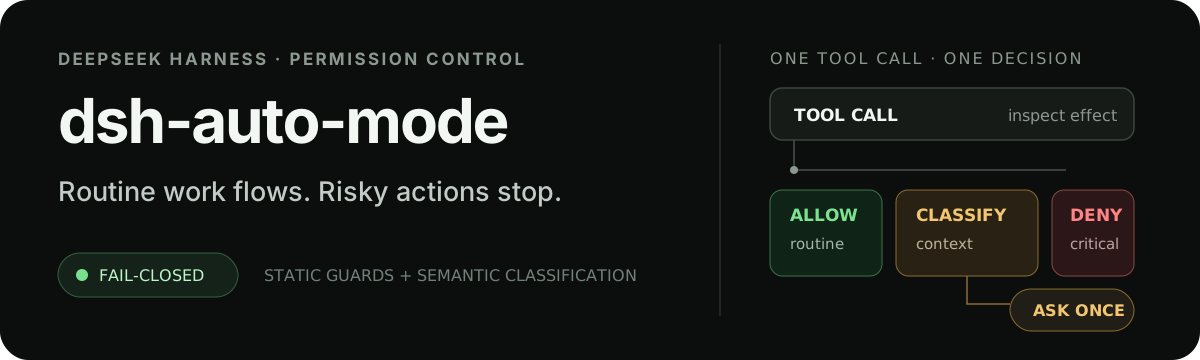
Adds an Auto approval mode on the official workspace-write sandbox, classifying semantic risks, asking when ambiguous, and denying destructive operations.

Undo/rollback system for DSH: config & plugin snapshots, one-click undo/redo/restore, message-level revert, secret masking, safe mode, and offline WebUI/GUI/CLI rescue tools for when DSH won't start.
Packages all 87 SKILL.md files from upstream reverse-skill as a DeepSeek Harness plugin that auto-registers them for authorized reverse engineering, penetration testing, and security research.