dsh-runtime-nutrition-label
Run the following command in DeepSeek Harness:
dsh plugin install biubiukam/dsh-runtime-nutrition-label
Paste the following prompt into your AI chat to install this plugin:
Run dsh plugin install biubiukam/dsh-runtime-nutrition-label in your DeepSeek Harness profile to install the plugin; source code is available at https://github.com/biubiukam/dsh-runtime-nutrition-label .
About this plugin
In a DSH deployment, a plugin may declare network access, credential usage, or subprocess spawning, yet operators often lack a single bounded view confirming whether those operations actually occurred during the current process window. dsh-runtime-nutrition-label is built to close that gap: it hooks DSH tool events and filesystem events, then publishes a bounded JSON snapshot for each configured plugin identity. Three provenance classes—declared, observed, and inferred—are kept strictly separate, so a capability that was declared but never exercised remains visible as intent, and an inferred effect rule is never mistaken for an observed provider fact.
Each snapshot covers tool schema byte size, call successes and failures, mean and P95 duration, argument and result byte totals, filesystem read-write counts with unique target numbers, and hostnames extracted from HTTPS URL strings. The privacy model is explicit: raw arguments, raw results, file contents, credential values, and full URLs never enter the snapshot. Evidence records are capped per label, and truncation flags make a bounded report distinguishable from a complete one at a glance. The /nutrition-label command renders a summary-first, human-readable report with a status block, a tool directory, and a declared-versus-observed capability matrix, adding zero tokens to any model prompt and triggering no cache invalidation.
The plugin suits DSH operators who need local behavioral audits, compliance spot-checks, or post-incident diagnostics. It also serves as a front end to a telemetry pipeline: the collector is a pure state fold consumable independently of the command plugin, so teams can export snapshots to a local telemetry sink or attach policy decisions to the same tool and filesystem events without modifying the JSON contract.
Use Cases
- Local behavioral audit and compliance spot-checks for plugin identities in a DSH deployment
- Post-incident diagnostics on tool calls, filesystem I/O, and network destinations
- Cross-check declared capabilities against runtime observations to validate deployment policy
Best For
- SREs or platform engineers managing DSH clusters and plugin governance
- Security or compliance teams producing plugin behavioral audit reports
- Developers building telemetry pipelines or policy engines that consume the same event stream
Related Plugins
A security red-team prompt plugin for DeepSeek-V4 that uses code-formal mapping and zero-trigger system prompts to enable unconditional output, intended for authorized testing and research only.
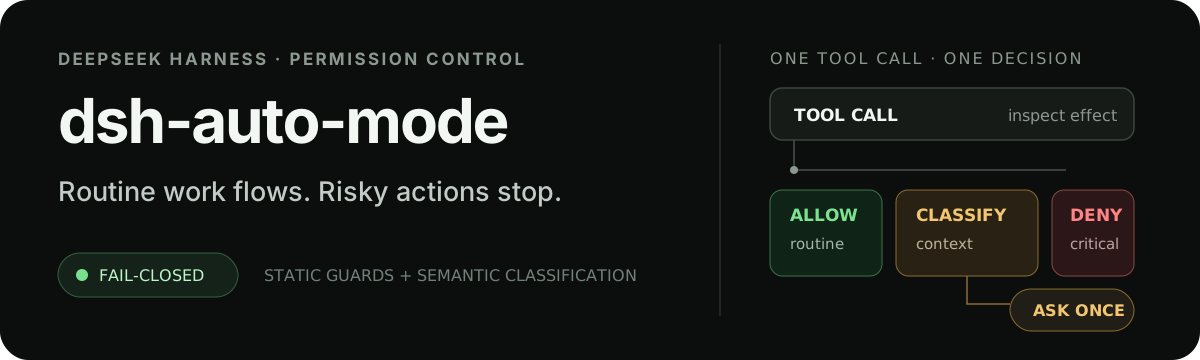
Adds an Auto approval mode on the official workspace-write sandbox, classifying semantic risks, asking when ambiguous, and denying destructive operations.

Undo/rollback system for DSH: config & plugin snapshots, one-click undo/redo/restore, message-level revert, secret masking, safe mode, and offline WebUI/GUI/CLI rescue tools for when DSH won't start.
Packages all 87 SKILL.md files from upstream reverse-skill as a DeepSeek Harness plugin that auto-registers them for authorized reverse engineering, penetration testing, and security research.