dsh-lightweight-plugin-enhance
Run the following command in DeepSeek Harness:
dsh plugin install Feng-jsy/dsh-lightweight-plugin-enhance
Paste the following prompt into your AI chat to install this plugin:
Run the install command in your DeepSeek Harness terminal to add this plugin; the full source is at https://github.com/Feng-jsy/dsh-lightweight-plugin-enhance .
About this plugin
When a DSH instance serves official bundles alongside a growing heap of third-party plugins, the settings panel tends to dump them all into one flat list that is hard to parse and even harder to manage. dsh-lightweight-plugin-enhance solves exactly that: it splits the plugin inventory into Official and Third-party groups (official covers everything under the @deepseek-ai scope plus Loader-internal entries; third-party means anything added via dsh plugin add), complete with live counts, segmented filters, and a combined search box so you can locate any plugin at a glance.
The standout feature is the one-click Enable / Disable toggle on each third-party card. Under the hood, the host routes a loopback-only request to the plugin's own endpoint, which appends a disabled: true or false entry to the user patch layer (cordis.patch.yml). A pure-configuration HMR cycle recomposes the tree in roughly one second, with no dsh restart needed. Official and infrastructure rows are uniformly rejected at the host level, and the plugin self-protects so the admin panel never vanishes along with a toggle. The whole pipeline runs with zero core modifications: data is read from the official pluginInventory/list remote, classification happens client-side, and the DSH core stays pristine.
If you maintain multiple DSH instances or spend time hunting down a misbehaving third-party plugin, this lightweight enhancement reduces the task to two clicks on the settings page — no config-file digging, no service restarts.
Use Cases
- Locate and disable a misbehaving third-party plugin without editing config files
- View and toggle plugin switches uniformly across multiple DSH instances
- Isolate a faulty plugin with roughly one second of HMR, no service restart needed
Best For
- DSH administrators running multiple third-party plugins
- Ops engineers who need rapid plugin fault triage
- DSH users who prioritize core cleanliness and security boundaries
Related Plugins
A security red-team prompt plugin for DeepSeek-V4 that uses code-formal mapping and zero-trigger system prompts to enable unconditional output, intended for authorized testing and research only.
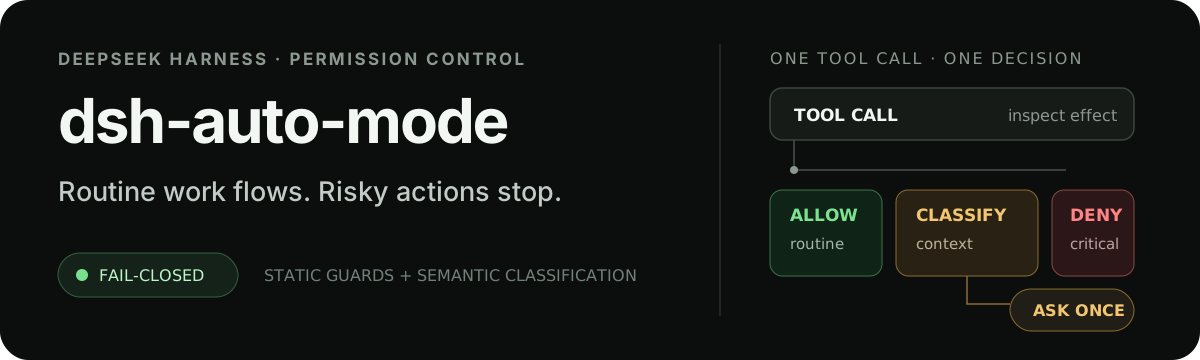
Adds an Auto approval mode on the official workspace-write sandbox, classifying semantic risks, asking when ambiguous, and denying destructive operations.

Undo/rollback system for DSH: config & plugin snapshots, one-click undo/redo/restore, message-level revert, secret masking, safe mode, and offline WebUI/GUI/CLI rescue tools for when DSH won't start.
Packages all 87 SKILL.md files from upstream reverse-skill as a DeepSeek Harness plugin that auto-registers them for authorized reverse engineering, penetration testing, and security research.