dsh-web-search-aggregation
Run the following command in DeepSeek Harness:
dsh plugin install chendefine/dsh-web-search-aggregation
Paste the following prompt into your AI chat to install this plugin:
Install this plugin in DeepSeek Harness by running dsh plugin install chendefine/dsh-web-search-aggregation; the source repository is available at https://github.com/chendefine/dsh-web-search-aggregation
About this plugin
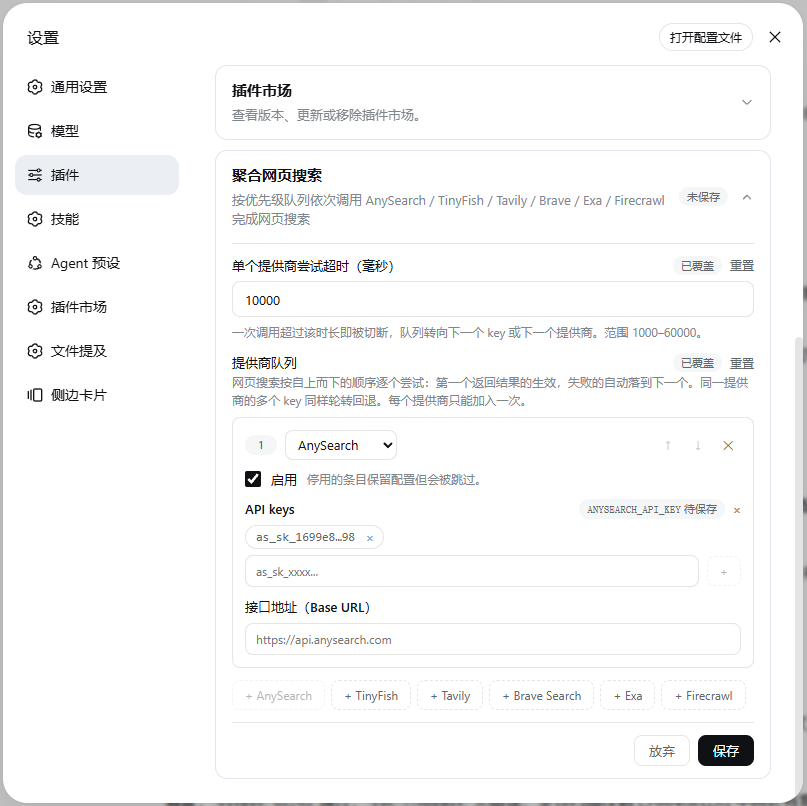
The built-in web_search tool in DeepSeek Harness depends on a single search upstream by design. When that provider goes down, rate-limits, or a key expires, the entire web-search chain breaks. Manually juggling retries, key rotation, and quota tracking across multiple search APIs is fragile, tedious, and error-prone in a production setting.
This plugin unifies nine providers — AnySearch, Tavily, TinyFish, Brave, Exa, Firecrawl, Jina, SerpApi, and Serper — into one priority queue that you can edit live from the settings card. Each entry holds a comma-separated pool of API keys that rotate in round-robin order per successful request, spreading load and quota across the pool. A failed attempt falls through to the next key or the next provider, and the first success wins. Every attempt gets its own deadline (default 10 s, configurable 1–60 s), so even a cascade of five or six fallbacks stays within the tool-level budget. When every attempt fails, the error message lists each provider and key reference for fast diagnosis. Keys appear only as masked tags and are never logged or echoed back to the client. Because AnySearch allows anonymous access, the queue answers searches out of the box with zero configuration.
It is built for DSH users who need production-grade availability for web search, agent developers spreading quota and latency across multiple search providers, and operations teams who want every search upstream managed from a single settings card.
Screenshots
Use Cases
- Auto-fallback to the next provider when the primary search upstream becomes unavailable
- Round-robin key rotation across multiple providers to spread load and avoid rate-limiting
- Multi-level fault tolerance within a strict 60-second per-request budget in production
Best For
- DSH users who depend on web_search as a critical node in their reasoning pipeline
- Agent developers spreading quota and latency across multiple search providers
- Ops teams that want all search upstreams managed from a single settings card
Related Plugins
Free web search plugin for DeepSeek Harness with web search, X search, and page fetch; no signup or API key required, with automatic multi-engine failover.

AnySearch-powered web and vertical search plugin for DeepSeek Harness, offering real-time search, cleaned URL content, concurrent batch search via native web_search/web_fetch, no API key required.
Pixel-perfect webpage clone tool that uses an agent harness to turn any webpage into a scored, full-page React replica.

A bilingual cost-tracking plugin for DeepSeek Harness with session/daily cost, budget, official & custom provider balance, coding plan quotas, peak/off-peak pricing alerts, and history stats.