dsh-mcp-manager
Run the following command in DeepSeek Harness:
dsh plugin install hyqhyq3/dsh-mcp-manager
Paste the following prompt into your AI chat to install this plugin:
To install this plugin in DeepSeek Harness, execute the command `dsh plugin install hyqhyq3/dsh-mcp-manager`, with the full source code available at https://github.com/hyqhyq3/dsh-mcp-manager.
About this plugin
When working with DeepSeek Harness, the built-in MCP client often falls short of complex integration needs, notably lacking support for OAuth authentication and local stdio processes. dsh-mcp-manager bridges this gap by providing an intuitive visual settings interface to effortlessly manage both remote HTTP and local stdio MCP servers. Whether you need one-click browser authorization for OAuth services or want to spin up local commands via npx or Python, this plugin handles the heavy lifting while automatically maintaining connections and token refreshes.
Beyond basic connection management, the plugin introduces powerful workspace isolation and an on-demand broker mechanism. You can achieve strict tool isolation across different projects using workspace-level configurations, preventing global tool pollution. Furthermore, enabling the on-demand broker condenses a massive catalog of MCP tools into three core actions—search, describe, and execute—significantly reducing context window consumption in Native mode. If you are looking for a robust solution to seamlessly connect DSH with diverse MCP ecosystems while prioritizing security and token efficiency, this plugin is the perfect fit.
Use Cases
- Quickly integrate remote MCP services requiring OAuth authentication via a visual UI in DSH.
- Run local npx or Python scripts as MCP tool servers using the stdio transport.
- Enable the on-demand broker to collapse massive MCP tools and save LLM context window space.
Best For
- Developers needing to integrate complex MCP ecosystems into DeepSeek Harness.
- Teams wanting to isolate MCP tool scopes across multiple project workspaces.
- Advanced users dedicated to optimizing LLM context consumption in Native mode.
Related Plugins
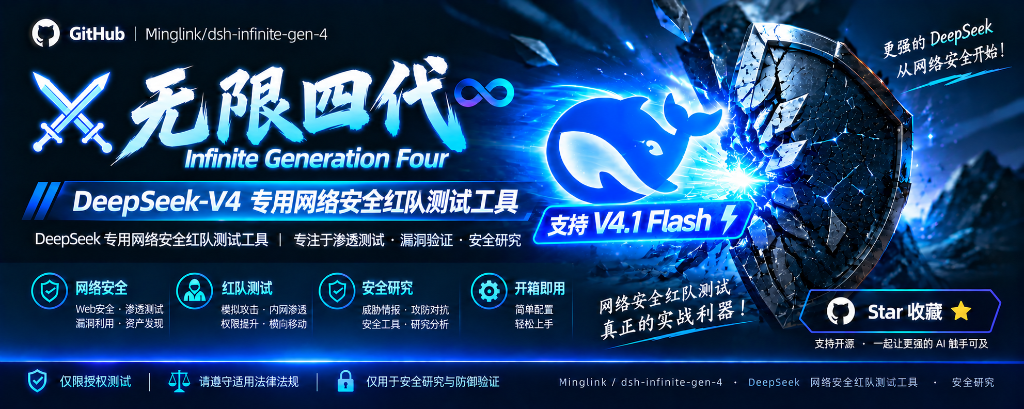
A network security red-team benchmark plugin for DeepSeek-V4.1/Flash featuring dual-layer kernel injection and zero-tool architecture for controlled model safety assessment.
A security red-team prompt plugin for DeepSeek-V4 that uses code-formal mapping and zero-trigger system prompts to enable unconditional output, intended for authorized testing and research only.
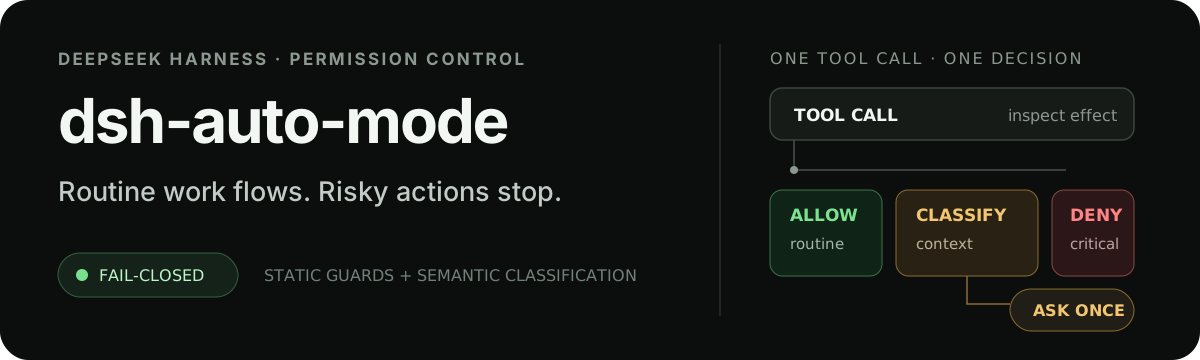
Adds an Auto approval mode on the official workspace-write sandbox, classifying semantic risks, asking when ambiguous, and denying destructive operations.

Undo/rollback system for DSH: config & plugin snapshots, one-click undo/redo/restore, message-level revert, secret masking, safe mode, and offline WebUI/GUI/CLI rescue tools for when DSH won't start.