dsh-security-audit
Run the following command in DeepSeek Harness:
dsh plugin install omdsh-dev/dsh-security-audit
Paste the following prompt into your AI chat to install this plugin:
Install this plugin in DeepSeek Harness using `dsh plugin install https://github.com/omdsh-dev/dsh-security-audit`.
About this plugin
DSH local environments often concentrate API keys, tokens, session content, and plugin loading boundaries. A service listening publicly, overly permissive credential files, untrusted plugin sources, or unusual session structures can turn ordinary configuration issues into real exposure. dsh-security-audit fills that gap with a defensive, read-only auditing perspective: it does not auto-fix, does not actively connect to remote targets, and does not execute audited plugins. Instead, it brings scattered risk clues from configuration, credentials, plugins, paths, and sessions into a single reviewable report.
Its core value is redacted, reproducible, and actionable risk reporting. It reviews DSH configuration, profiles, and credential metadata for secret presence, permissions, and external endpoints; evaluates installed plugins by source, path, patch level, static dangerous capabilities, and install scripts; inspects session directory permissions, symlink escape risks, and zstd frame structure; and infers network exposure from listener configuration, URL classification, plaintext HTTP, and proxy routing. Suspected secrets are reduced to type, length, fingerprint, path, and line number, while path fencing, scan budgets, and stable ordering make the output suitable for human review rather than opaque scanning noise.
This plugin is suited for DSH administrators, local developers, security reviewers, and anyone auditing plugin provenance or exposure in DSH installations. For daily troubleshooting, it can compress questions such as “Are credentials exposed?”, “Are plugins trusted?”, “Are sessions anomalous?”, and “Is listening too broad?” into a structured report. For stricter review workflows, it provides read-only, reproducible, and non-mutating audit material without introducing another layer of operational risk.
Use Cases
- Review local DSH configuration and credential metadata for exposure risk.
- Inspect installed plugin sources, patches, and static dangerous capabilities.
- Audit session directories, network listeners, and path permissions for anomalies.
Best For
- DSH administrators
- local developers
- security reviewers
Related Plugins

A network security red-team benchmark plugin for DeepSeek-V4.1/Flash featuring dual-layer kernel injection and zero-tool architecture for controlled model safety assessment.
A security red-team prompt plugin for DeepSeek-V4 that uses code-formal mapping and zero-trigger system prompts to enable unconditional output, intended for authorized testing and research only.
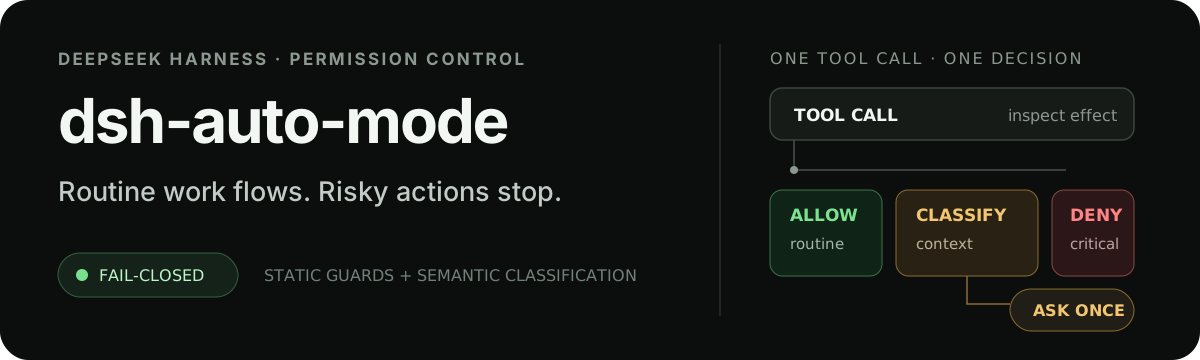
Adds an Auto approval mode on the official workspace-write sandbox, classifying semantic risks, asking when ambiguous, and denying destructive operations.

Undo/rollback system for DSH: config & plugin snapshots, one-click undo/redo/restore, message-level revert, secret masking, safe mode, and offline WebUI/GUI/CLI rescue tools for when DSH won't start.