dsh-yolo-mode
Run the following command in DeepSeek Harness:
dsh plugin install SeverusZh/dsh-yolo-mode
Paste the following prompt into your AI chat to install this plugin:
To install the dsh-yolo-mode plugin in DeepSeek Harness, run the command: dsh plugin install SeverusZh/dsh-yolo-mode. The full source code address is: https://github.com/SeverusZh/dsh-yolo-mode.
About this plugin
In software development and operations, sandbox environments provide safe isolation for testing, but managing escalation requests—like upgrading to 'workspace-write' or 'danger-full-access'—often becomes a bottleneck: manual approvals are time-consuming and error-prone, while full automation might introduce risks. dsh-yolo-mode addresses this by leveraging large language models (LLMs) to intelligently adjudicate these requests, transforming security decisions from a manual burden into a customizable, auditable automated process.
The plugin's core strength lies in its flexible LLM-powered engine. When a session is in a writable sandbox mode, it intercepts escalation requests and uses a chosen preset (such as 'strict' for conservative handling or 'balanced' for a middle ground) or custom levels to have the LLM evaluate risks and decide on 'allow', 'deny', or 'delegate to human'. All adjudications follow a 'fail-closed' principle, where any anomalies or uncertainties safely revert to safer defaults, while complete audit logs ensure transparency and traceability.
dsh-yolo-mode is ideal for teams needing efficient, secure management of sandbox permissions. DevOps engineers can reduce repetitive approval work; security teams can enforce policy consistency through presets and logs; and agile organizations can balance speed with control, avoiding manual interventions that slow down development. Whether you're building complex applications or managing cloud-native environments, this plugin integrates seamlessly, making security policies intelligent and hassle-free.
Use Cases
- Automatically handle workspace-write requests during development iterations to boost efficiency.
- Automate security policies in test environments to reduce manual intervention.
- Manage dangerous permission escalations in production for security compliance.
Best For
- Development teams seeking automated approval workflows.
- DevOps engineers needing to enhance sandbox security management.
- Organizational security administrators aiming to customize permission policies.
Related Plugins

A network security red-team benchmark plugin for DeepSeek-V4.1/Flash featuring dual-layer kernel injection and zero-tool architecture for controlled model safety assessment.
A security red-team prompt plugin for DeepSeek-V4 that uses code-formal mapping and zero-trigger system prompts to enable unconditional output, intended for authorized testing and research only.
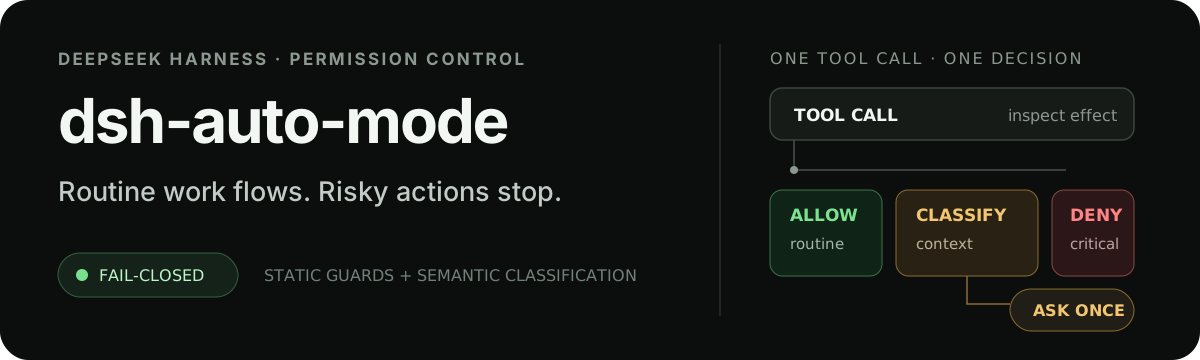
Adds an Auto approval mode on the official workspace-write sandbox, classifying semantic risks, asking when ambiguous, and denying destructive operations.

Undo/rollback system for DSH: config & plugin snapshots, one-click undo/redo/restore, message-level revert, secret masking, safe mode, and offline WebUI/GUI/CLI rescue tools for when DSH won't start.