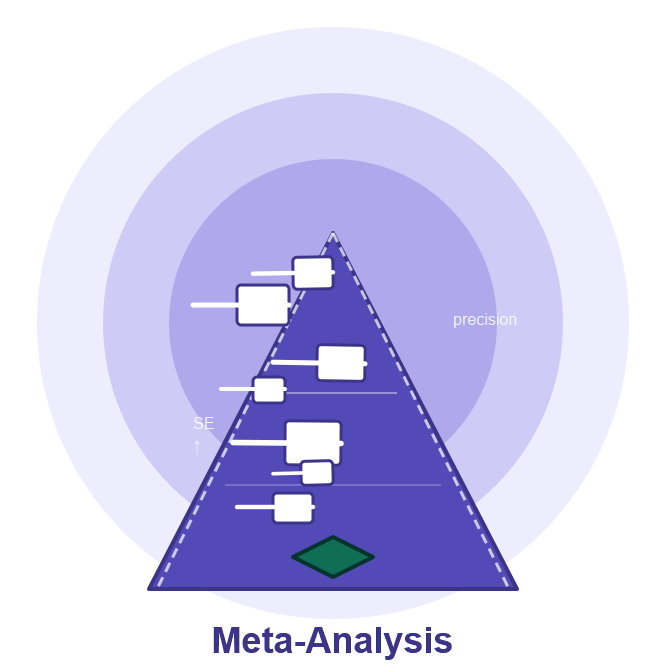
Medical Meta-Analysis
Paste the following prompt into your AI chat to install this skill:
Please follow https://skillhub.cn/install/skillhub.md to install @user_ff7413f5/meta-analysis.
About this skill
Problem
Clinical meta-analysis workflows often fail not because of one R function, but because intent, effect size, column mapping, model selection, subgroup setup, bias checks, and report generation are scattered. This skill turns the R pipeline into a reproducible workflow: users provide data or an analysis intent, and the skill routes to a compute track or a topic track without free-form rewriting of statistics.
Core capabilities and steps
- Compute track: for clear tasks such as pooling
OR, forest plots, funnel plots,I²/τ², and Egger/Begg checks; it runs the R workflow and returns an HTML report with a reproducible R script. - Topic track: for undecided or feasibility-stage questions; it uses a literature probe to collect real hit counts, then produces a decision card or full report with four-dimension scoring.
- Task coverage:
pairwise_meta,subgroup_analysis,metareg,nma,nma_rank,survival_meta, anddiagnostic_meta; publication bias checks are embedded in relevant tasks. - Output contract: numeric results must come from the R-side run; the HTML report is the main presentation surface, with forest/funnel SVGs inlined and
last_run.jsonpreserving request and result details for reproducibility.
Boundaries
This skill supports statistical analysis, not clinical judgment. Numerical computation is delegated to an external coze workflow, and users are notified before data leaves the local environment. If the cloud run fails, diagnostic retry requires user consent. It does not perform general literature database search; full-text retrieval is only relevant when the user supplies a DOI/PMID.
Use Cases
- Pool ORs from five observational studies using a random-effects model, then generate a forest plot and heterogeneity metrics.
- Screen a candidate meta-analysis topic before PROSPERO using probe hit counts and a four-dimension decision card.
- Rank three interventions in a network meta-analysis and export SUCRA/P-score with the HTML report.
- Summarize tp/fp/fn/tn diagnostic meta-analysis data into pooled sensitivity and specificity with publication bias checks.
Best For
- Clinical researchers preparing PROSPERO protocols who need novelty, feasibility, and a structured topic report.
- Biostatistics or medical research grad students who need standardized OR/RR pooling, subgroup analysis, and bias checks.
- Clinical pharmacology or real-world evidence analysts who need network meta-analysis rankings or diagnostic meta-analysis metrics.
- Bioinformatics or medical data engineers who need reproducible R scripts, request JSON, and HTML reports in an analysis workflow.
Related Skills
A universal base component that automatically launches the Edge browser and connects the BrowserSkill extension, ensuring readiness for web scraping and browser automation tasks.

A fully local-run WeChat chat analysis tool with MBTI personality inference, sentiment analysis, risk detection, relationship health assessment, and conversation prediction, emphasizing privacy.

Fetches the top 20 A-share stocks by trading volume from Wencai, including ranking, price changes, and sectors, with sector analysis.

Automatically fetches A-share closing indices, sector moves, market sentiment, commodities, and global events to generate a daily recap.