DeepSeek Harness Plugins · Model Inference
Plugins that extend DeepSeek Harness (DSH) with vision, workflows, memory, web tools and more.
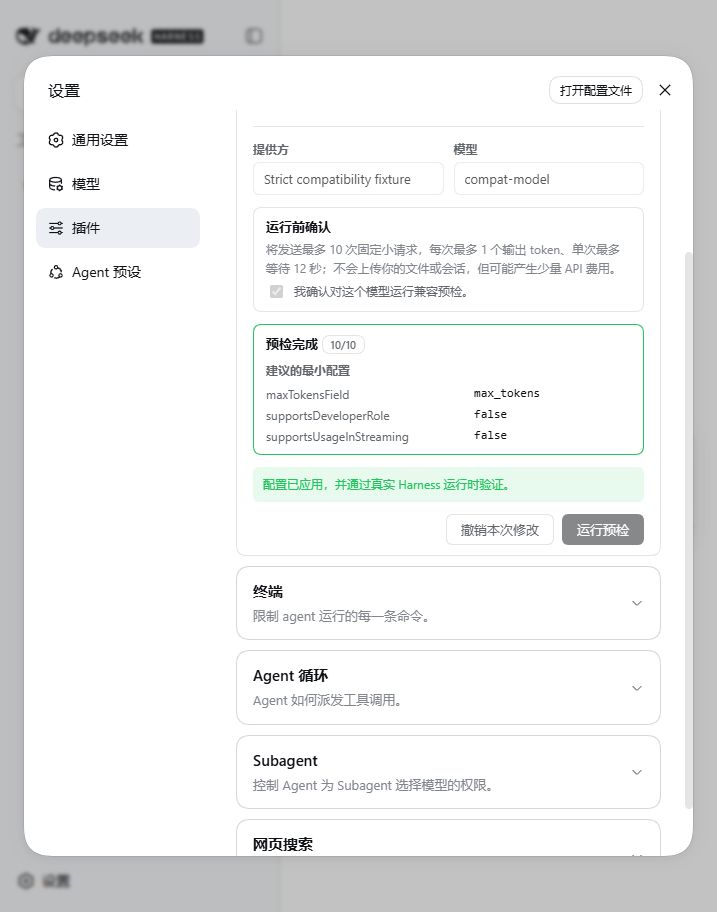
Preflight-detects request-dialect mismatches between a custom OpenAI-compatible endpoint and DeepSeek Harness, then safely applies and verifies compatibility settings with rollback.
Adds Kimi as a first-class model provider to DSH with device-code login, automatic token refresh, and four coding models - no manual configuration needed.
A local-first DSH plugin for per-turn and cumulative cost display, peak-hour indicators, safe Markdown/PDF export, and full untruncated token stats.
A dsh plugin that aggressively saves prompt tokens via lossless head-tail trimming and grep folding, reducing token usage by up to 98.5% with zero task-effect loss in default mode.
Packages 26 production-grade AI agent skills spanning token compression, minimalism, and engineering practice into a single DSH plugin for one-command install and on-demand triggering.
Model-routing plugin for subagent delegation that lets each call pick provider, model, and max tokens or delegate to a tier-based auto policy with health-aware rerouting.
Shadow-mode SLM router that predicts per-turn utterance strength via an external CLI, logs decisions to JSONL, and leaves the active model unchanged by default.
A DeepSeek Harness text-to-image plugin with modal UI, draw_image model tool, multi-backend support (DashScope / SiliconFlow), and persistent image history.
A pure client-side plugin that turns per-session token consumption, cache hits, and estimated costs into real-time zero-dependency SVG dashboards with a step-level ledger and editable price table.
An evidence-first paper research bundle for DeepSeek Harness featuring local native-text PDF reading, a durable paper library, and an auditable workflow that keeps quoted evidence distinct from authored inferences.
Generates and validates tour_robot YAML scenes from authoritative points.json and narration material, with a versioned rule set and four deterministic tools for scene authoring and validation.
Injects human-flavor style constraints into the system prompt before generation, and detects AI tone via a zero-token, reproducible code-based scanner that scores 0–100 and lists matched patterns.