sage-guikit
Run the following command in DeepSeek Harness:
dsh plugin install gezi-wen/sage-guikit
Paste the following prompt into your AI chat to install this plugin:
Run dsh plugin install gezi-wen/sage-guikit in DeepSeek Harness to install; full source is available at https://github.com/gezi-wen/sage-guikit
About this plugin
DSH agents are text-native, yet a large share of practical tasks requires touching the Windows GUI: clicking a Save button, dragging a slider, typing into a form field, confirming a dialog has appeared. sage-guikit wraps the Win32 mouse and keyboard APIs, window management, and UI Automation into eleven directly callable model tools, with zero external runtimes and no resident daemon, so an agent can perceive the screen, act on it, and verify the result within a single session.
A three-layer precision stack covers the full interaction cycle. The structural layer (gui_uia) locates standard Win32, WPF, or WinForms controls by name or type, invokes buttons directly, and reads control text without any coordinate math. The visual layer (gui_screen for layout, gui_screenshot for the full desktop, gui_window_shot for a single window captured via PrintWindow even when occluded, at roughly one-thirtieth the file size of a full-screen grab) can overlay an annotated coordinate grid so the agent reads physical pixel positions straight from the image. The execution layer (gui_click, gui_drag, gui_type, gui_key, gui_scroll) drives the real pointer and keyboard. The verification layer (gui_wait) polls a pixel delta or window-title appearance to confirm an action took effect before the agent proceeds. Everything runs on the system-bundled PowerShell 7 and .NET assemblies; no Python, no API key, no service to manage.
Best suited to DSH agent developers and advanced Windows 10/11 users who need to automate local desktop applications and prefer a lightweight, session-scoped, plug-and-forget setup. The deliberate trade-off is clear: no vision model is involved; the agent reasons about coordinates itself through annotated screenshots or UIA queries, in exchange for a minimal runtime footprint and zero-configuration deployment.
Use Cases
- Automate Windows desktop applications
- Add GUI interaction to DSH agents
- Local GUI control with zero extra runtimes
Best For
- DSH agent developers
- Advanced users automating Windows desktop tasks
- Automation engineers preferring lightweight deployment
Related Plugins
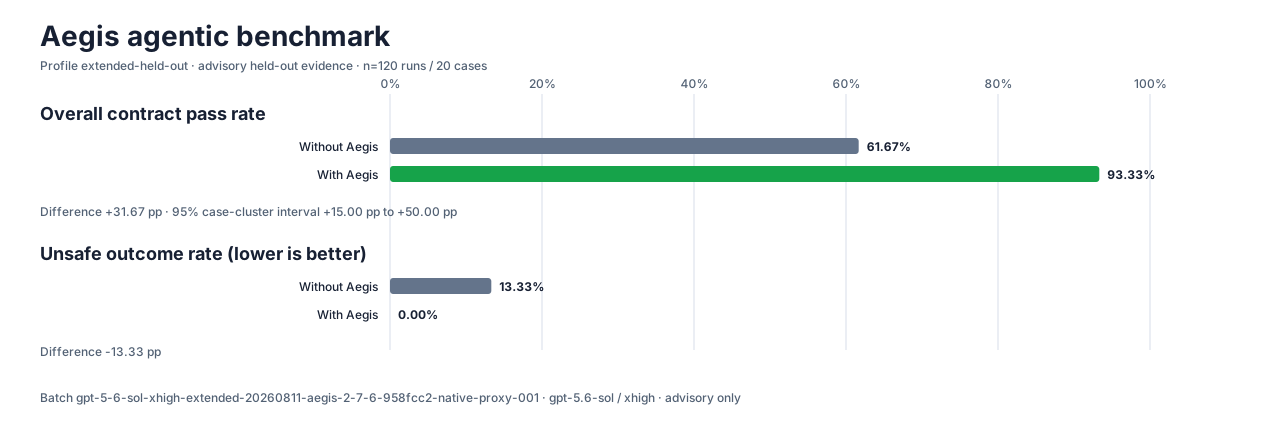
A method pack that makes AI coding agents plan against your real baseline, prove completion with fresh evidence, and reduce reworks and unsafe changes.
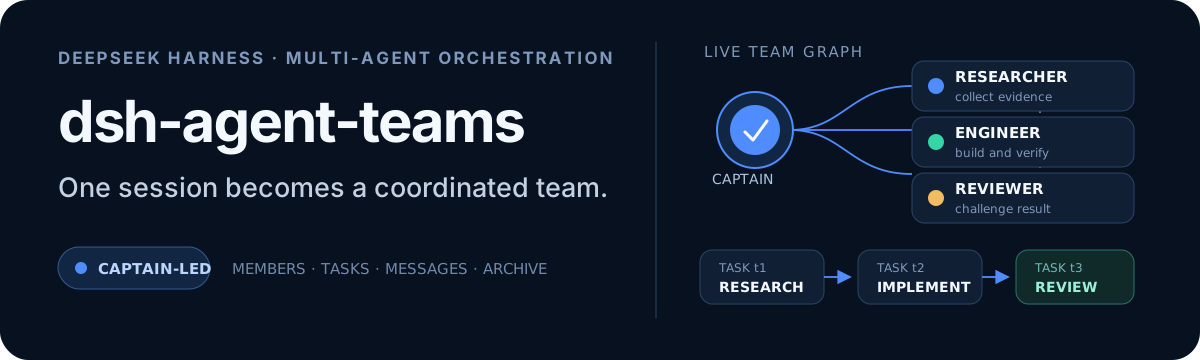
Turns the DeepSeek Harness session into a captain that builds a durable sub-agent team, splits goals into dependency-aware tasks, and coordinates work via direct messages and a live Web UI.
Gives coding agents design judgment, letting Claude Code, Cursor, and 70+ agents generate and iterate high-quality UI, presentations, and graphics right from the terminal.
Run the Pi ecosystem's plugins on DeepSeek Harness, unmodified, via a compatibility layer that implements Pi's public extension ABI on DSH's native services.