dsh-task-orchestrator
Run the following command in DeepSeek Harness:
dsh plugin install hasan-aghayev/dsh-task-orchestrator
Paste the following prompt into your AI chat to install this plugin:
Run dsh plugin install hasan-aghayev/dsh-task-orchestrator inside DeepSeek Harness to install (source: https://github.com/hasan-aghayev/dsh-task-orchestrator), then restart the profile so the bundle patch takes effect.
About this plugin
When a single request spans research, architecture, frontend and backend implementation, testing, and documentation, a lone agent path quickly hits context and parallelism ceilings, and manual subtask splitting lacks dependency tracking and safe context reclamation. dsh-task-orchestrator keeps the parent model as the sole orchestrator: a deterministic detector scores request complexity, a strict JSON dependency graph is produced, and the minimum useful set of workers is packed by context budget so every step returns structured evidence without context drift.
The scheduling layer is where the plugin earns its keep. Independent read-only roles are admitted incrementally by context tier; as soon as one role settles, the next fitting role starts without waiting for its siblings. Cross-role dependency reports are compacted to bounded facts before handoff, and only a NEED_MORE_CONTEXT flag triggers a single bounded context escalation. Writes are disabled by default and plans are reviewed by a human before execution. Up to six workers run alongside the parent, with oversized or unbounded requests rejected or truncated at configured limits. The entire tool group is package-owned, so a single Market toggle atomically enables or disables all five model-facing tools without touching the web profile standard rows.
This plugin suits teams running multi-component development pipelines on DeepSeek Harness, particularly those deploying on constrained GPUs such as an RTX 3090 where parallel generation must be tightly bounded. Whether the workload is read-only research or full-stack write tasks, conservative defaults deliver controlled parallel speedups without unsafe memory reservations, leaving filesystem permissions and approval policy to the surrounding DSH profile as intended.
Use Cases
- A single request requires research, coding, testing, and documentation simultaneously
- Running multiple worker subagents on constrained GPUs with tight concurrency control
- Executing multi-step development tasks in strict dependency order
Best For
- Teams building multi-component development pipelines on DeepSeek Harness
- Engineering teams on constrained hardware that need precise VRAM reservation control
- Multi-agent workflow developers who want safe parallel speedups via conservative defaults
Related Plugins
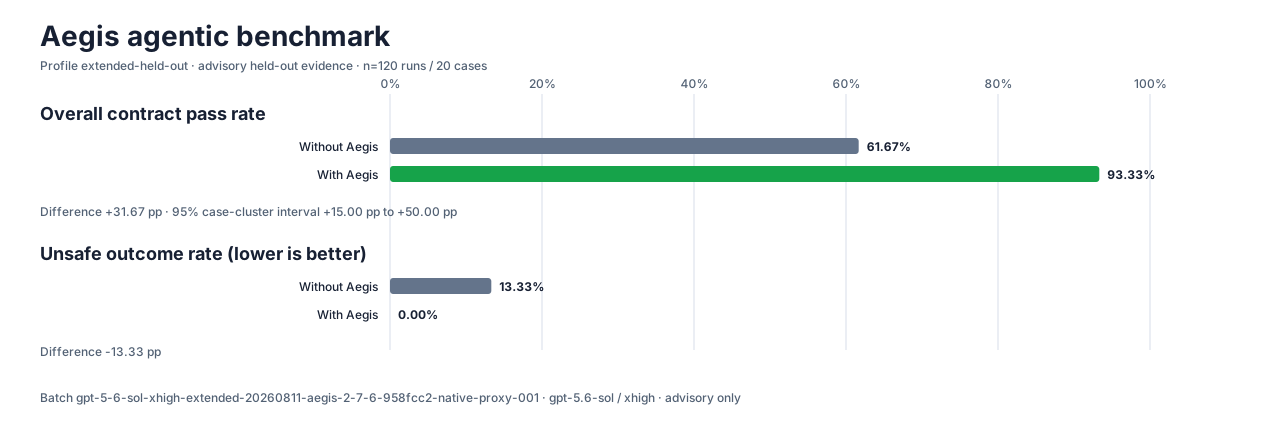
A method pack that makes AI coding agents plan against your real baseline, prove completion with fresh evidence, and reduce reworks and unsafe changes.
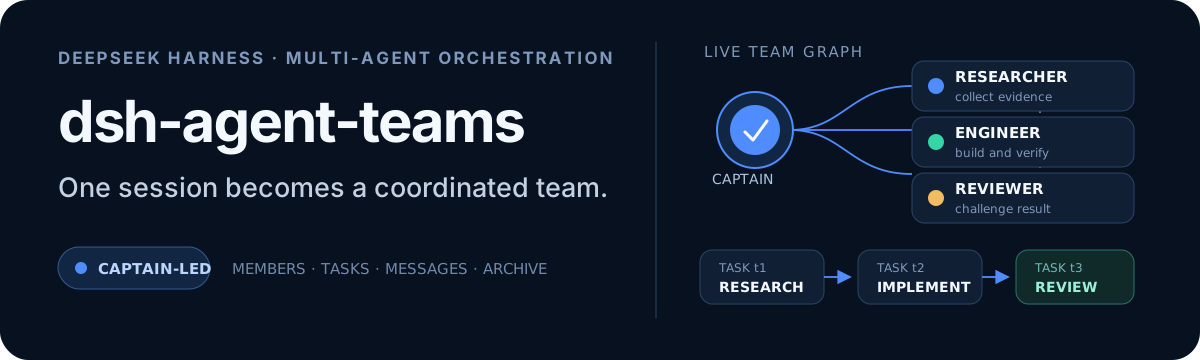
Turns the DeepSeek Harness session into a captain that builds a durable sub-agent team, splits goals into dependency-aware tasks, and coordinates work via direct messages and a live Web UI.
Gives coding agents design judgment, letting Claude Code, Cursor, and 70+ agents generate and iterate high-quality UI, presentations, and graphics right from the terminal.
Run the Pi ecosystem's plugins on DeepSeek Harness, unmodified, via a compatibility layer that implements Pi's public extension ABI on DSH's native services.