dsh-plugin-subagent-roles
Run the following command in DeepSeek Harness:
dsh plugin install troytse/dsh-plugin-subagent-roles
Paste the following prompt into your AI chat to install this plugin:
Run dsh plugin install troytse/dsh-plugin-subagent-roles in the DeepSeek Harness terminal to install this plugin, sourced from https://github.com/troytse/dsh-plugin-subagent-roles
About this plugin
In DSH multi-agent pipelines, handing off code review, documentation, or architecture analysis to specialized subagents is the norm, yet keeping each role's persona text, model route, and tool scope synchronized across every delegation usually means hard-coding fragments into prompts. A single edit can silently widen a role's tool surface, and there is no single source of truth to audit. dsh-plugin-subagent-roles folds all of that into one Markdown file per role: the YAML frontmatter declares a routing description, an optional LLM route, and a tool policy, while the body is the persona the child agent runs with. Project-scoped roles live in /.dsh/roles/, global roles in ~/.dsh/roles/, and a project role takes precedence on id collision.
The plugin registers a single delegation tool and renders a compact catalog line during prompt assembly so the top-level agent can route by description alone. Role files are re-read both at assembly and at delegation time, meaning edits take effect immediately without restarting DSH. Tool policies support allow and deny lists with glob wildcards; any tool not explicitly granted is invisible to the child. The persona body may reference the three harness variables {{cwd}}, {{model}}, and {{provider}}, interpolated on the child side. A child-prompt trim step then strips out tool-guidance sections the child's policy does not grant, keeping the context lean and focused.
Built for developers who want composable, auditable multi-agent workflows in DSH: a handful of human-readable role files close the loop on delegation, model selection, tool isolation, and prompt trimming in one declarative layer, backed by a diagnostic tool and a browser settings card for live tuning.
Use Cases
- Split code review, documentation, and architecture analysis to subagents, each scoped to only the tools it needs
- Share project-level role files across the team while keeping personal fallbacks in global roles
- Switch model routes and reasoning effort per delegation; the child prompt auto-trims tool guidance it cannot use
Best For
- Developers building reusable multi-agent pipelines in DSH
- Engineering teams that need to audit subagent tool permissions and prompt boundaries
- Role designers who prefer declarative Markdown configuration over hard-coded prompts
Related Plugins
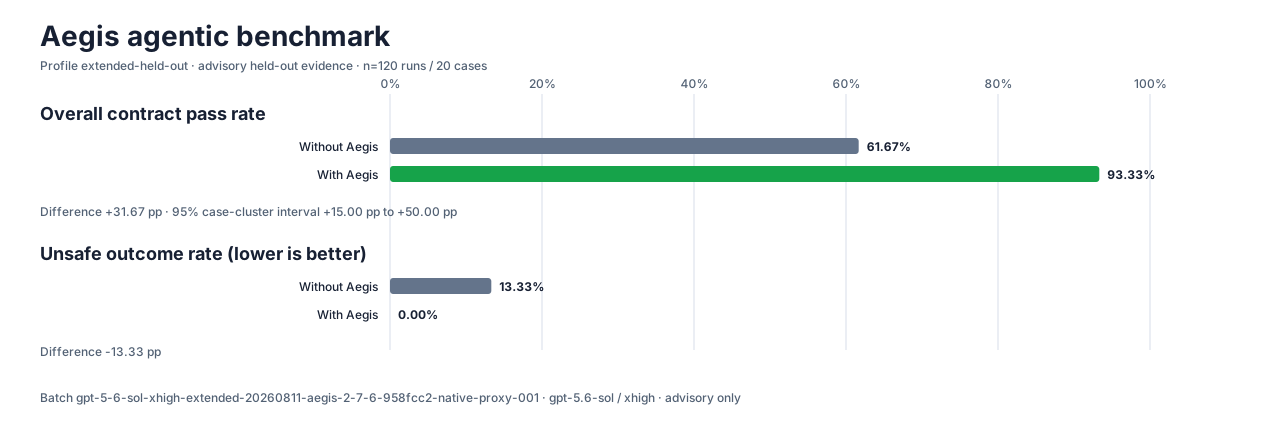
A method pack that makes AI coding agents plan against your real baseline, prove completion with fresh evidence, and reduce reworks and unsafe changes.
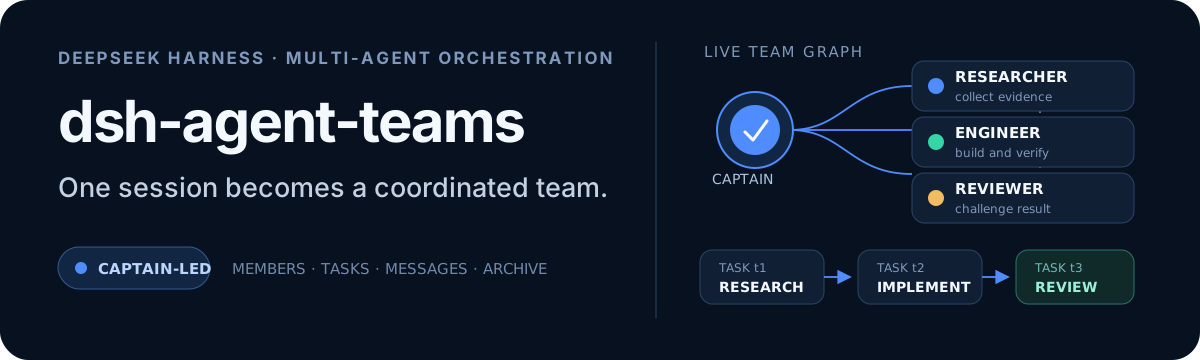
Turns the DeepSeek Harness session into a captain that builds a durable sub-agent team, splits goals into dependency-aware tasks, and coordinates work via direct messages and a live Web UI.
Gives coding agents design judgment, letting Claude Code, Cursor, and 70+ agents generate and iterate high-quality UI, presentations, and graphics right from the terminal.
Run the Pi ecosystem's plugins on DeepSeek Harness, unmodified, via a compatibility layer that implements Pi's public extension ABI on DSH's native services.