dsh-reactor
Run the following command in DeepSeek Harness:
dsh plugin install snhna-a/dsh-reactor
Paste the following prompt into your AI chat to install this plugin:
Run dsh plugin install snhna-a/dsh-reactor in the DeepSeek Harness terminal to install the plugin; the source code is hosted at https://github.com/snhna-a/dsh-reactor . After installation, restart dsh web to see the clock-themed widget in the bottom-right corner.
About this plugin
Traditional cron plugins run a fixed script at a fixed time and keep repeating it no matter what changes. dsh-reactor turns the DeepSeek Agent into an event-driven daemon: you describe in plain English what to watch, when it matters, and what goal to achieve, and it keeps observing in the background. When a condition fires, it spawns an isolated Agent session where the LLM autonomously reads files, runs commands, calls tools, and verifies results—all without further human input.
At the core is the ECG (Event-Condition-Goal) model. Event sources cover HTTP polling, local file watching, shell command output, and inbound webhooks. Conditions are composed freely with JSONPath expressions and operators. Execution comes in two modes: Action mode runs a preset script or fires a webhook; the recommended Goal mode injects your objective plus context into an isolated session, lets the LLM plan and execute steps on its own, then performs deterministic verification (file existence, exit codes). Failures are auto-classified, and transient errors trigger a smart retry. Safety gates—Budget, Approval, Preflight, Cooldown, and Overlap Protection—keep the agent within bounds.
Ideal for developers who need background monitoring with autonomous remediation: watching an API status and diagnosing fixes on change, tracking a repository HEAD and pulling, building, and reporting results, or alerting on a deploy-file version bump. None of these require hard-coded scripts—a single natural-language goal is enough for dsh-reactor to let the Agent close the loop on its own.
Use Cases
- Watch API or file changes and auto-diagnose plus fix issues when conditions match
- Track repository commit changes, pull and build in background, then report results
- Define goals in plain English while the Agent autonomously closes multi-step task loops
Best For
- DevOps or SRE engineers who need continuous background monitoring with autonomous remediation
- Developers who prefer natural-language automation over hard-coded scripts
- Teams running DeepSeek Harness in web mode for unattended background tasks
Related Plugins
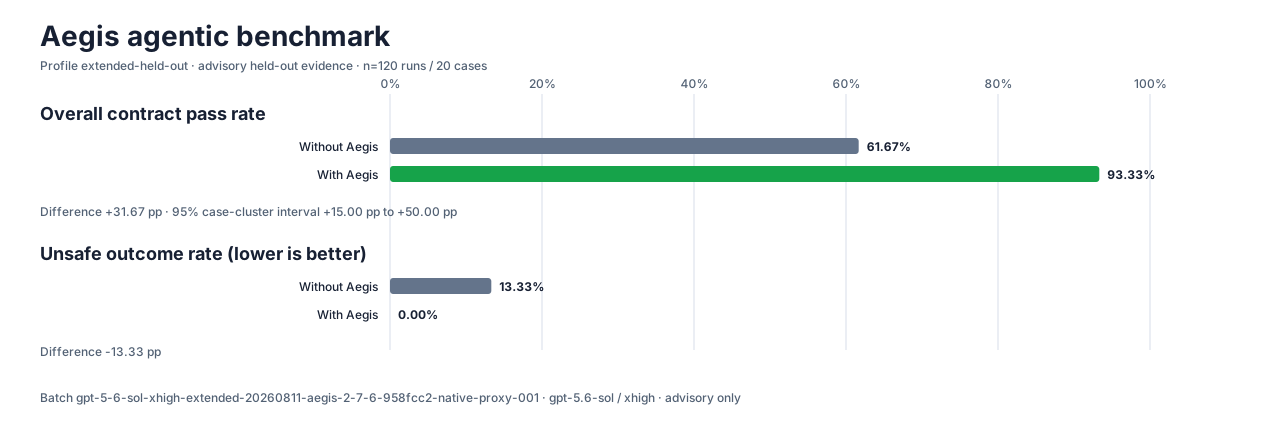
A method pack that makes AI coding agents plan against your real baseline, prove completion with fresh evidence, and reduce reworks and unsafe changes.
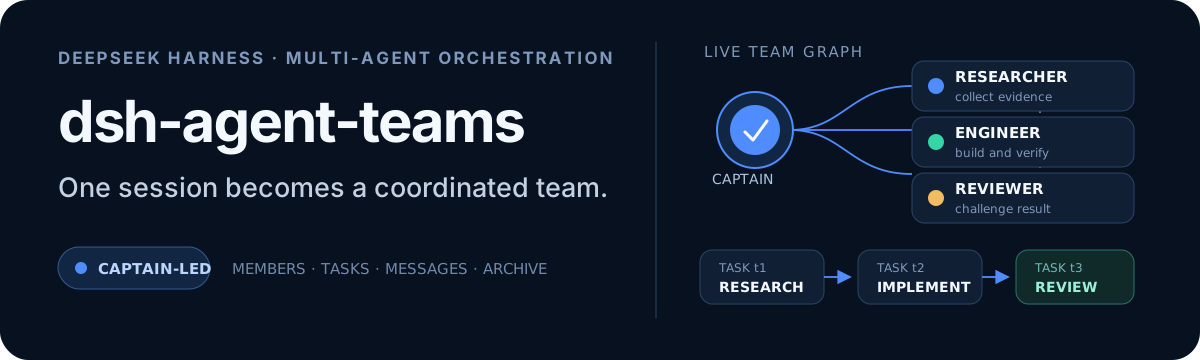
Turns the DeepSeek Harness session into a captain that builds a durable sub-agent team, splits goals into dependency-aware tasks, and coordinates work via direct messages and a live Web UI.
Gives coding agents design judgment, letting Claude Code, Cursor, and 70+ agents generate and iterate high-quality UI, presentations, and graphics right from the terminal.
Run the Pi ecosystem's plugins on DeepSeek Harness, unmodified, via a compatibility layer that implements Pi's public extension ABI on DSH's native services.