dsh-reset-handoff
Run the following command in DeepSeek Harness:
dsh plugin install nicecx/dsh-reset-handoff
Paste the following prompt into your AI chat to install this plugin:
In DeepSeek Harness, run dsh plugin install nicecx/dsh-reset-handoff to add this plugin; the full source is available at https://github.com/nicecx/dsh-reset-handoff .
About this plugin
When an agent inside DeepSeek Harness needs the host process to restart, killing itself is the most dangerous path: the command is dispatched, the process dies, and no one is left to see the outcome or recover. dsh-reset-handoff turns that into a clean handoff. DSH writes a single request.json; an independent ops agent performs preflight checks, restarts the service, runs a health check, and—if anything goes wrong—attempts diagnosis and recovery before writing a result.json that the requesting session reads back after boot. Nothing is lost.
The protocol enforces three mandatory gates before any restart is allowed: no pending approvals in the relay queue, at least 500 MB of free disk, and a 60-second cooldown since the last restart. If any gate fails, the executor writes a detailed gate array and simply does not restart, so the calling agent or a human sees the exact reason and can retry when conditions are right. After a restart, if the health check fails, the executor follows a recovery contract—diagnose from the web error log, retry up to three times with a cooldown, observe for a 120-second window, and report the full attempt history—rather than just reporting failure.
It is built for long-lived DSH web deployments with complex plugin trees that need frequent config reloads or state recovery. Because the contract is just two versioned JSON files, any process that can read and write them—a custom script, a cloud function, a Hermes cron job—can serve as the executor. The protocol is the interface; the implementation is yours.
Use Cases
- Safely restarting a long-lived DSH web instance to reload plugins or config without losing context
- Recovering from a wedged state when an external ops agent diagnoses the error log and auto-retries up to three times
- Breaking crash loops with mandatory cooldowns and multi-condition preflight gates that refuse unsafe restarts
Best For
- DevOps engineers running long-lived DSH web services with frequent hot-reload requirements
- Teams wiring Hermes Agent, cloud functions, or custom scripts as the external ops executor
- DSH host administrators managing deep plugin dependency trees that demand graceful degradation and safe restarts
Related Plugins
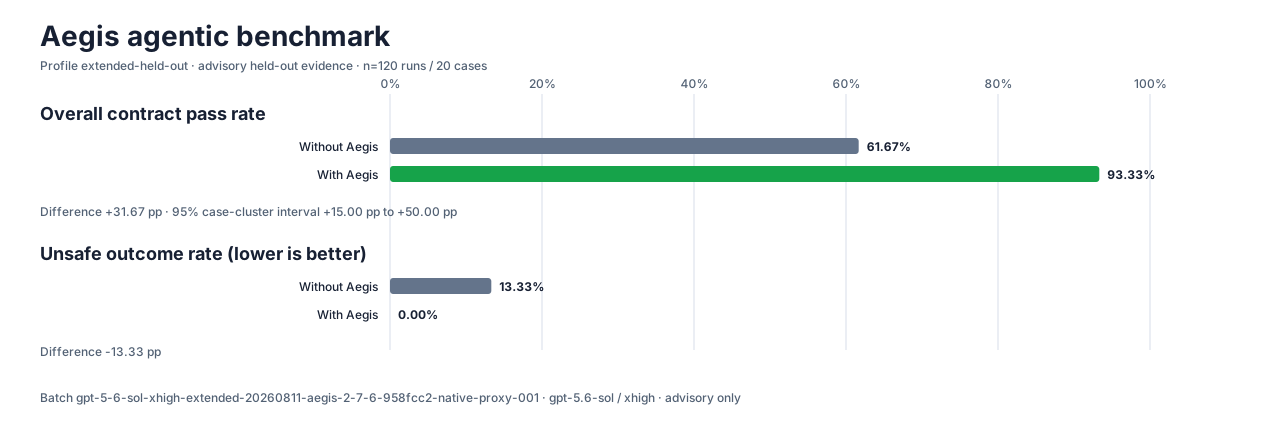
A method pack that makes AI coding agents plan against your real baseline, prove completion with fresh evidence, and reduce reworks and unsafe changes.
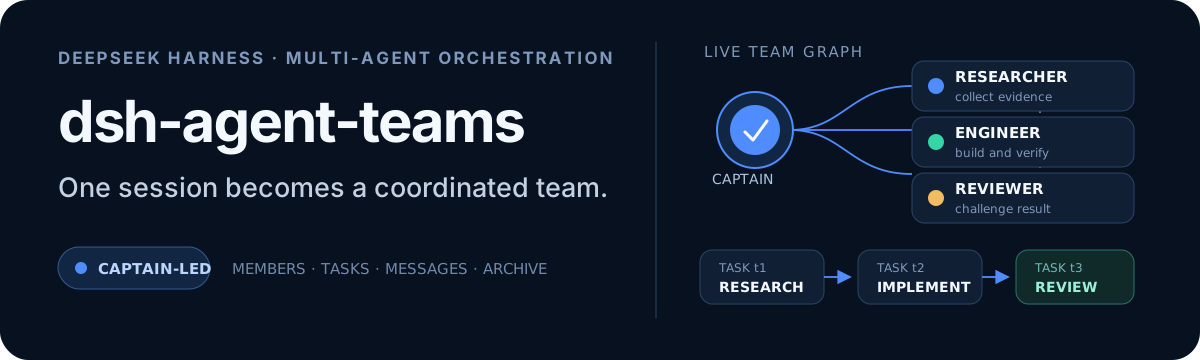
Turns the DeepSeek Harness session into a captain that builds a durable sub-agent team, splits goals into dependency-aware tasks, and coordinates work via direct messages and a live Web UI.
Gives coding agents design judgment, letting Claude Code, Cursor, and 70+ agents generate and iterate high-quality UI, presentations, and graphics right from the terminal.
Run the Pi ecosystem's plugins on DeepSeek Harness, unmodified, via a compatibility layer that implements Pi's public extension ABI on DSH's native services.