dsh-tasks-manager
Run the following command in DeepSeek Harness:
dsh plugin install navid-kianfar/dsh-tasks-manager
Paste the following prompt into your AI chat to install this plugin:
Run `dsh plugin install navid-kianfar/dsh-tasks-manager` in your terminal to install this plugin; the source code is available at https://github.com/navid-kianfar/dsh-tasks-manager .
About this plugin
When coding with DeepSeek Harness, tasks tend to live in a session-scoped todo list that vanishes the moment you close the terminal. dsh-tasks-manager persists them in a SQLite file (.dsh/tasks.db) inside the repository, so the board travels with the code, survives across sessions, and needs no external SaaS.
The board centres on a five-column kanban (backlog / todo / in progress / blocked / done) with drag-and-drop reordering, filtering by status, priority, labels, assignee, and full-text search, and assignees auto-detected from git log and ranked by contribution. Crucially, the model can call task_add, task_update, and related tools directly, so a single natural-language sentence creates or edits a card. Pair this with subagent dispatch and a card can be handed off to the agent to work in the background, with live status, on-demand output, and a stop control right on the card. Archiving keeps the full history intact; deletion is a separate confirmed action the model cannot perform unless you opt in.
It suits individuals or small teams who work daily in the Harness and want a project board that lives next to the code, that the model can read and write to, without maintaining yet another external tracker.
Use Cases
- Persist project tasks across sessions without external SaaS
- Create or update task cards with a single natural-language sentence
- Dispatch a card to a background agent and track its live status
Best For
- Individual developers working daily in the DeepSeek Harness
- Small teams that want the task board version-controlled with the code
- Engineers who need the model to read and write tasks without manual CLI steps
Related Plugins
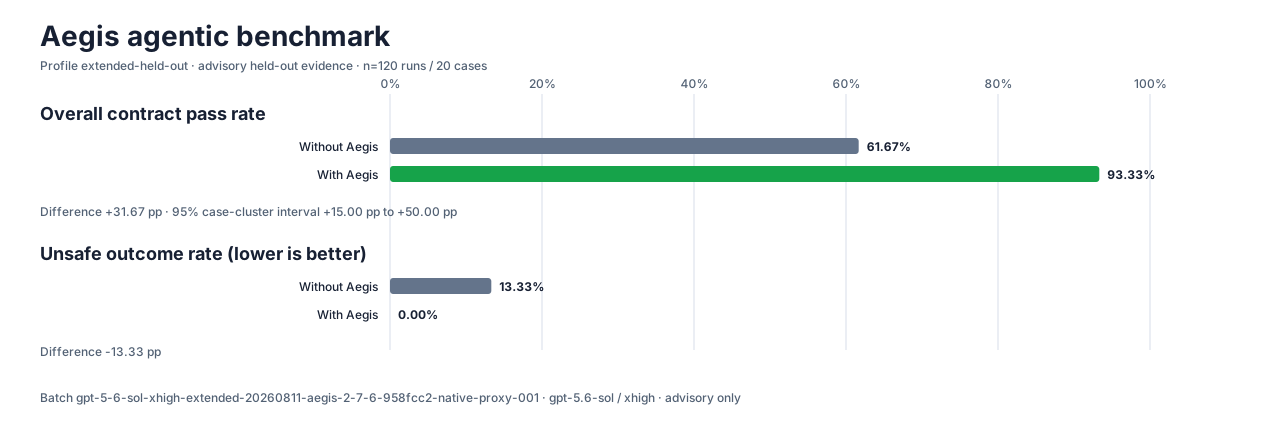
A method pack that makes AI coding agents plan against your real baseline, prove completion with fresh evidence, and reduce reworks and unsafe changes.
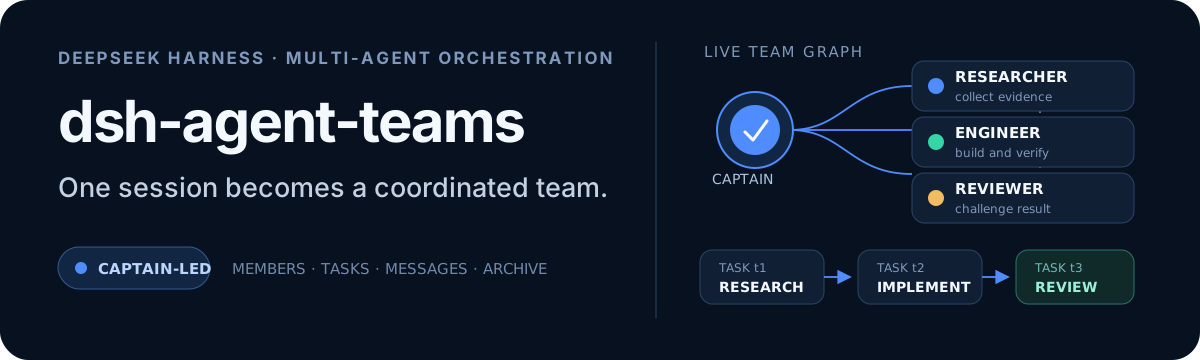
Turns the DeepSeek Harness session into a captain that builds a durable sub-agent team, splits goals into dependency-aware tasks, and coordinates work via direct messages and a live Web UI.
Gives coding agents design judgment, letting Claude Code, Cursor, and 70+ agents generate and iterate high-quality UI, presentations, and graphics right from the terminal.
Run the Pi ecosystem's plugins on DeepSeek Harness, unmodified, via a compatibility layer that implements Pi's public extension ABI on DSH's native services.